Read preferred stock’s dividend and liquidation rights, distinguish a stated rate from current yield and see why priority does not guarantee full recovery.
Preferred stock
Preferred stock, also called a preference share, is an equity security whose terms give it priority over common stock for specified dividends, liquidation distributions, or both. It generally ranks behind creditors. For an investor or valuation model, that middle position matters: a preferred share can offer a stated income rate while still losing distributions and capital.
“Preferred” describes rights relative to another class. It does not mean the dividend is guaranteed, the market price is stable, or the shareholder can demand repayment on a chosen date. Read the particular series’ documents before treating its cash flows as bond-like.
Three numbers that should stay separate
Consider a synthetic nonconvertible preferred share with USD 100 par value and a stipulated fixed annual dividend rate of 6% of par. Assume a full year under those terms. The annual amount, if declared and paid, is
D=100×0.06=USD 6.
If the share trades at USD 90, its current dividend yield, calculated using that full annual amount, is
ycurrent=906≈6.6667%.
The 6% stated rate applies to par. The 6.67% current yield, rounded to two decimal places, uses the trading price. Neither tells you the investor’s eventual total return. Total return also depends on the dividends actually received, the sale or redemption proceeds and any costs or taxes. The USD 100 par value does not, by itself, promise that the investor will receive USD 100 back.
Current yield is also different from yield to maturity: it neither discounts a full cash-flow schedule nor incorporates a terminal repayment. Many preferred issues are perpetual. A callable issue requires attention to the issuer’s redemption option rather than an assumption that its first call date is a maturity date.
For the underlying ownership and return arithmetic, the Equities lesson compares common and preferred claims and includes cash dividends in holding-period return. Its preview is public; the full lesson requires membership.
Priority can still leave a shortfall
Now consider a separate synthetic company-wide liquidation. All amounts are USD millions, and the distribution pool is measured after liquidation expenses. Stipulate debt claims of 80, followed by a 30 non-participating preferred liquidation claim; common shareholders receive the remainder. There are no other claims, dividend arrears, conversion rights or departures from this strict priority. “Non-participating” means the preferred class does not share in the surplus after receiving its preference.
Net distribution pool
Debt receives
Preferred receives
Common receives
120
80
30
10
100
80
20
0
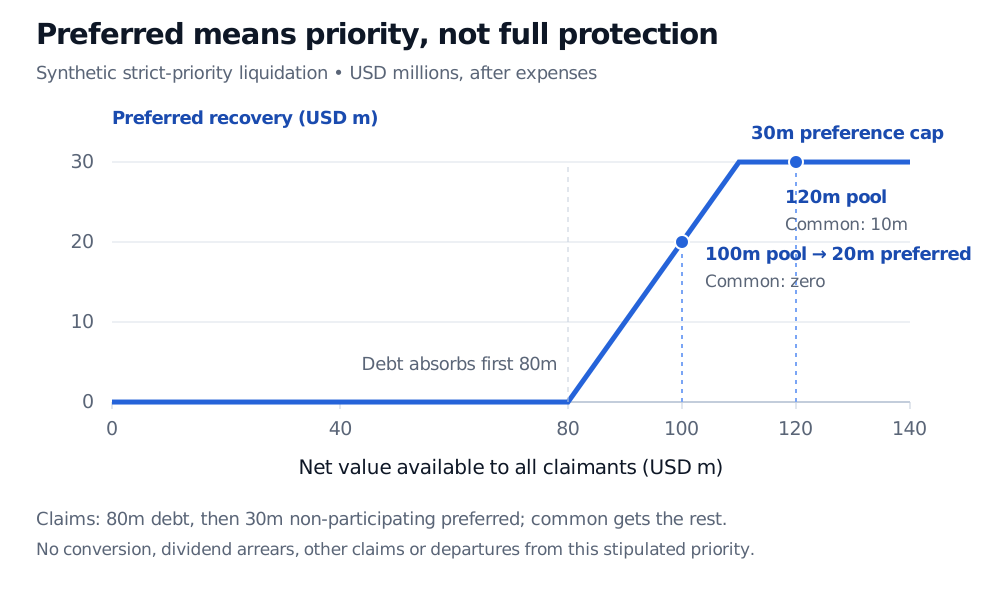
At a 120 pool, preferred receives its entire 30 claim. At a 100 pool, only 20 remains after debt, so preferred suffers a shortfall even though it ranks ahead of common. If the pool is no larger than 80, preferred receives nothing.
Preferred recovery is zero through a USD 80 million pool, rises to 30 million at a 110 million pool and then stays capped. A 100 million pool pays preferred 20 million and common zero; a 120 million pool pays preferred 30 million and common 10 million.
Original synthetic liquidation allocation in USD millions after expenses. Debt has an 80 million claim and non-participating preferred a 30 million claim. Actual recoveries depend on the instruments, other claims and applicable insolvency rules.
The flat upper section shows the other side of priority: this preferred claim has limited participation in a larger liquidation pool. Its recovery stops increasing at 30 once the pool reaches 110. This is a distribution rule for the stipulated liquidation, not a formula for the share’s market price today.
The terms that change the investment
Cumulative or non-cumulative. Cumulative terms generally carry omitted dividends forward as arrears that must be addressed before common distributions permitted by those terms. For non-cumulative shares, a dividend not declared for a period generally does not accrue for payment in a later period; follow the series’ terms. Cumulative does not mean cash must arrive on schedule or that the issuer has enough assets to pay it.
Fixed, floating or reset dividends. The stated rate may remain fixed, track a reference rate, or reset periodically. The USD 6 example above deliberately assumes a fixed rate. A model should follow the actual rate and declaration conditions.
Callable or convertible. A call lets the issuer redeem on specified terms and can end the investor’s income stream. Conversion rights exchange or convert the preferred claim into common shares under a defined rule, changing the payoff. Neither feature belongs to every preferred issue.
Voting and liquidation rights. Ordinary voting rights are often limited, but class protections or voting rights triggered by omitted dividends may apply. The dividend base, legal par value, liquidation preference and price of a traded depositary share can also differ. Keep the quoted unit consistent with the dividend numerator.
A concrete example is JPMorgan Chase’s Series MM prospectus supplement dated 22 July 2021. It specifies conditional, non-cumulative dividends, perpetual life, issuer redemption rights, no conversion rights and limited voting rights. A traded depositary share represents a fraction of a preferred share. These are the documented terms of that issue, rather than a definition of the whole asset class. See its Summary and Description of the Preferred Stock.
For quant work, store those contract features alongside prices. A high observed current yield may reflect a low market price, distribution uncertainty or redemption terms; it is not enough information to rank preferred shares by expected return.
JPMorgan Chase — Fixed Income Information, preferred-stock table, checked 25 October 2026: examples of fixed, reset and floating-rate structures. This article does not use the table as a live price quote.
Edwin J. Elton, Martin J. Gruber, Stephen J. Brown and William N. Goetzmann, Modern Portfolio Theory and Investment Analysis, 9th edition, Wiley, 2014, Chapter 2, p. 16: preferred priority, dividend variability, cumulative terms, callability and conversion. The cash and liquidation examples here are original and synthetic.