Total return includes changes in investment value and income. Reconcile shares and cash, distinguish reinvestment and index tax conventions, and link returns through wealth.
Total return
Total return measures an investment’s gain or loss from both changes in value and the income it produces over a stated period. A quant comparing a portfolio with a benchmark needs both: a price-only series can leave out a material part of the investor’s wealth. FINRA’s explanation of return makes the same distinction between investment earnings and changes in value.
The cleanest starting point is the whole investment account. With positive starting wealth W0, no external deposits or withdrawals, and ending wealth W1 that includes all retained income,
Rtotal=W0W1−W0.
State what happens to income between receipt and the end of the period. Keeping it in cash and reinvesting it are different investment policies.
The cash account belongs in the answer
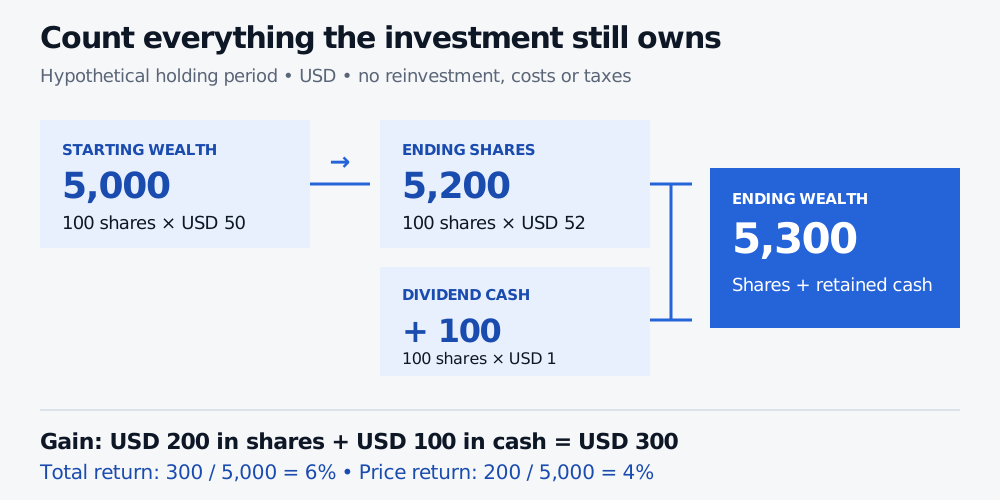
Buy 100 shares at USD 50 each. By the end of the holding period, each share is worth USD 52 and has paid a USD 1 cash dividend. Keep the dividend as cash earning zero interest. Assume no trades, splits, external flows, costs or taxes; the dividend has been received by the end.
The starting investment is USD 5,000. Ending wealth is
W1=100×52+100×1=USD 5,300.
The USD 300 gain consists of USD 200 of price appreciation and USD 100 of income. Total return is 300/5,000=6%, while price return is 200/5,000=4%. The dividend contributes 2 percentage points, measured against the starting investment.
A 100-share investment starts at USD 5,000. Ending shares worth USD 5,200 plus USD 100 retained dividend cash give USD 5,300, a 6% total return versus a 4% price return.
Original hypothetical wealth ledger. The separate cash account is included once; dividends are retained without interest rather than reinvested.
For this fixed share count and cash policy, the same result can be written per share:
Rtotal=P0P1−P0+D=5052−50+1=6%.
Here D is the cash dividend per original share received during the period. This is a holding-period return, not automatically an annualised return. The USD 52 quote already reflects the market’s valuation at the end; adding the separate cash account does not assume that a dividend creates free value.
Reinvestment changes what you own next
With dividend reinvestment, cash buys more investment units. The purchase itself transfers value from cash to shares. Subsequent price moves and distributions then apply to the new holdings. Do not add the original dividend cash again after including the shares it purchased.
For a longer horizon, adding all cash dividends to the final original-share price does not reproduce every reinvested strategy. You need the reinvestment dates, purchase prices and resulting quantities. Reinvestment can raise or lower ending wealth relative to retaining cash, depending on what the purchased units subsequently earn.
An index’s total-return series specifies its own policy. For example, MSCI’s February 2026 methodology, §§2.2–2.2.3 generally reinvests announced regular cash distributions on the ex-date, subject to stated exceptions, and allocates them across index constituents. That theoretical index convention differs from an investor receiving payment later and leaving it in a cash account.
Also identify the index’s tax version. MSCI’s gross and net daily total-return series use different dividend treatments; its net series deducts specified withholding taxes before reinvestment. A net index is not a calculation of your personal after-tax return. The assumed investor category, tax treaties, account structure and other taxes can differ. Read the relevant methodology rather than interpreting “net” as all costs and taxes deducted. The mathematical growth factor 1+R is also sometimes called a gross return; that usage is separate from an index’s gross dividend-tax convention.
Link wealth, not percentage headlines
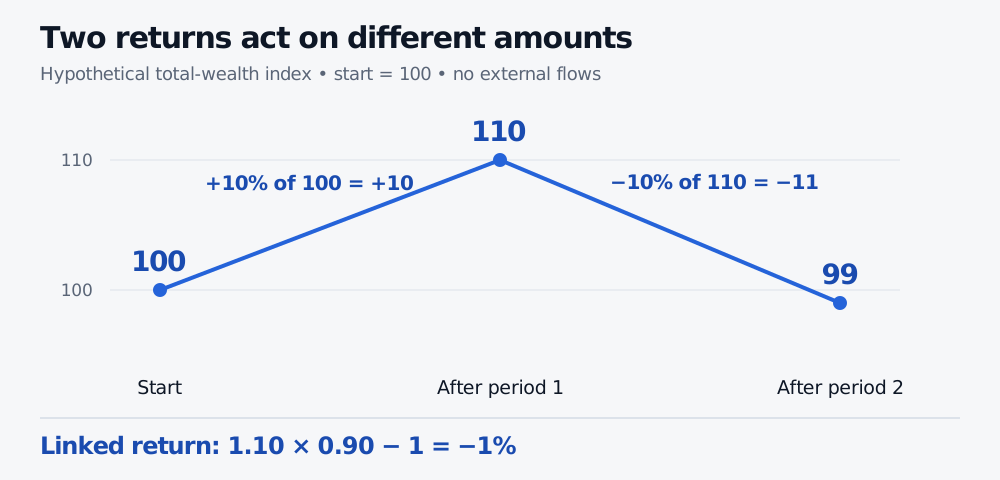
Suppose two successive periods have total returns of +10% and −10%, using a consistent income and valuation policy with no external flows. Starting wealth indexed to 100 becomes 110, then 99. The second period loses 11 because it starts with 110.
R0:2=(1+0.10)(1−0.10)−1=−1%.
Adding the percentages gives zero, but it does not reconcile the wealth account. In general,
1+R0:T=t=1∏T(1+Rt).
A hypothetical total-wealth index moves from 100 to 110 with a 10% gain, then to 99 with a 10% loss. The gains and losses are plus 10 and minus 11 index units, producing a minus 1% linked return.
Original hypothetical wealth path. The two simple returns compound to −1%; their arithmetic sum is 0%.
Financial Return Characteristics develops this distinction between multiplying simple-return growth factors and adding log returns. The public preview is available; the full lesson requires membership.
For an actual account, a deposit is new capital, not investment income. If there are external contributions or withdrawals, the raw start-to-end wealth ratio confounds performance with those flows. Time-weighted return and money-weighted return answer different performance questions. Before comparing any return figures, match their period, currency, income/reinvestment policy, fees and tax treatment.
Practice: did reinvestment help?
An investor buys 50 shares at USD 40. During the holding period, each original share pays USD 2. The investor immediately uses all the dividend cash to buy more shares at USD 50. There are no later distributions, and all shares finish at USD 44. Assume fractional purchases are permitted, no external flows, costs or taxes, and zero interest on any retained cash. What is the total holding-period return? Would retaining the dividend cash have produced more ending wealth?
Answer. The USD 100 dividend buys 2 shares, bringing holdings to 52 shares. Ending wealth is 52×44=USD 2,288 against an initial USD 2,000, so total return is 2,288/2,000−1=14.4%. Keeping the dividend would instead leave USD 2,200 in original shares plus USD 100 cash: USD 2,300 and a 15% return. Reinvestment leaves USD 12 less because the extra shares fall from USD 50 to USD 44. Adding the USD 100 dividend to the reinvested ending shares would count the same income twice.
Sources
Edwin J. Elton, Martin J. Gruber, Stephen J. Brown and William N. Goetzmann, Modern Portfolio Theory and Investment Analysis, 9th edition (Wiley, 2014), Chapter 2, p. 19 and footnote 9: income-inclusive holding-period return and the need to specify the treatment of intermediate cash income.