Price return is the percentage change in an asset’s price over a stated period, excluding cash income such as dividends. For equity data, prices must first be put on a consistent share basis across splits. This distinction matters when a quant measures a signal, compares a portfolio with an index or checks whether a backtest has counted all investor cash flows.
For a positive starting price and ending price on the same currency and share basis, the simple price return is
This is a return over the chosen interval, not automatically an annualised return. It measures the price component; it does not by itself measure the holder’s full economic gain.
The dividend lives outside the price
Suppose a share starts at USD 50 and ends at USD 52. During the holding period it pays a USD 1 cash dividend per share. There is no split, trading, tax, fee or financing cost. The dividend is received by the end and kept as cash earning no interest.
The price return is . The total return, including that cash, is
An investor holding 100 shares starts with USD 5,000. At the end, the shares are worth USD 5,200 and the cash account contains USD 100. The USD 300 increase in wealth is the USD 200 price gain plus USD 100 of dividend income. The dividend contributes 2 percentage points, measured against the starting investment.
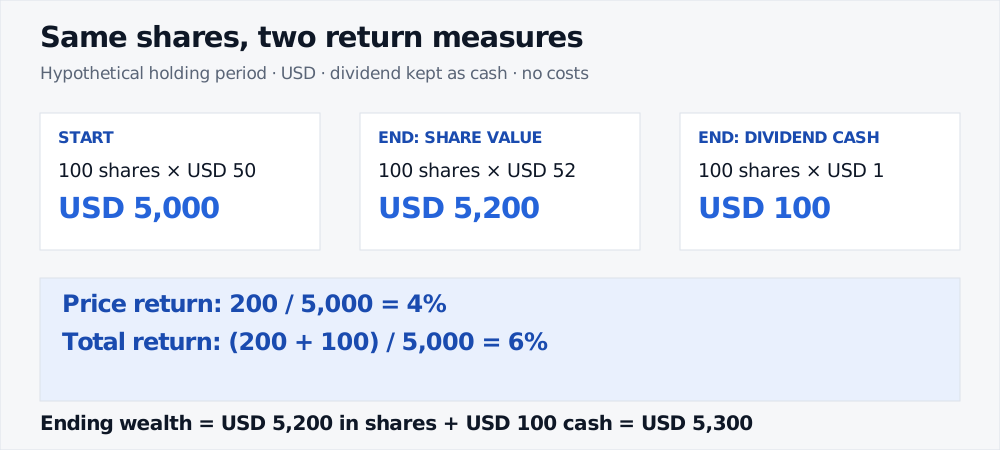
Original hypothetical holdings-and-cash ledger. The dividend is retained without interest, rather than reinvested; all values are before costs and taxes.
The USD 52 ending quote is the observed price after the period’s events. Adding the dividend to it values the holder’s separate cash entitlement; it does not predict that paying a dividend creates an extra dollar of company value. A share can fall in price while its holder has a positive total return.
For an equity index, check the return version. S&P Dow Jones Indices distinguishes a price index from a total-return index that reinvests dividend income in the overall index. That reinvestment convention differs from keeping distributions idle in cash over a longer horizon. Compare a portfolio and benchmark using compatible income, tax, currency and reinvestment conventions. See its Index Mathematics Methodology, pp. 21–22.
A split is a change of units
Consider a separate scenario: 100 shares at USD 50 undergo a mechanical 2-for-1 stock split, with no dividend or market movement. The investor now holds 200 shares at USD 25. Both positions are worth USD 5,000. The SEC’s stock-split explanation describes this offset between share count and price per share.
The raw quote falls by 50%, but comparing USD 25 per new share with USD 50 per old share mixes units. Express the starting quote on the post-split basis: USD 50 divided by 2 is USD 25. The like-for-like price return is therefore .
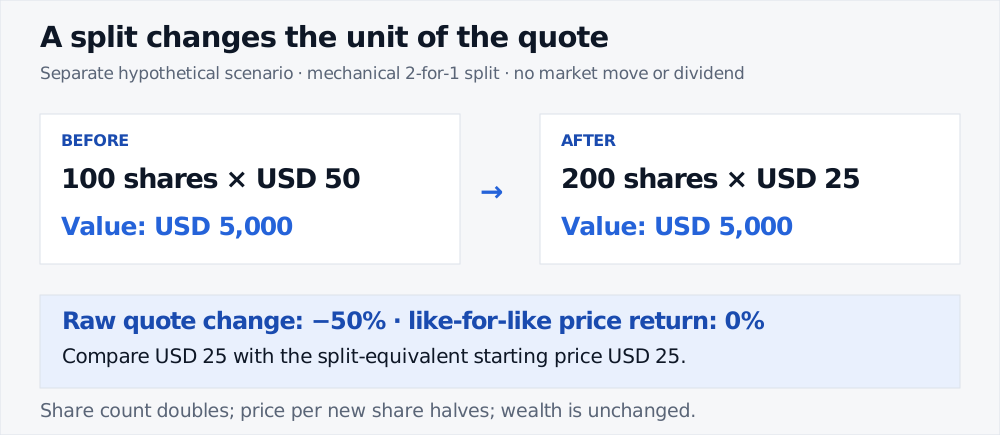
Original split-only scenario. The split itself changes units without changing wealth; an actual event date can also have market price movement.
A split-only adjusted history makes that unit conversion across the event. It does not add cash-dividend income. Alternatively, a position ledger can preserve raw quotes and change the number of shares held. The prices, quantities and distributions must all use compatible units.
Read the series definition before taking a ratio
“Adjusted close” is not a promise that a column contains price-only returns. For example, Alpha Vantage’s documentation distinguishes raw daily prices from split/dividend-adjusted data. An adjustment may incorporate dividend events as well as splits; the field name alone does not establish a total-return reinvestment convention.
Before using a series, establish:
- What has been adjusted? Split-only prices, dividend-adjusted prices and an explicit total-return index are different representations. Check special distributions and other corporate actions in the provider’s methodology too.
- What does the ratio measure? A split-consistent price ratio excludes dividend income. A total-return series already incorporates its specified distribution treatment.
- Where is cash recorded? If distributions are already included in the return series, adding the same dividends again double-counts them. If using raw prices and an explicit cash ledger, process entitlement, payment and any reinvestment consistently.
For a fuller research workflow, Corporate Actions and Survivorship develops split invariance, dividend receivables and the separation between research histories and executable prices. A public preview is available; the full lesson requires membership.
Sources
- Edwin J. Elton, Martin J. Gruber, Stephen J. Brown and William N. Goetzmann, Modern Portfolio Theory and Investment Analysis, 9th edition (2014), Chapter 2, pp. 19 and 21: holding-period income and the distinction between price appreciation and an income-inclusive return.
- S&P Dow Jones Indices, Index Mathematics Methodology, September 2026, pp. 21–22: total-return reinvestment and net-return treatment.
- SEC Investor.gov, “Stock Split”: share count, price and ownership mechanics.
- Alpha Vantage, API documentation: daily and daily-adjusted series: raw quotes versus split/dividend adjustments.