Follow a cash dividend from company to shareholder, separate the payment from investment profit, and reconcile share value, dividend entitlement and total return.
Dividend
A dividend is a distribution by a company to eligible shareholders, commonly paid as cash per share. For a quant, the cash payment and the share-price change belong in separate parts of the return calculation: receiving a dividend does not, by itself, mean the investment made a profit.
Suppose a synthetic investor holds 100 shares and is entitled to a USD 0.40 cash dividend per share. The gross distribution is
100×0.40=USD 40.
“Gross” means before any applicable withholding, taxes or charges. The amount credited to an investor can differ from that figure; a payment in another currency also requires an exchange-rate convention.
To isolate the distribution mechanism, start with a share price of USD 20.00. Use an idealised model in which the share goes ex-dividend at USD 19.60, exactly USD 0.40 lower, with every other valuation input held fixed. Assume zero interest, certain payment, no taxes or costs, no other corporate actions and no trading by the holder.
State of the holding
Share value
Separate dividend asset
Combined wealth
Before the share goes ex-dividend
USD 2,000
None
USD 2,000
Ex-dividend, before payment
USD 1,960
USD 40 receivable
USD 2,000
After payment
USD 1,960
USD 40 cash
USD 2,000
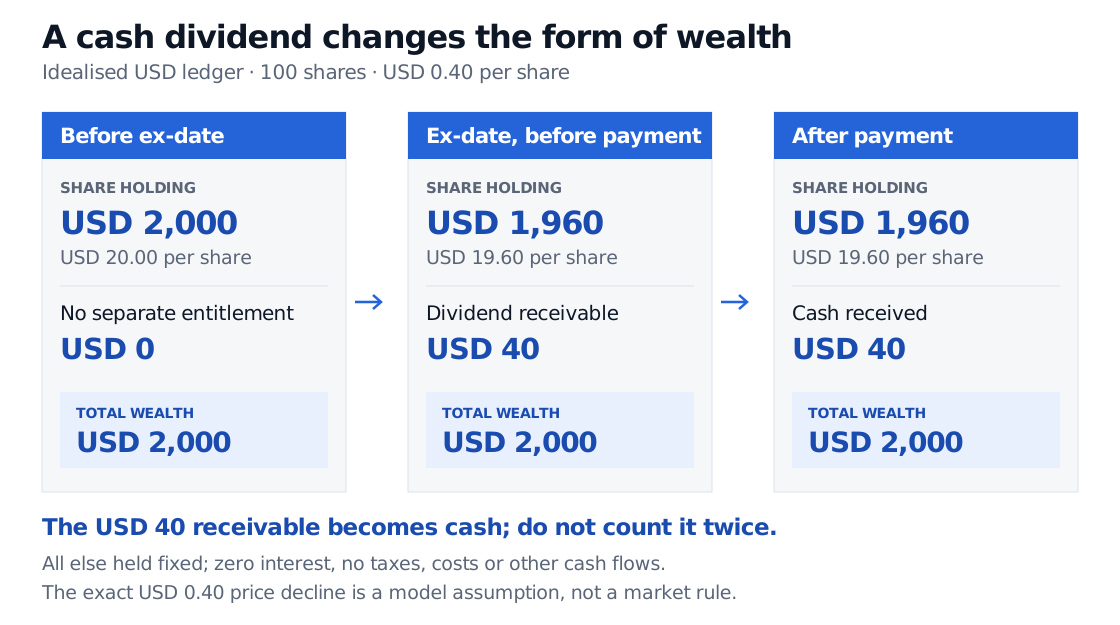
The investor still owns 100 shares. When the dividend is paid, the receivable becomes cash; it is not another USD 40 gain. The zero-interest assumption lets us ignore the value of the delay between entitlement and payment.
Idealised 100-share ledger: before the ex-date, USD 2,000 in shares; after the ex-date, USD 1,960 in shares plus USD 40 receivable; after payment, USD 1,960 in shares plus USD 40 cash. Combined wealth remains USD 2,000.
Original synthetic USD ledger. The exact dividend-sized price decline is an all-else-equal model assumption, with zero interest and no taxes or costs; it is not a forecast of traded prices.
The economic reason is that cash distributed to shareholders is no longer inside the company. It cannot remain in the share's value and simultaneously arrive as an extra asset in the holder's account. Hull uses the dividend-sized price adjustment in his option-pricing treatment, while explicitly noting that tax effects can change the observed adjustment.
Actual market prices need not fall by exactly the cash dividend. News, market movements, tax effects and trading conditions occur alongside the distribution. The ledger illustrates why a dividend is not free wealth, rather than predicting the next market quote.
Cash income and total return answer different questions
For a fixed holding, with initial price P0>0, final price P1 and a cash dividend D per share received during the period, the simple gross total return is
R=P0P1−P0+D.
This convention assumes the dividend is retained as cash at zero interest, with no reinvestment, costs, taxes or other cash flows. In the idealised example, the price return is −2%, but the dividend-inclusive return is 0%. Neither is annualised. A cash payment and an overall investment gain are different facts.
A dividend yield compares a specified dividend amount with the share price. It does not include the capital gain or loss, and a yield based on past payments does not promise the next payment. For backtests, check the data provider's adjustment method before adding dividends: a series that already incorporates them can otherwise count the same distribution twice.
The Equities lesson develops ownership, dividend-inclusive returns and price versus total-return indices. Its public preview can be browsed; the full lesson requires membership.
Identify what is being distributed
A cash dividend pays money. A stock dividend distributes shares instead. A dividend reinvestment plan uses a cash dividend to buy additional shares under the plan's terms; it is not the same corporate action as a stock dividend. Investor.gov explains dividend reinvestment plans.
Read the issuer's announcement for the amount, currency, eligible share class and payment dates. For example, Apple's dividend history separates declared, record and payable dates and warns that its listed amounts are not split adjusted. Such details matter when joining dividend records to historical share counts.
Entitlement is governed by the ex-dividend date and the relevant market rules, rather than by the payment date alone. Date conventions and special-distribution procedures depend on the market and type of distribution; Investor.gov's current U.S. explanation also describes exceptions. A historical calendar rule should not be applied to every security or jurisdiction.
Practice: income without profit
An investor buys 80 shares at USD 25.00, receives a USD 0.30 cash dividend per share and later sells all shares at USD 24.50. The investor is eligible for the payment, retains it as cash at zero interest and has no taxes, costs or other cash flows. What are the gross dividend income and total holding-period return?
Answer. Dividend income is USD 24. The shares cost USD 2,000 and sell for USD 1,960, so the combined proceeds are USD 1,984 and the net loss is USD 16. The total holding-period return is −0.8%. The price return alone is −2%; receiving a dividend reduces this loss but does not turn it into a profit. Neither return is annualised.
Sources
John C. Hull, Options, Futures, and Other Derivatives, 9th edition, Global Edition, Pearson Education Limited, 2018, §15.12, printed p. 365 and footnote 11: dividend adjustments in an option-pricing model and the tax qualification.