Common stock, also called an ordinary share, is an ownership security with a residual claim on a company’s earnings and assets. In liquidation, common shareholders receive whatever remains after creditors and any preferred stock with senior liquidation rights have been paid. That remainder can be zero. For valuation and risk analysis, the order of claims matters: a modest decline in the value available to distribute can wipe out the common shareholders’ recovery.
Common stock is a particular kind of stock. The equity market is the system in which ownership securities are issued and traded; the common share is the claim an investor owns.
Ownership does not fix every right
Three features need to be read separately.
- Distributions. A common shareholder may receive a dividend, but future common dividends are not guaranteed. Earnings can be retained in the business instead. An accounting profit is not automatically cash payable to each shareholder.
- Control. Common shares often carry voting rights, including votes in director elections. One share does not universally mean one vote: rights can differ by class and jurisdiction.
- Liquidation. Common shares stand behind creditors and applicable senior equity preferences. A priority claim is valuable even when two instruments are both called equity.
Alphabet’s 2024 Form 10-K illustrates why the class documents matter. It reports one vote per Class A common share and ten per Class B common share; its Class C capital stock has no voting rights except where law requires them. The filing also makes future cash dividends subject to board declaration. These are documented terms for that issuer and reporting period, not a universal template for ordinary shares. See Note 11 and the ownership-risk discussion.
For an ordinary, fully paid common share held outright without borrowing, limited liability normally limits the shareholder’s investment loss to the purchase amount. It does not protect the share’s price, and borrowing to buy shares creates a separate repayment obligation. Nor does the protection extend to the losses of a short sale.
What “residual” means in cash
Consider a synthetic liquidation with USD 100 million available for distribution after liquidation expenses. Stipulate strict priority: USD 80 million of senior claims must be paid first, followed by a USD 15 million non-participating preferred liquidation preference. Common shareholders get the balance. There are no other claims, preferred participation or conversion rights, or negotiated departures from this order.
| Distribution pool | Senior claims paid | Preferred paid | Common receives |
|---|---|---|---|
| USD 100 million | USD 80 million | USD 15 million | USD 5 million |
| USD 90 million | USD 80 million | USD 10 million | USD 0 |
At USD 100 million, common receives million. At USD 90 million, the USD 10 million left after senior claims is insufficient to satisfy the preferred preference. Common gets nothing; it does not receive a negative distribution.
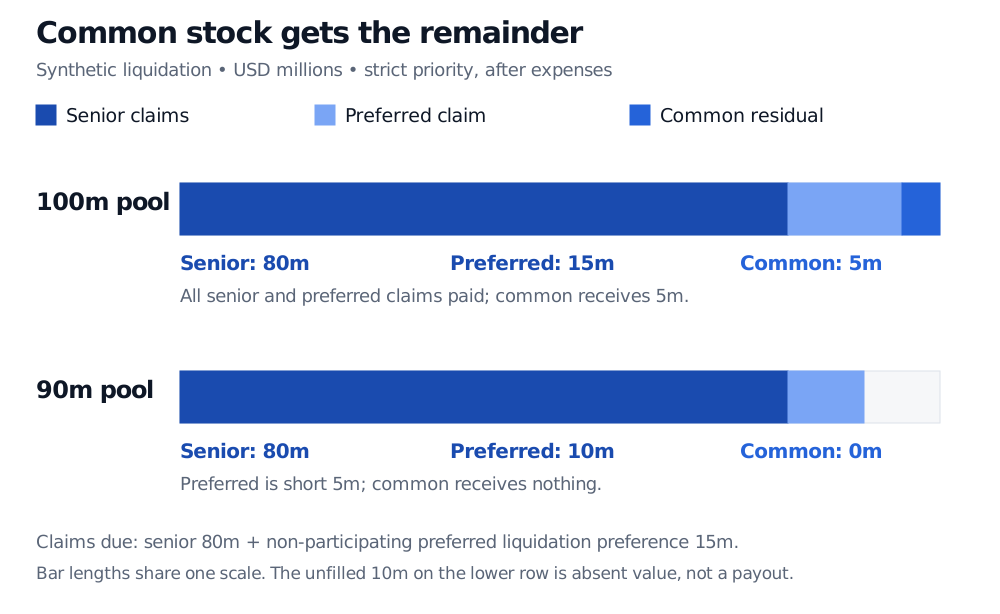
Original synthetic strict-priority distribution, in USD millions after expenses. Both bars share one scale; the lower pool contains less value. Actual outcomes depend on applicable law and the instruments’ terms.
If is the net distribution pool, the senior amount due and the non-participating preferred preference, this stipulated common-class recovery is
All four amounts use the same currency units. In this example, the pool falls by 10%, while the common liquidation recovery falls by 100%. This is the amplification created by being last in line. The formula is a liquidation allocation, not today’s stock price: a going concern’s market value also reflects expectations about future distributions, growth, risk and financing.
A shareholder’s return has two cash components
Suppose an investor buys 100 common shares at USD 50 each, holds them throughout the period, receives a USD 0.50 cash dividend per share, then sells at USD 52. Assume entitlement to the dividend and receipt before sale; retain it as cash at zero interest. Exclude costs, taxes, reinvestment and other corporate actions.
The purchase costs USD 5,000. Sale proceeds are USD 5,200 and the dividend contributes another USD 50. The price gain is USD 200, while the total gain is USD 250:
The dividend adds one percentage point to the holding-period return. It is separate cash, not part of the USD 52 final price. Neither return is annualised because the holding period has no specified calendar length. A total-return data series can use a dividend-reinvestment convention, so check the data definition before adding dividends again.
The Equities lesson develops common and preferred claims, dividend-inclusive returns and stock-index conventions. Its preview is public; the full lesson requires membership.
Sources
- SEC Investor.gov — Stocks: stock ownership, common/preferred distinctions and common shareholders’ liquidation position.
- Office of the New York Attorney General — Stock Investments: shareholder rights and enhanced-voting share classes.
- Alphabet — 2024 Form 10-K, Note 11 and “Risks Related to Ownership of our Stock”: specific share-class voting rights and discretion over future dividends.
- Edwin J. Elton, Martin J. Gruber, Stephen J. Brown and William N. Goetzmann, Modern Portfolio Theory and Investment Analysis, 9th edition, Wiley, 2014, Chapter 2, pp. 16–17: preferred priority, common ownership, residual claims and limited liability. The liquidation and holding-period examples here are original synthetic calculations.