Follow cash through primary share issuance and secondary trading, then distinguish a stock’s price return from the holder’s dividend-inclusive return.
Equity market
The equity market, also called the stock market, is the system through which company ownership shares are issued and traded. For a quant working with stock data, the first task is to identify the claim being priced: a share can provide dividend income as well as a resale gain or loss, and its quoted price is not a promise of future payment.
Common shares are residual claims. In liquidation, common shareholders receive what remains after creditors and any senior equity claims have been satisfied; that remainder can be zero. Preferred shares usually rank ahead of common shares but behind creditors. Dividend and voting rights depend on the share class and its terms: ownership does not universally mean one vote per share, and common dividends are not guaranteed. See Investor.gov’s stocks guide and the New York Attorney General’s explanation of share rights.
Follow the payment
Two transactions can involve the same company’s shares while serving different purposes.
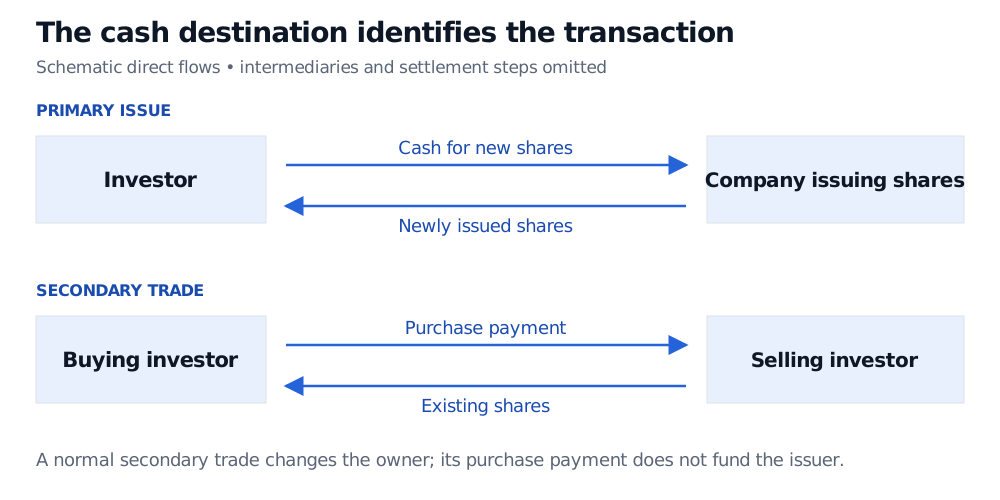
In a primary issue, the company sells newly issued shares and receives the proceeds, before issuance costs. This raises equity capital for the issuer.
In a secondary trade, an existing holder sells shares to another investor. The purchase payment goes to the seller. The company does not receive that trade’s proceeds merely because its shares changed hands.
This primary–secondary distinction is also how SEBI’s investor guide separates issuance from investor-to-investor trading. A public offering can include both newly issued shares and shares sold by existing holders, so the destination of the proceeds matters more than the offering’s headline label. Investor.gov’s IPO bulletin explains the difference.
In a primary issue, cash goes from the investor to the company and new shares go back. In a secondary trade, cash goes from the buyer to the selling investor and existing shares go back.
The arrows show schematic economic transfers. Intermediaries, underwriting arrangements and settlement steps are omitted.
Secondary trading still serves the issuer indirectly: it gives investors a way to exit and supplies prices at which ownership claims are being exchanged. Those prices can inform later financing decisions. It does not follow that every stock is easy to sell at its last quoted price.
The familiar stock market usually means publicly traded equities, but equity ownership also exists in private companies. Private secondary transactions can face resale restrictions and limited liquidity, as the SEC’s private-market guide explains. Even a listed share need not execute on its listing exchange: a broker can route it to other venues or market makers. Investor.gov describes those execution choices.
A share-price chart misses the cash dividend
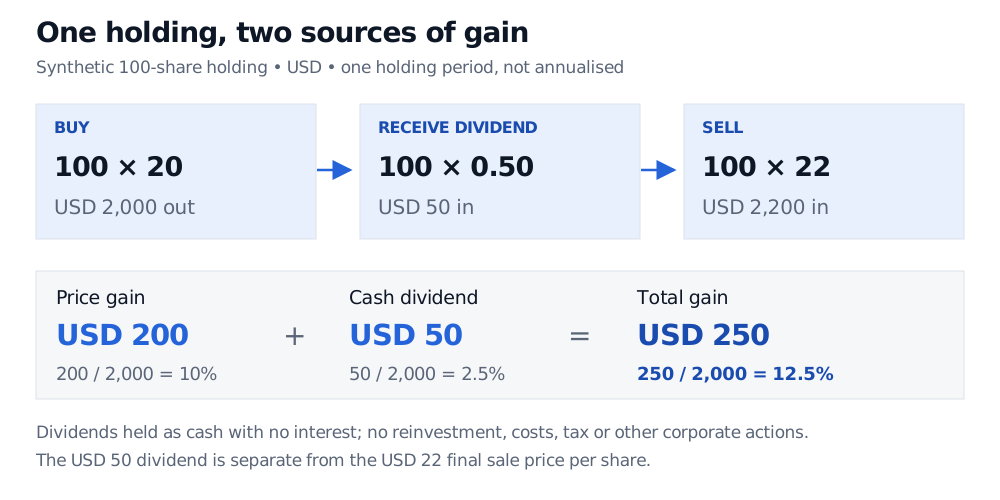
Consider a synthetic investor who buys 100 shares at USD 20, holds all 100 throughout the period, receives a USD 0.50 cash dividend per share, then sells at USD 22. Assume the investor is entitled to the dividend and receives it before selling. There are no other corporate actions, costs or taxes; the dividend remains in cash without earning interest or being reinvested.
Cash flow
Amount
Initial share purchase
USD 2,000 paid
Dividend received
USD 50 received
Final share sale
USD 2,200 received
Net gain over the holding period
USD 250
The share-price gain is USD 200, giving a 10% price return. Including the separate USD 50 dividend gives a 12.5% total holding-period return. Neither number is annualised: no calendar length has been specified.
For a fixed number of shares, the quantity cancels from the return calculation. With initial price P0>0, final price P1 and cash dividends D per share over the period,
Rprice=P0P1−P0,Rtotal=P0P1−P0+D.
Here the dividend adds 0.50/20=2.5% of the initial investment, or 2.5 percentage points to the holding-period return. The final USD 22 share price excludes the USD 0.50 already paid out; counting that dividend in both places would overstate the gain.
A synthetic 100-share purchase costs USD 2,000, pays USD 50 in dividends and sells for USD 2,200. Price gain is USD 200; total gain is USD 250. Price return is 10% and total holding-period return is 12.5%.
Original fixed-holdings ledger in USD. The dividend is retained as cash at zero interest; trading costs, taxes, reinvestment and other corporate actions are excluded.
The Equities lesson develops ownership, dividend returns and index conventions further. Its public preview is available to browse; the full lesson requires membership.
“The market rose” needs a benchmark
A stock index measures a specified basket under a weighting and membership rule. It is not a census of all company ownership. A price-return version tracks price changes; a total-return version also incorporates dividends under its stated reinvestment methodology. The cash-retention example above is therefore not a recipe for constructing a reinvested total-return index.
For a backtest, name the universe, share class and return convention before comparing performance. Check how the data handle dividends, splits, delistings and historical index membership. Adding dividends separately to a series that already includes them can double-count income; applying today’s constituents to the past can omit firms that failed or left the index. These choices can change the measured strategy return even when the trading rule is identical.
Sources
SEC Investor.gov — Stocks: ownership, common and preferred shares, dividends and liquidation priority.
Edwin J. Elton, Martin J. Gruber, Stephen J. Brown and William N. Goetzmann, Modern Portfolio Theory and Investment Analysis, 9th edition, Wiley, 2014. Chapter 2, pp. 16–17 and 21–22, on preferred/common claims and price versus dividend-inclusive indices; Chapter 3, p. 35, on primary issues. The diagrams and numerical ledger here are original synthetic examples.