The secondary market is the market in which existing securities are bought and sold. It lets an investor change or exit a holding without asking the issuer to repay the investment. For a quant, secondary-market prices help value positions and measure returns, while the ability to transact at those prices determines whether a proposed trade is feasible.
An ordinary resale moves an existing claim between holders. Its cash goes to the seller. In a primary-market issue, the issuer sells new securities and receives the issue proceeds. A busy market in a company's existing shares therefore does not mean the company is raising that trading volume as fresh capital.
A resale changes the holder, not the share count
Suppose investor A sells 100 existing shares at USD 25 each to investor B. Assume the trade settles as agreed, and exclude fees, taxes, dividends and other share transactions. This is a synthetic example.
| Participant | Cash change at settlement | Change in holdings or issuance |
|---|---|---|
| A, the seller | +USD 2,500 | −100 shares held |
| B, the buyer | −USD 2,500 | +100 shares held |
| Company that issued the shares | USD 0 proceeds | 0 new shares |
The investors' cash changes sum to zero, and the same 100 shares pass from A to B. Shares outstanding do not increase. A's USD 2,500 is sale proceeds, not necessarily a capital gain: calculating a gain also requires A's acquisition cost and any relevant costs.
Later, suppose B still holds the shares and values them at a USD 26 per-share mark. Their marked value is USD 2,600, so B has a USD 100 unrealised gain relative to the USD 2,500 purchase cost. That revaluation does not transfer USD 100 to B or to the company. B would need a further transaction to turn the holding into cash, and the actual selling price could differ from the mark.
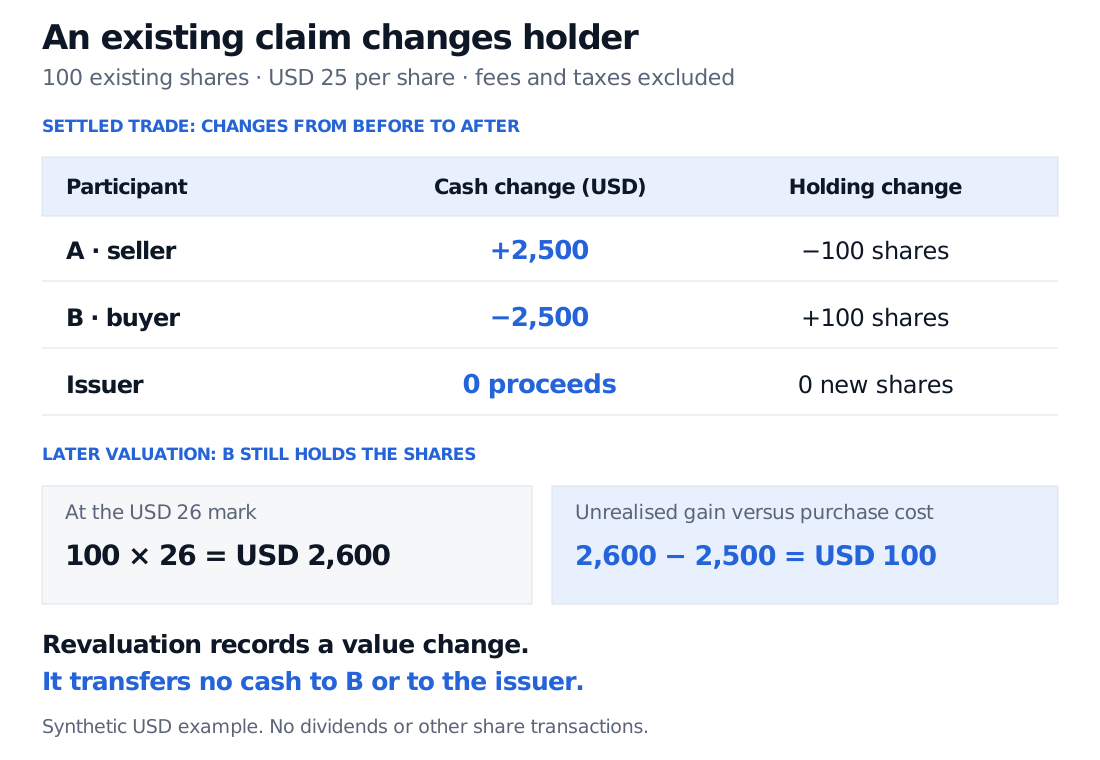
Original synthetic USD example. The ledger shows changes after an agreed trade has settled; the later mark is a valuation, not another sale. Fees, taxes, dividends and other share transactions are excluded.
What a functioning resale market provides
An exit and a way to rebalance. A pension fund can sell a position to meet payments or change its exposures while the security continues to exist. Liquidity describes how readily it can do that for the required size, at an acceptable price and cost. A security can have a secondary market yet trade infrequently, with a wide bid–ask spread or few willing counterparties. The existence of a resale route does not guarantee an immediate exit.
Price formation. Bids, offers and completed trades reveal the terms on which participants are prepared to transfer risk. Those observations inform valuations and trading decisions. They do not establish one permanent, universally executable value: a last trade may be old, and a displayed quote may cover less size than a portfolio needs. The SEC's execution guide explains why an order may execute at a different price from the quote a customer saw.
A connection to future financing. Investors' willingness to buy a new issue can depend on their expected ability to resell it. Secondary-market liquidity can therefore matter to an issuer's financing conditions, even though an ordinary investor resale sends no new proceeds to the issuer. This is an economic connection, not another cash entry in the example's company account.
A market need not be a stock exchange
Secondary trading can use an exchange, a dealer or another trading platform. A dealer may buy from one holder and later sell from its inventory; buyer and seller need not meet directly. Fabozzi and Fabozzi's corporate-bond discussion illustrates dealer markets and several electronic trading arrangements, including customer-to-dealer and cross-matching systems.
Private-company securities can also change hands in secondary transactions. Access and transferability are separate questions: the SEC's US private-secondary-market guidance describes securities-law restrictions that can limit resales. “Secondary” does not itself mean public, freely tradable or liquid.
Finally, execution and settlement are distinct. Execution establishes the trade's price and quantity; settlement completes the relevant securities and cash transfers. The ledger above deliberately shows a settled result without assigning a universal settlement cycle. Timing depends on the instrument, market and applicable rules. The Market Participants lesson follows the different jobs performed by brokers, dealers and post-trade institutions. Its public preview is available; the full lesson requires membership.
Sources
- SEC Investor.gov — Secondary Market: definition based on trading existing securities.
- SEC Investor.gov — Executing an Order: execution routes, quote size and changing prices.
- SEC — Private Secondary Markets: private resales and US transfer restrictions; updated 24 April 2026.
- SEC Investor.gov — New “T+1” Settlement Cycle: Investor Bulletin: explanation of settlement as transfer of securities and cash; its cycle discussion is US-specific.
- Fabozzi, F. J., and Fabozzi, F. A. Bond Markets, Analysis, and Strategies, 10th edition, MIT Press, 2021. Chapter 8, “Secondary Market for Corporate Bonds” and “Electronic Bond Trading” (local PDF pages 267–269). Used for trading structures, not as a source of current market statistics.