The primary market funds issuers through new securities. Separate gross and net proceeds, later resales and selling-shareholder shares in an IPO.
Primary market
The primary market is where newly issued securities are sold to investors, raising funds for their issuer. The distinction matters when measuring a company's financing: money spent buying its shares is new capital for the company only when the transaction actually funds an issue. A later purchase from another shareholder pays that seller.
The SEC's primary-market definition identifies both parts: newly issued securities and proceeds received by the issuer. “Primary” describes the issuance transaction, rather than a particular building, exchange or type of investor.
Follow the cash and the share count
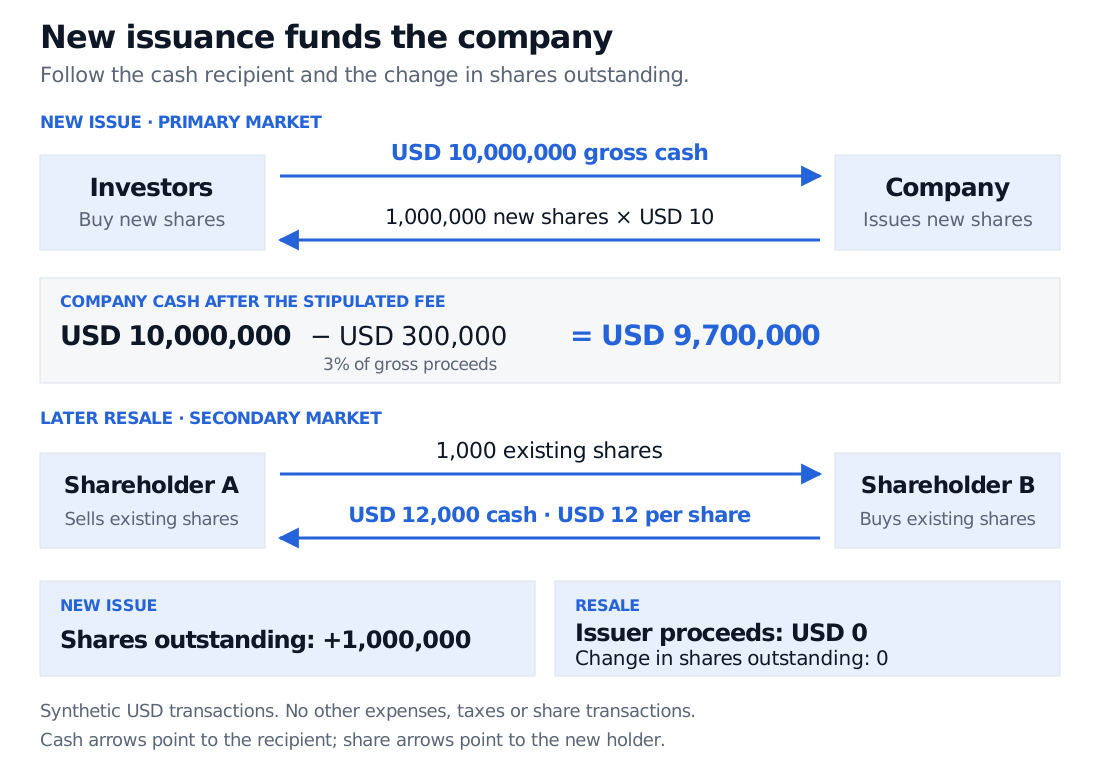
Suppose a company sells 1,000,000 newly issued shares at USD 10 each. Stipulate an underwriting fee equal to 3% of gross issuer proceeds, paid by the company. Exclude all other expenses and taxes. These are synthetic terms, not a typical or required fee schedule.
New issue
Calculation
USD
Gross proceeds to the company
1,000,000 × 10
10,000,000
Underwriting fee
10,000,000 × 3%
−300,000
Net cash retained by the company
10,000,000 − 300,000
9,700,000
Investors receive one million new shares. The company's shares outstanding increase by one million, assuming no simultaneous cancellation or other share transaction. The USD 10 million gross proceeds describe the sale size; the USD 9.7 million net proceeds describe the financing cash left after the stipulated fee. Neither amount is revenue from selling the company's goods or services.
Later, one investor sells 1,000 of those existing shares at USD 12 each to another investor. With fees and taxes again excluded, the seller receives USD 12,000. The company receives USD 0 from that resale, and its shares outstanding do not increase. This is a secondary-market transaction: the security changes hands rather than being created again.
Synthetic share financing ledger: investors pay USD 10 million for one million new shares. A stipulated 3% underwriting fee takes USD 300,000, leaving USD 9.7 million for the company. Later, 1,000 existing shares sell for USD 12,000; seller proceeds are USD 12,000, issuer proceeds are zero, and the change in shares outstanding is zero.
Original synthetic transactions in USD. Issue price: USD 10 per new share; later resale price: USD 12 per existing share. Only the stipulated 3% issue fee is included. Share-count changes exclude other corporate actions.
The later USD 12 trading price does not retroactively change the USD 10 issue price or the company's proceeds. It is evidence about the price investors subsequently agree for existing shares. It is not an extra cash payment to the issuer.
An IPO can contain two different sales
An initial public offering, or IPO, can include new shares sold by the company and existing shares sold by shareholders. Those components have different recipients of the cash. Calling the whole transaction an IPO does not make every share newly issued.
The SEC's IPO investor bulletin explains that proceeds from selling shareholders' shares go to those shareholders. It also distinguishes an allocation at the offering price from a purchase after shares begin trading publicly.
For an offering with both components, separate:
Company shares: new issuance; identify gross proceeds, fees and net proceeds to the company.
Selling-shareholder shares: existing holdings sold; identify proceeds to those holders.
Subsequent market trades: investor-to-investor transfers at trading prices that can differ from the offering price.
In a US IPO prospectus, the cover and selling-shareholder disclosures help establish who is selling how many shares; Use of Proceeds explains the company's intended use of the money it raises. Read those amounts separately from any headline offering total.
New issuance has several routes
Primary financing is broader than an IPO. An already-public company can issue additional shares; companies and governments can issue new bonds. New securities can also be placed privately with selected investors. Public versus private distribution is a different distinction from new issuance versus resale.
Fabozzi and Fabozzi's discussion of the municipal primary market gives a concrete example: a new bond issue may be publicly offered or privately placed, and public distribution may use competitive bidding or negotiation with underwriters. Those routes are examples, not a universal issuance procedure for every instrument or jurisdiction.
An underwriter may help arrange, price and distribute an issue; the underwriting agreement determines its commitments. That role differs from an investor simply selling an existing position. The Market Participants lesson explains how issuers, investors and intermediaries fit together. Its public preview is available; the full lesson requires membership.
For a financing dataset, keep the new security count, issue price, gross issuer proceeds, issuance costs and net issuer proceeds as separate fields. Keep selling-holder proceeds separate as well. Adding secondary trading turnover to issuance proceeds would overstate how much fresh funding companies receive.
Practice: separate the two recipients
An offering sells 200,000 new shares and 50,000 existing shareholder shares, all at USD 8 per share. The company pays a stipulated 2% fee on its own gross proceeds only. Selling shareholders pay no fees in this example; exclude all other costs, taxes and share transactions. How much net cash does the company receive, how much do selling shareholders receive, and how many shares are added to those outstanding?
Answer. The company raises 200,000 × USD 8 = USD 1,600,000 gross and pays 2% × USD 1,600,000 = USD 32,000, retaining USD 1,568,000 net. Selling shareholders receive 50,000 × USD 8 = USD 400,000. Shares outstanding increase by 200,000, not the 250,000 shares sold in total: selling existing shares changes their owners. Applying the company's fee to the whole offering would also use the wrong base under these stipulated terms.
Frank J. Fabozzi and Francesco A. Fabozzi, Bond Markets, Analysis, and Strategies, 10th edition, MIT Press, 2021, Chapter 9, “Municipal Bond Market — Primary Market” (local PDF pages 316–317): public and private placement of new issues, competitive bidding and negotiated underwriting. The share ledgers and practice question are original synthetic examples.