An issuer creates a security. Trace the money raised, the obligations retained after resale, and the legal entity behind a bond or share.
Issuer
An issuer is the entity that creates a security, such as a company issuing shares or a government issuing bonds. Identifying the issuer tells you whose financing and obligations you are analysing. The firm selling you an existing security may be someone else entirely. Deutsche Börse’s definition covers both corporate and public-sector issuers.
For a bond, the issuer is the borrower responsible for the payments specified by the contract. For common stock, the issuer is the company in which shareholders hold an ownership interest. Issuing common shares does not create the same promise to repay principal and pay coupons as issuing a conventional bond. Investor.gov’s comparison makes that distinction explicit.
Cash raised is not face value owed
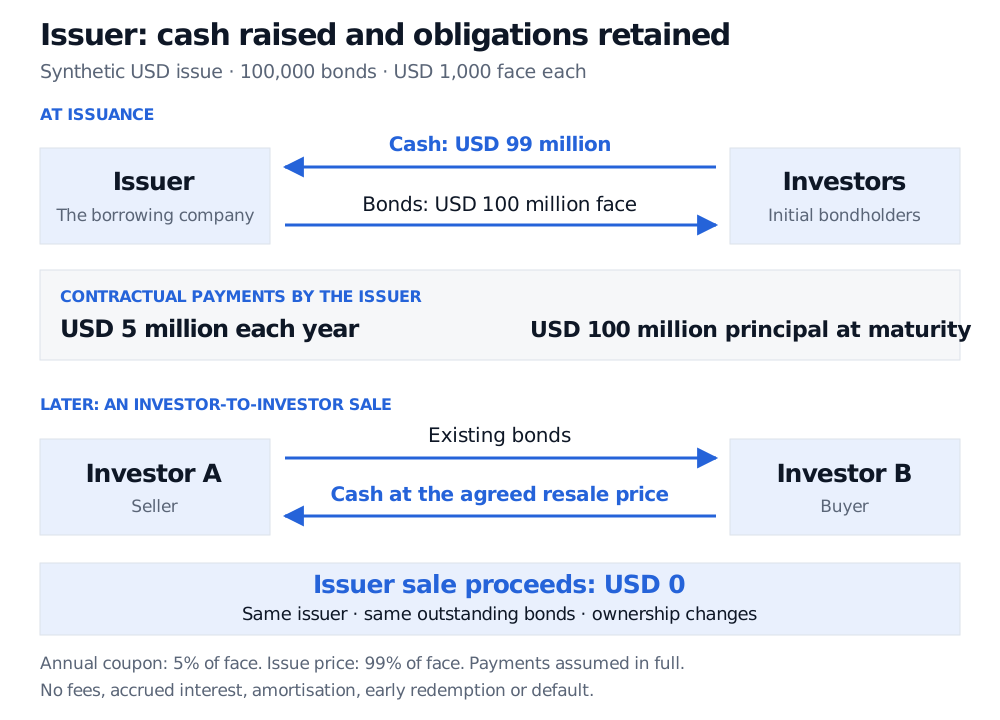
Suppose a company issues 100,000 bonds, each with USD 1,000 face value, at an issue price of 99% of face value. Each bond pays a fixed 5% annual coupon rate on face value. This is a synthetic issue with annual coupon payments, no accrued interest at issuance, and no fees. Assume every bond remains outstanding until maturity, with no amortisation, early redemption or default.
The issuer receives less than the amount it promises to repay at maturity. The coupon is calculated on face value, not on the USD 99 million raised. Applying 5% to proceeds would incorrectly give USD 4.95 million. Actual net proceeds would also reflect any issuance costs. These contractual cash flows are not a calculation of the issuer’s accounting carrying value or all-in funding yield.
Investors pay the issuer USD 99 million for a USD 100 million face-value issue. The issuer owes USD 5 million in annual coupons and USD 100 million principal at maturity. A secondary sale exchanges bonds and cash between investors, providing zero sale proceeds to the issuer.
Synthetic USD issue at 99% of face value with a 5% annual coupon on face. All bonds remain outstanding; fees, accrued interest, default and early redemption are excluded.
The Bonds and Yields lesson develops the next step: valuing promised payments and separating coupon from yield. The full lesson requires membership; a public preview is available.
Reselling the bond does not issue it again
The initial sale belongs to the primary market: new securities provide funding to their issuer. If an original investor later sells a bond to another investor in the secondary market, the buyer pays the seller. The issuer receives no sale proceeds from that investor-to-investor trade. The SEC’s glossary distinguishes the primary and secondary markets on this basis.
Ownership changes; the company remains the issuer. In the example, a resale neither increases the number of bonds outstanding nor resets the coupon basis. A new issue or an issuer buyback would be a different transaction.
Secondary prices still matter to the company. Prices and yields on its existing bonds help indicate the terms investors might demand for new financing. That economic feedback does not turn secondary trading volume into issuer funding.
Read the legal name behind the brand
A familiar group name can conceal several issuers: an operating company, a holding company or a financing subsidiary. Check the named issuer in the offering documents, together with any guarantees and their conditions. Common ownership does not by itself establish a parent guarantee. The SEC’s guarantor-disclosure explanation treats issuers and guarantors as distinct roles and highlights disclosure of guarantee terms and conditions.
Likewise, an underwriter’s role in arranging or distributing an offering does not itself make that institution the guarantor of the bond’s future payments. The NCUA’s underwriter definition describes pricing and distribution; a repayment guarantee is a separate undertaking. A broker executing a later sale is also performing a different job. The Market Participants lesson explains these institutional roles; its full text requires membership, with a public preview available.
For risk analysis, record the legal issuer, any guarantor, and the particular security’s seniority and collateral. Several bonds from one issuer can have different recovery prospects. Several securities with different names can still concentrate exposure to the same borrower. An issuer identifier is therefore a useful grouping key, while a complete credit-risk view also needs the obligations and protections attached to each instrument.
Frank J. Fabozzi and Francesco A. Fabozzi, Bond Markets, Analysis, and Strategies, 10th edition, MIT Press, 2021, Chapter 1, “Introduction” and “Principal and Coupon Rate” (local PDF pages 22 and 27).