Calculate coupon payments from face value, distinguish coupon rate from current yield, and follow an original quarterly-payment example through changing market prices.
Coupon rate
The coupon rate is the contractual annual interest rate used to calculate a bond's coupon payments from its principal amount. For an ordinary fixed-rate bond with unchanged face value, the annual coupon amount equals face value multiplied by the coupon rate. A 4.8% coupon on 20,000 USD face promises 960 USD of interest over a regular full year.
The rate does not say how much you paid for the bond, when the interest arrives, or what your investment will earn overall. Those distinctions matter when a bond trades away from face value.
Turn a headline percentage into a payment schedule
Nila manages a fictional firm's cash reserve. She buys 20,000 USD face value of a non-callable, fixed-rate bullet bond with one year remaining, a 4.8% annual coupon and four regular quarterly payments. The principal remains unchanged and is repaid at maturity. Assume the issuer makes every promised payment; taxes and costs are excluded.
For annual coupon rate c, face amount F and m equal regular payments per year, the payment at each coupon date is
C=mFc.
The annual rate is entered as a decimal: c=0.048, not 4.8. With m=4,
C=420,000(0.048)=240 USD.
Each quarterly coupon is 1.2% of face value. The 4.8% is the annual rate; paying 4.8% every quarter would quadruple the promised annual interest and misread the contract.
Time after purchase
Coupon
Principal repayment
Total receipt
Three months
240 USD
—
240 USD
Six months
240 USD
—
240 USD
Nine months
240 USD
—
240 USD
Twelve months
240 USD
20,000 USD
20,240 USD
The final 20,000 USD is repayment of principal, not another coupon. The year's four coupons sum to 960 USD. A bullet structure means the principal is repaid at the end rather than gradually through the year.
Suppose Nila's purchase occurs immediately after a coupon date, so this example has no accrued interest. The full purchase price is 19,500 USD, equivalent to a quote of 97.50 per 100 face. She has bought the claim to coupons calculated on 20,000 USD, not on 19,500 USD.
Her annual coupon-income-to-price ratio, or current yield, is
19,500960×100%≈4.9231%.
That differs from the 4.8% coupon rate because its denominator is the purchase price. At a hypothetical price of 20,200 USD, the same 960 USD annual coupon produces a current yield of approximately 4.7525%. The issuer does not rewrite the fixed coupon because the bond's trading price changes.
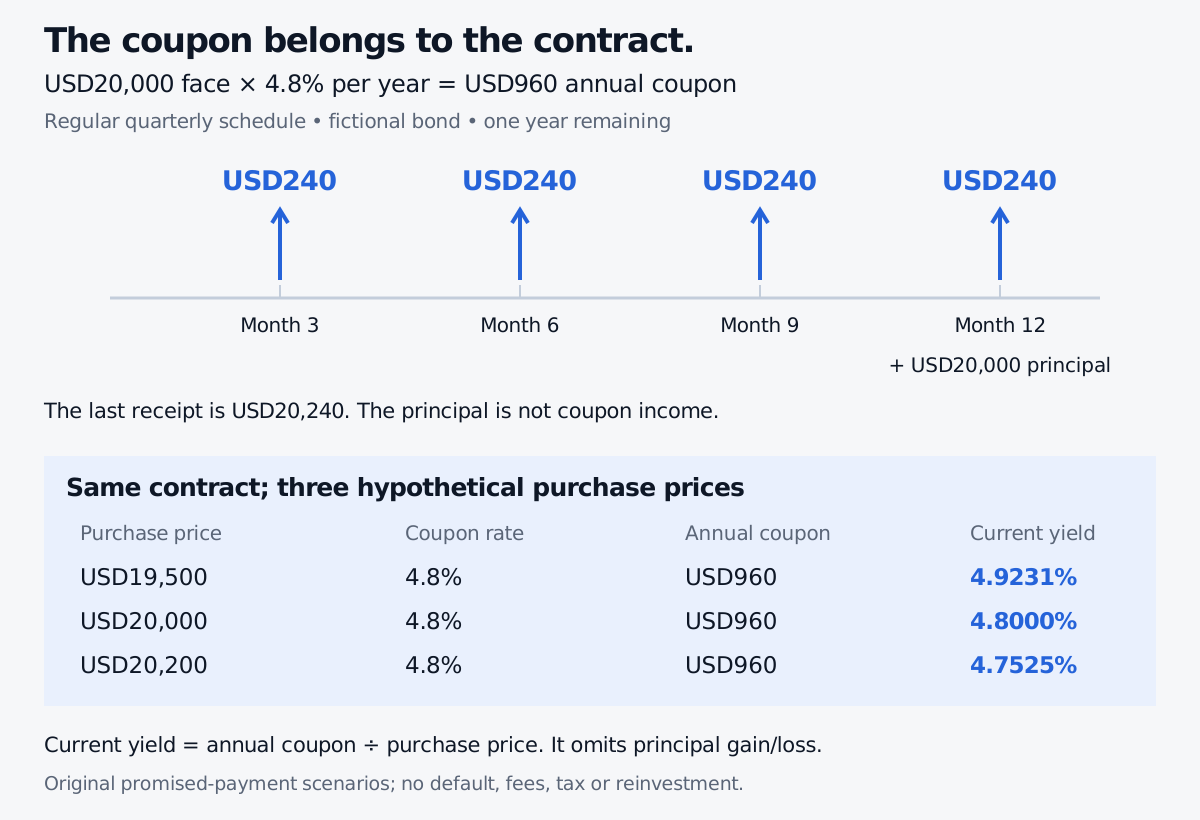
Four quarterly coupons of 240 USD arise from a fixed 4.8% annual rate on 20,000 USD face. Three purchase prices produce different current yields while the coupon rate and annual coupon amount remain unchanged.
Original fictional cash-flow and price scenarios. The chart separates coupon income from principal repayment; its prices are assumptions, not observed quotes.
Current yield also leaves something out: buying for 19,500 USD and receiving 20,000 USD principal creates a separate 500 USD difference if the promised repayment occurs. Conversely, paying more than face creates a loss on principal repayment. Yield to maturity includes the dated coupons and principal in one present-value equation; it is not obtained by relabelling the coupon rate. FINRA's yield comparison explains the distinction between coupon, current yield and YTM.
Nila's total promised receipts in this one-year example are 20,960 USD. Subtracting the 19,500 USD purchase gives 1,460 USD before costs and tax, with coupons left uninvested. That cash difference does not turn the coupon into a 1,460 USD payment. With interim coupons held as zero-interest cash until year-end, terminal wealth is 20,960 USD, giving a one-year return of approximately 7.4872% on the 19,500 USD purchase. Reinvesting coupons at other rates changes that terminal-wealth return. Neither calculation changes the 4.8% contractual coupon rate.
What the simple formula assumes
Dividing the annual coupon by the payment frequency works for this bond's equal regular periods and unchanged principal. A rate alone is not a complete payment specification. The contract supplies the coupon dates, principal base and calculation rules.
An unusually short or long first or final period—a stub—needs its contractual calculation. Day-count conventions also determine accrual fractions where applicable; do not blindly substitute calendar days divided by 365 for every bond. Between payment dates, accrued interest can affect the settlement amount without changing the fixed coupon rate.
“Fixed coupon rate” and “unchanging cash payment” are not universal synonyms. An amortising bond can have a fixed rate applied to a declining principal balance. An inflation-linked instrument can apply a fixed rate to an adjusted principal. A floating-rate note instead resets its coupon rate according to its specified reference-rate terms. A zero-coupon bond makes no periodic coupon payment, yet can still have a positive yield.
For the next step, bond yield prices one payment schedule under different required yields. SelfMadeQuant's Bonds and Yields lesson extends the coupon/price distinction into discount-factor and YTM equations. Its public page is a preview; the full lesson requires membership.
Sources
Frank J. Fabozzi, Bond Markets, Analysis, and Strategies, 9th ed., Chapter 1, “Principal and Coupon Rate”: coupon amounts, face value, payment frequency and floating-rate resets.