A zero-coupon bond pays no coupons. Its whole return is the gap between a discounted price and face value at maturity, so its yield equals one spot rate and its Macaulay duration equals its maturity.
Zero-coupon bond
A zero-coupon bond pays no coupons. Its only cash payment is its face value at maturity, and it is bought below that face value. The holder's return is the gap between purchase price and face value, earned as the price rises toward par. Fabozzi says it directly: the holder "realizes interest by buying the bond substantially below its principal value," and the interest is the difference between the principal value and the price paid.
A coupon bond is a bundle of single payments. A zero is one payment, which makes it the simplest bond and the natural reference point for the rest of fixed income. The US Treasury issues no zero-coupon notes or bonds, so the zeros most investors meet are short Treasury bills or strips made from notes and bonds.
Every number below comes from a fictional 10-year zero with 10,000 USD face value and no credit risk. Yields are annual effective unless stated, and each quoted rate carries its compounding label.
Pricing
With yield y and n years to maturity, the price is the face value discounted at that yield:
P=(1+y)nF.
Equivalently, P is the present value of F, or F times the discount factor for maturity n. Fabozzi's Equation 2.8 discounts over 2n semiannual periods at half the annual yield. The convention changes the price, so a rate alone does not fix it:
Annual effective: P=10,000/1.04510=6,439.28 USD.
Semiannual, the convention used for US Treasury yields: P=10,000/1.022520=6,408.16 USD.
Both quotes read "4.50%", yet the prices differ by 31.12 USD. Write the compounding frequency beside every rate.
The yield is the spot rate
A zero has one payment, so there is no coupon to blend across dates. Its yield to maturity equals the spot rate for its maturity. This is why zeros are the cleanest way to read a term structure. A coupon bond's yield, by contrast, mixes several spot rates, so the two can differ. The spot rate page shows how the individual rates are extracted from coupon bonds.
Pull to par
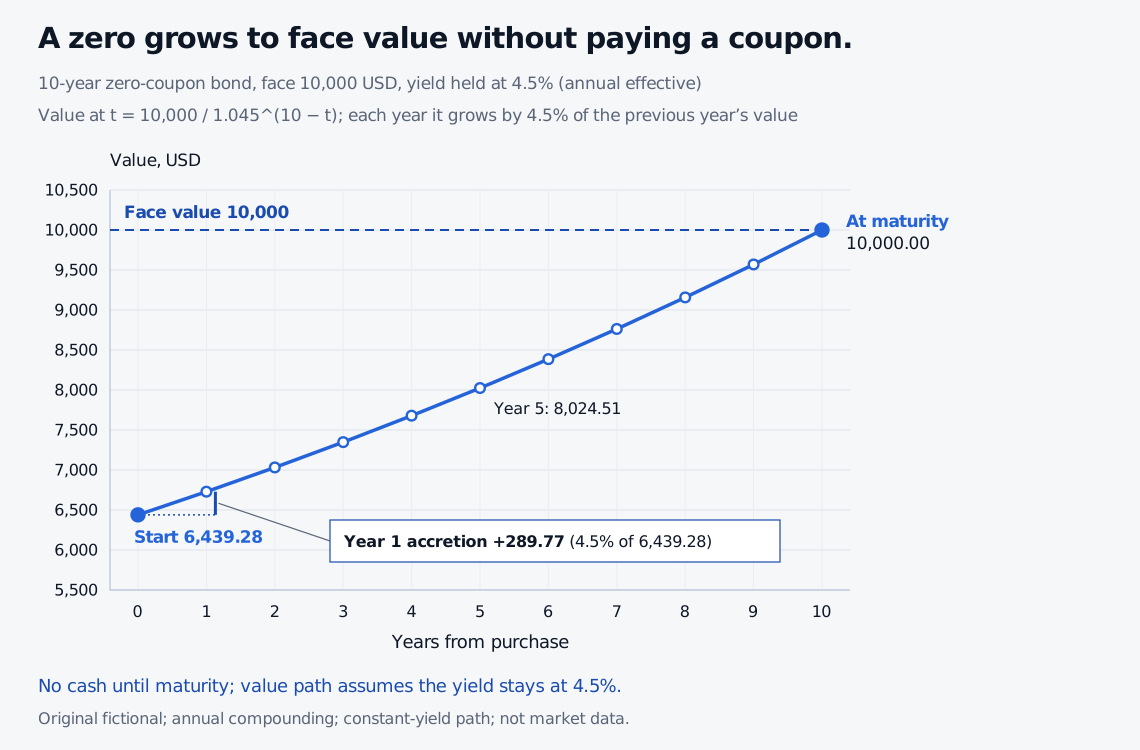
Hold the yield at 4.50% annual effective. The zero's value then rises each year until it reaches face value at maturity. Its value after t years is 10,000/1.04510−t.
Line chart of the value of a 10-year zero with face value 10,000 USD over its life at a constant 4.50 percent annual effective yield. It rises from 6,439.28 USD at purchase to 10,000.00 USD at maturity, passing 7,031.85 at year 2, 8,024.51 at year 5 and 9,157.30 at year 8. The first-year gain is 289.77 USD.
Original fictional illustration. Face value 10,000 USD, 10 years, constant 4.50% annual effective yield. No cash flows occur before maturity, so the rise is pure accretion.
The first year adds 289.77 USD, which is 4.50% of 6,439.28. Later years add more, because each gain is earned on a larger base. Nothing is paid until maturity, so the whole return is accretion of this kind. Tax treatment of the accreted interest varies by jurisdiction.
Reinvestment and price risk
If you hold to maturity, the return is set on the day you buy. The only cash flow is the face value, so no coupon has to be reinvested at an unknown future rate. Coupon bonds carry that reinvestment risk; a zero does not.
Selling early is different. You receive the market price on that date, and that price moves with the yield. A zero has no reinvestment risk but carries substantial price risk before maturity.
Duration and rate sensitivity
Macaulay duration is the present-value-weighted average time until a bond's payments arrive. A zero has one payment, so its Macaulay duration equals its maturity: 10.00 years. No bond that pays by year 10 can have a longer Macaulay duration. Modified duration, which measures price sensitivity to yield, is DMac/(1+y) under annual compounding, so the zero's is 10/1.045=9.57 years.
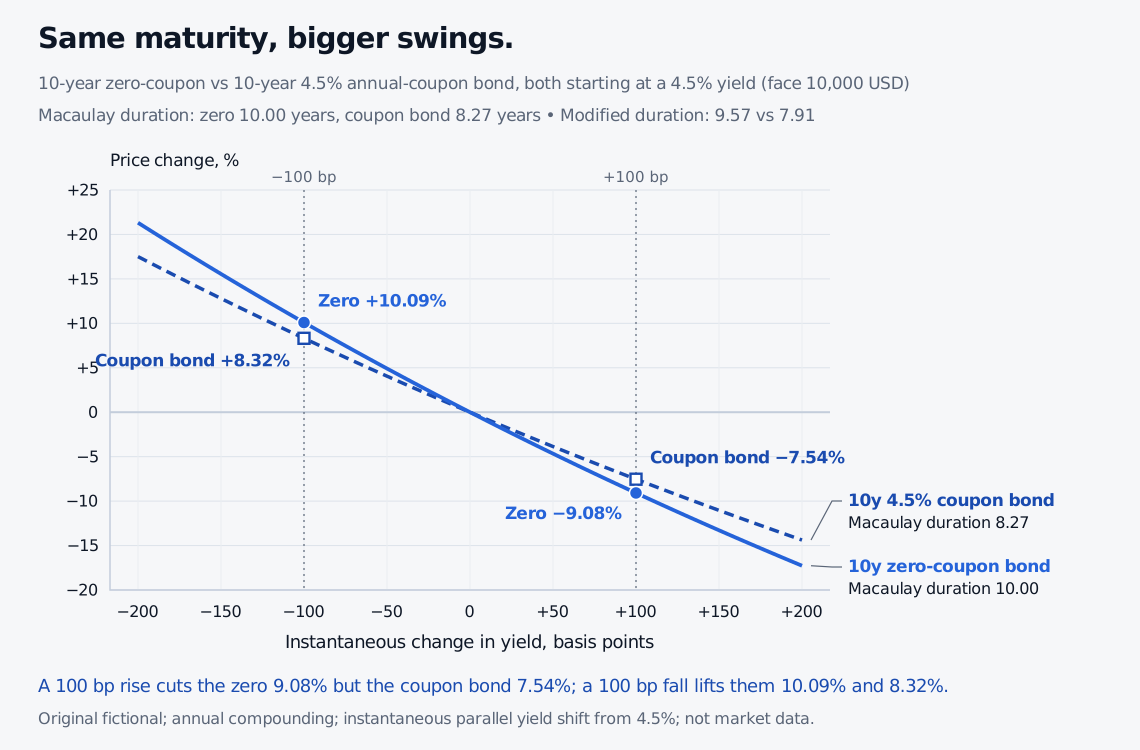
A 10-year, 4.50% annual-coupon bond priced at par at the same yield has Macaulay duration 8.27 years and modified duration 7.91. The table moves each yield by 100 basis points:
Yield
Zero price (USD)
Zero change
Coupon bond price (USD)
Coupon bond change
3.50%
7,089.19
+10.09%
10,831.66
+8.32%
4.50%
6,439.28
—
10,000.00
—
5.50%
5,854.31
−9.08%
9,246.24
−7.54%
Changes are measured from each bond's starting price at 4.50%.
Line chart of the percentage price change of a 10-year zero and a 10-year 4.50 percent annual-coupon bond, both priced at 4.50 percent annual effective, for yield moves from minus 200 to plus 200 basis points. Marked at plus and minus 100 basis points: the zero falls 9.08 percent at 5.50 percent and rises 10.09 percent at 3.50 percent; the coupon bond falls 7.54 percent and rises 8.32 percent.
Original fictional illustration. Both bonds start at 4.50% annual effective. The zero starts at 6,439.28 USD and the coupon bond at 10,000.00 USD; each line shows the percentage change from its own starting price.
The zero moves more in both directions. Its entire value sits at year 10, while the coupon bond's value is spread across earlier payments. The uneven pair of moves, −9.08% for a rise and +10.09% for a fall, reflects convexity: the price curve bends, so equal-sized shocks do not produce mirror-image changes.
Where zeros come from
Treasury bills. Short-term bills are sold at a discount and repaid at face value, so each is a zero.
STRIPS. The Treasury announced its STRIPS program in 1985. It lets designated notes and bonds be split into separate zeros, one for each payment. Coupon strips come from interest payments and principal strips from the final repayment. Fabozzi notes that the resulting zeros are direct obligations of the US government.
Corporate and municipal zeros. Some issuers sell zeros that carry credit risk, which Treasury strips do not.
Why the zero matters
Liability matching. A payment due in ten years can be funded directly by a ten-year zero, with no reinvestment. Wider matching techniques are covered under bond immunisation.
Discount factors. A zero's price is a discount factor times face value, so zero prices read the discount curve directly.
Building blocks. A coupon bond's price is the sum of each payment times its own discount factor. This is the law of one price applied to a bundle of zeros.
Practice
Question 1 (calculation). A 5-year zero-coupon bond has a face value of 1,000 USD. Its yield is 6% annual effective. What is its price?
Answer.P=1,000/1.065=747.26 USD. The single payment is discounted over five annual periods. A semiannual quote would give a different price, so the answer depends on the stated convention.
Question 2 (multiple choice). At a 6% annual effective yield, which bond has the longest Macaulay duration?
(a) A 10-year zero-coupon bond
(b) A 10-year, 5% annual-coupon bond
(c) A 12-year, 8% annual-coupon bond
(d) All three have the same duration, because their maturities are similar
Answer. (a). The zero's Macaulay duration equals its maturity, 10.00 years. The 10-year, 5% bond has a Macaulay duration of about 8.02 years, and the 12-year, 8% bond about 8.45 years. Option (c) is the tempting distractor because it has the longest maturity. Its large coupons return cash early, which pulls the weighted average time down to about 8.45 years, below the zero's 10.00. Option (d) is wrong because a bond that pays coupons always has a Macaulay duration below its maturity.
Question 3 (interview). A 20-year zero trades at 50% of face value. What annual effective yield does that imply, and how close is the rule-of-72 shortcut?
Answer. Solve 0.50=(1+y)−20, so y=21/20−1=3.53%. The rule of 72 gives 72/20=3.6%, which overstates the yield by about 0.07 percentage points. The shortcut is tuned for rates near 8%, where it is almost exact; at low rates like this one it overstates slightly, because the exact constant for small rates is closer to 69.3 (100ln2).
Sources
John C. Hull, Options, Futures, and Other Derivatives, 9th ed., Global Edition, Chapter 4, Section 4.3: the n-year zero rate is the rate on an investment that starts today and pays all interest and principal at the end of n years.
Frank J. Fabozzi, Bond Markets, Analysis, and Strategies, 9th ed., Chapter 2 ("Pricing Zero-Coupon Bonds", Equation 2.8) and Chapter 6 ("Stripped Treasury Securities").