the first two terms of a Taylor series in , with the modified duration. For a bond with fixed cash flows is positive, so for equal-sized moves the bond gains more than it loses.
What the number is made of
For fixed cash flows at times , with annual compounding, . Differentiating twice gives , and every term is positive. A sum of convex curves is convex, which is why a fixed-cash-flow bond cannot have negative convexity. For a zero-coupon bond maturing in years,
Duration grows roughly in proportion to maturity, convexity roughly with its square. Equivalently, convexity is how fast dollar duration changes: as yield falls, the tangent steepens and duration rises, which accelerates gains, and as yield rises, duration shrinks and slows losses (Fabozzi, Chapter 4). Spreading cash flows over a wider range of dates, at unchanged duration, raises convexity.
Check the convention before using any reported number:
- Yield basis. With payments a year and period index , the factor becomes and discounting uses . The duration page's bond uses .
- Units of . The formula needs a decimal, as in the first display.
- Scaling. Fabozzi notes that some writers define the measure as half the second derivative divided by price, so the price term has no ½. Others scale it by 100 so that can be entered in percentage points. The 10-year zero below, , could appear as 49.89 or 0.9977. A bare figure means little until you know which formula it feeds.
Same duration, more convexity
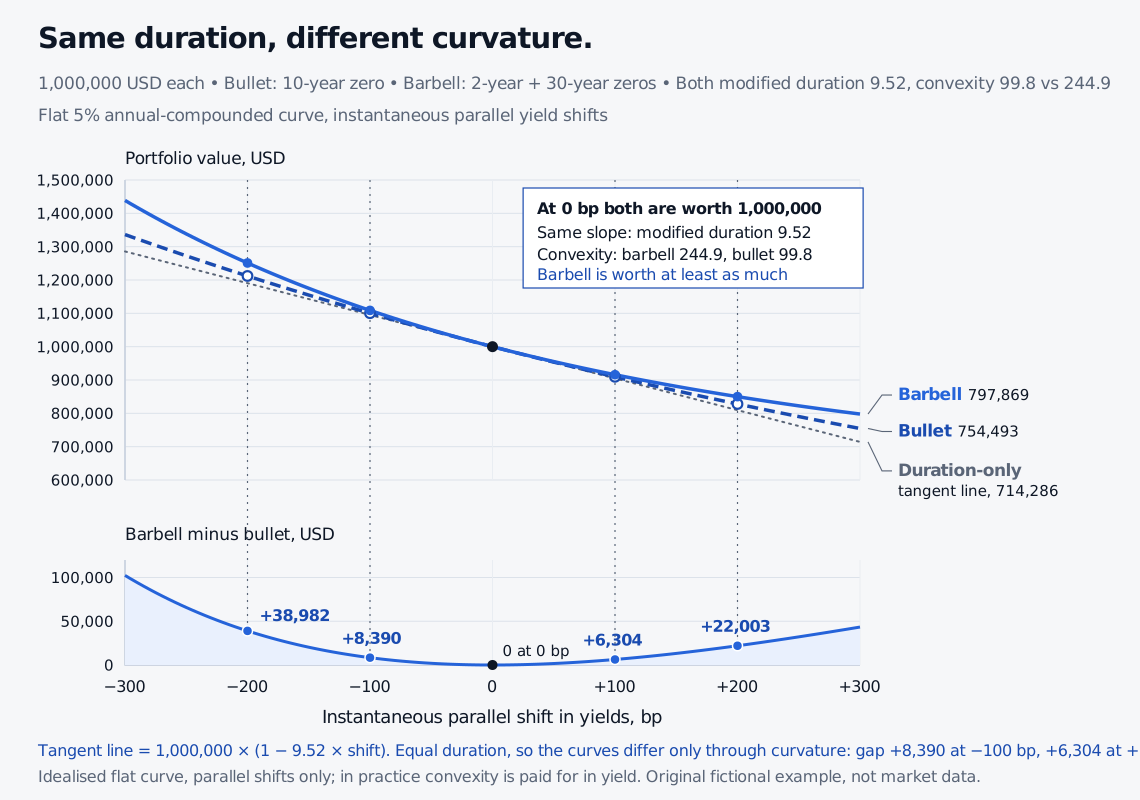
Two portfolios start at 1,000,000 USD on a fictional flat 5% annual curve. The holdings are zero-coupon bonds, shifts are instantaneous and parallel, and no time passes.
| Holdings (market value → face) | |||
|---|---|---|---|
| Bullet | 10-year zero: 1,000,000 → 1,628,894.63 | 9.5238 | 99.77 |
| Barbell | 2-year zero: 714,285.71 → 787,500.00; 30-year zero: 285,714.29 → 1,234,840.68 | 9.5238 | 244.90 |
The barbell weights, 20/28 and 8/28, are chosen so matches the bullet. Portfolio convexity is the value-weighted average, , more than double the bullet's. Exact repricing after each shift:
| Shift | Bullet | Barbell | Barbell − bullet |
|---|---|---|---|
| −200 bp | 1,212,050.58 | 1,251,032.29 | +38,981.71 |
| −100 bp | 1,100,422.84 | 1,108,812.45 | +8,389.61 |
| +100 bp | 909,566.25 | 915,870.47 | +6,304.22 |
| +200 bp | 828,047.43 | 850,050.46 | +22,003.03 |
Duration alone gives both portfolios the same answer: 1,095,238.10 at −100 bp and 904,761.90 at +100 bp, and 1,190,476.19 and 809,523.81 at ±200 bp. Adding the convexity term separates them. At −100 bp the estimates are 1,100,226.76 (bullet) and 1,107,482.99 (barbell); at +100 bp, 909,750.57 and 917,006.80. The estimated barbell edge, USD, sits between the exact edges of 8,389.61 and 6,304.22. The quadratic still misses at ±200 bp, mostly through the 30-year leg: the barbell estimate is 11,576.51 below the exact value at −200 bp, the bullet's 1,619.74.
Convexity is valuable, so it is priced
The table looks like a free lunch. The barbell costs the same as the bullet today and is never worth less than the bullet after any parallel shift. If a flat curve could only move in parallel, buying the barbell and selling the bullet would be riskless profit, so real curves cannot behave that way. This is Tuckman's point in the barbell-versus-bullet discussion: greater convexity does better whether rates rise or fall, but bond prices reflect that advantage.
It is paid for in yield. In the models of Tuckman's Chapter 10, convexity lowers a bond's yield by about a year, where is the annual volatility of rates. With the gap above and an assumed , that is of value, the same 7,256 USD per million as the quadratic edge. An investor who holds the barbell therefore earns less carry while rates stay put. The barbell wins when rates move a lot, the bullet when they barely move; Fabozzi makes the same point, that investors who expect low rate volatility should be willing to sell convexity. A positive-convexity position is long volatility, which connects to gamma: both are second derivatives, both pay off on large moves in either direction, and both are financed by a lower running return.
Convexity also does not fix the other assumption in the example. The parallel-shift model sees only the level of the curve. Of the barbell's 9.5238 years of modified duration, the 30-year leg carries . If the 30-year yield rises 50 bp while the 2-year and 10-year yields stay put, a first-order estimate has the barbell losing about 4.08% (40,816 USD), the bullet nothing, far more than the convexity edge. A steepening hurts the barbell and a flattening helps it; key-rate duration measures that exposure.
When convexity turns negative
A callable bond lets the issuer redeem early. Economically, the investor owns the straight bond and is short a call option, so the price is the straight bond's value minus the option's value (Tuckman, Chapter 5). When yields are well above the coupon the call is unlikely and the price follows the usual convex curve. As yields fall toward the level where calling becomes attractive, the price flattens toward the call price: Fabozzi calls this price compression. Price gains from a fall in yield are then smaller than losses from an equal rise, which is negative convexity. The CFA Institute summary of embedded-option analysis says the convexity of a callable bond is negative when the option is near the money. Agency mortgage-backed securities behave alike because borrowers refinance when rates fall, so prepayment is the embedded option.
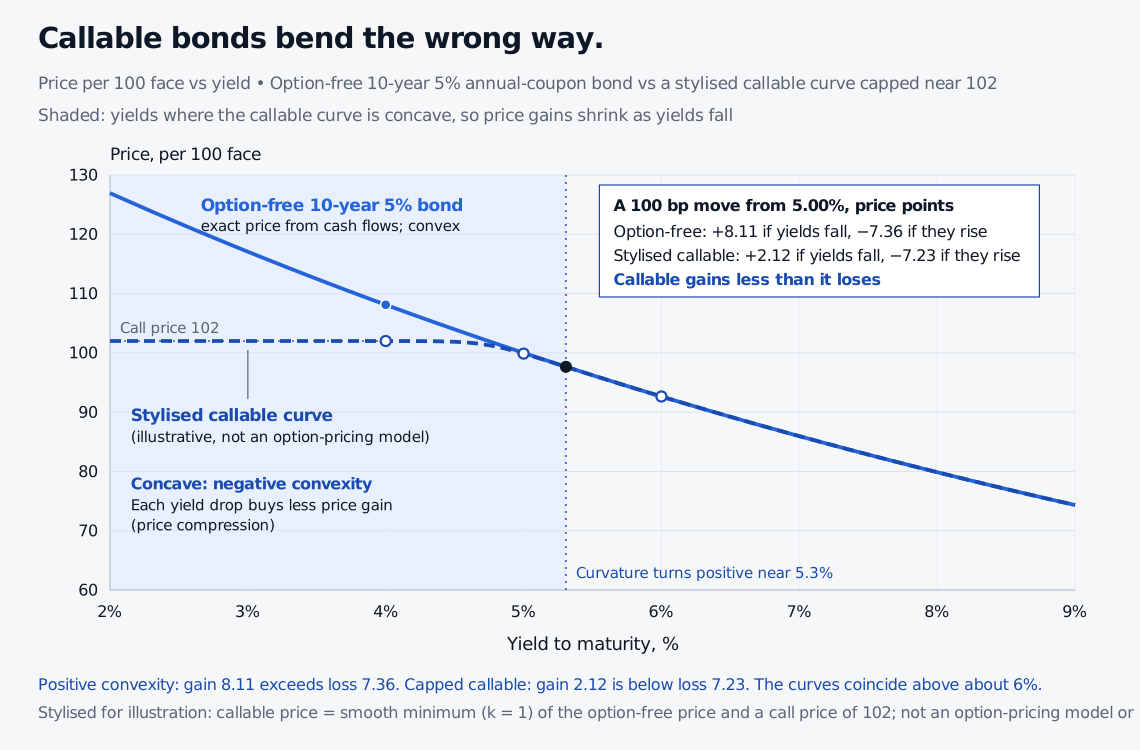
The fixed-cash-flow formulas above fail here because the cash flows change with rates. Practitioners reprice with a model after shifting the benchmark curve down and up by (decimal), holding the option-adjusted spread fixed, and use the finite differences
where and are the repriced values after the down and up shifts. These are effective duration and effective convexity. They depend on the model's volatility and exercise assumptions, so report those with the number. A short-convexity holder loses whether rates gap up or down, Tuckman's description of a short option hedged with bonds, which is why mortgage and callable-bond investors treat convexity as a risk to be compensated by spread.
Practice
- (a) X
- (b) Y
- (c) Neither: same duration means the same price change
- (d) It depends only on the direction of the jump
Continue learning
Three lessons in SelfMadeQuant's Fixed Income and Interest Rate Models Programme extend this page; each has a public preview and the full lesson requires membership.
- Key Rate Exposures, Bucket Shifts, and Immunization splits duration across maturity buckets.
- Expectations, Convexity, and Risk Premium in the Term Structure shows convexity lowering long rates in a small rate tree.
- Agency Mortgage Pass-Through Securities explains negative convexity and duration extension for pass-throughs; it is still in progress.
Sources
- Frank J. Fabozzi, Bond Markets, Analysis, and Strategies, 9th ed.: Chapter 4 (convexity, the convexity measure and its vendor scaling, the value of convexity, properties of convexity); Chapter 18 (callable-bond price–yield relationship, negative convexity, effective duration and effective convexity); Chapter 19 (negative convexity of residential mortgage-backed securities).
- Bruce Tuckman, Fixed Income Securities: Tools for Today’s Markets, 2nd ed.: Chapter 5 (convexity, short convexity, callable bonds), Chapter 6 (convexity of zeros, the barbell versus the bullet), Chapter 10 (the value of convexity and its effect on yield).
- CFA Institute, Valuation and Analysis of Bonds with Embedded Options, refresher reading summary.