In bond markets, face value is the stated principal amount of the debt, also called par value. For an ordinary fixed-principal bond repaid in one amount at maturity, it is the principal the issuer promises to repay. It also provides the base for calculating a fixed coupon rate's payments.
Face value does not tell you what you must pay to buy the bond today, what you could receive by selling it, or whether the issuer will pay in full. FINRA's bond glossary identifies face and par value with the maturity obligation and separately explains market pricing.
“Buy 25,000 face” does not mean “spend 25,000”
A fictional analyst, Daniel, buys 25,000 USD face amount of a fixed-principal corporate bond. Its clean price is quoted at 97.4 per 100 of face value. Assume settlement occurs immediately after a coupon payment, so accrued interest is zero. Ignore fees and taxes.
The purchase cost is
where is the face amount and is the quoted price per 100. A quote of 97.4 is a percentage-of-face price convention, not a payment of 97.40 USD for the entire holding.
| Quantity | Amount | What it describes |
|---|---|---|
| Face amount | 25,000 USD | The stated principal held |
| Quoted clean price | 97.4 per 100 | Market price relative to face |
| Purchase cost in this example | 24,350 USD | Money Daniel pays, with zero accrued interest and no fees |
| Discount below face | 650 USD | Face minus purchase cost; not an annual return |
At another coupon date the clean quote could be 103.1. The same face amount would then have a clean market value of 25,775 USD. This is a separate illustrative quote, not a forecast. The quoted value is 1,425 USD above the earlier purchase cost, but the contract's fixed face amount is still 25,000 USD. Measuring a return across those dates would also require elapsed time, intervening coupons and costs.
A quote of 100 is at par; below 100 is at a discount to par; above 100 is at a premium to par. FINRA's pricing explanation uses this per-100 convention. Between coupon dates, a clean price excludes accrued interest; the dirty price includes it. The cash paid can therefore differ from a clean quote converted into currency.
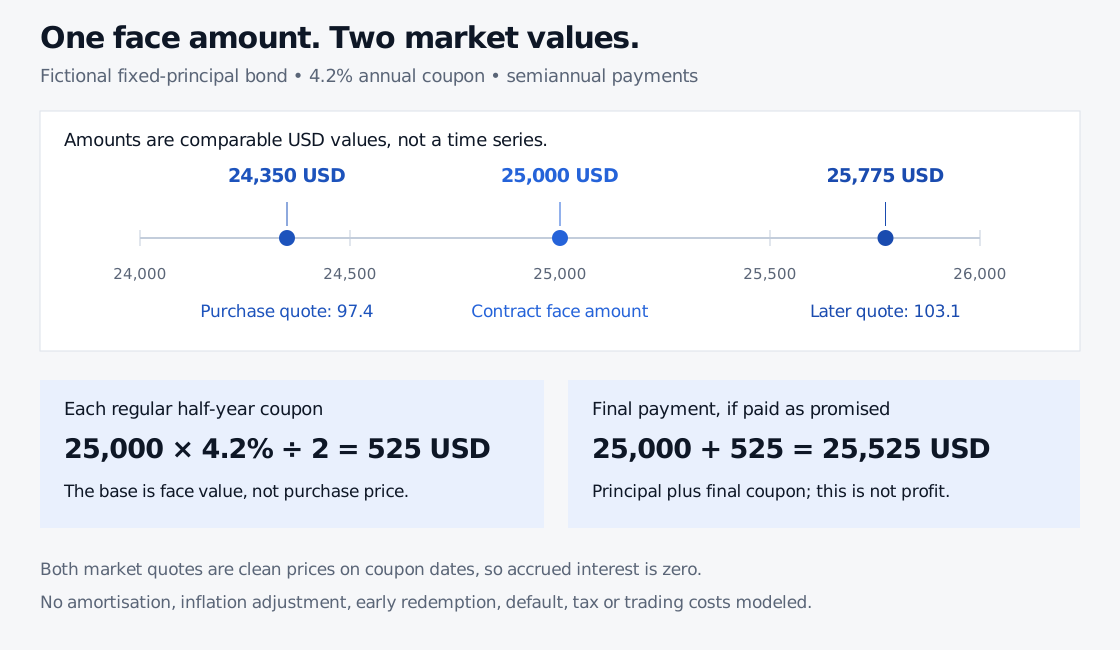
Original fictional example. The number line compares amounts rather than showing their evolution through time. The two market quotes are stipulated; neither is observed market data.
The coupon uses the face amount
Suppose the bond has a 4.2% annual coupon, paid in two equal regular installments a year. Daniel receives
per regular half year if the issuer pays as promised. Applying the coupon rate to the 24,350 USD purchase price would produce the wrong contractual payment. Price affects yield; it does not reset this fixed coupon.
For this bond, the final scheduled payment contains 25,000 USD principal plus a 525 USD coupon, totaling 25,525 USD. That payment is not profit: most of it returns principal, and the investment also had an initial purchase cost and earlier dated coupons. Present value compares those dated amounts; yield to maturity summarises their relation to the purchase price under a stated convention.
Read the contract before treating face as a fixed payoff
The example excludes features that change principal payments. An amortising bond repays principal over time. Early-redemption terms can specify a payment different from par. Inflation-linked principal can change: TreasuryDirect explains how TIPS principal adjusts and how its maturity floor works. The original face amount, current outstanding principal and actual redemption payment need not all be identical for every instrument.
Face is also a contractual reference, not protection against credit risk. If a company defaults, recovery can be lower than the amount owed; the SEC's corporate bond introduction discusses that payment risk. Even full nominal repayment does not guarantee preservation of purchasing power.
Finally, this page concerns bond par value. A stated par value attached to a share is not a bond-like maturity repayment promise. Common stock is an ownership interest, as the SEC's stock introduction explains.
For a worked transition from principal and coupons to valuation, read SelfMadeQuant's Bonds and Yields lesson. Its public page is a preview; the full lesson requires membership. For the smallest next step, coupon rate explains the payment base, while bond yield explains the role of purchase price.
References
- Frank J. Fabozzi, Bond Markets, Analysis, and Strategies, 9th ed., Chapter 1, “Principal and Coupon Rate”: principal terminology and coupon base.
- FINRA, Bonds, pricing and glossary sections: par, premium/discount and price quotations.
- SEC Investor.gov, Corporate Bonds and Stocks — FAQs: debt obligations, default risk and equity ownership.
- U.S. Treasury, Treasury Inflation-Protected Securities: adjusted principal and maturity repayment terms.