A broker arranges or executes transactions for a client as an agent. For a quantitative strategy, that makes the broker part of the path from an order to an actual fill: the price, quantity and fees recorded in the account can differ from a backtest's intended trade.
Whose account is taking the trade?
The central distinction is agent versus principal, rather than the name on the trading app.
| Capacity | What the firm does in that transaction |
|---|---|
| Broker, acting as agent | Handles a client's transaction with another buyer or seller. |
| Dealer, acting as principal | Buys or sells for its own account, becoming the client's trading counterparty. |
A securities firm can do both, which is why broker-dealer is a common U.S. term. A dealer can hedge or offset a position quickly; holding inventory for a long time is not what makes a trade principal. The SEC's registration guide explains the U.S. distinction. Legal definitions, permitted activities and duties vary across jurisdictions and instruments.
An agency broker need not be the exchange or the seller. It may route an order to a venue or another executing firm. Accepting the order does not guarantee a fill. Execution also differs from clearing, settlement and custody; the account provider may arrange those services through other entities. The Market Participants lesson traces these separate jobs (membership; public preview).
A commission is cash out, even at an unchanged price
Consider a hypothetical agency purchase of 10 shares at USD 100 each, with a separately charged USD 2 commission. Stipulate a complete fill and completed payment, with no tax, financing or other fees. The account starts with USD 1,002 cash and no shares.
The stock purchase uses USD 1,000. Total cash paid is USD. The commission does not buy extra shares.
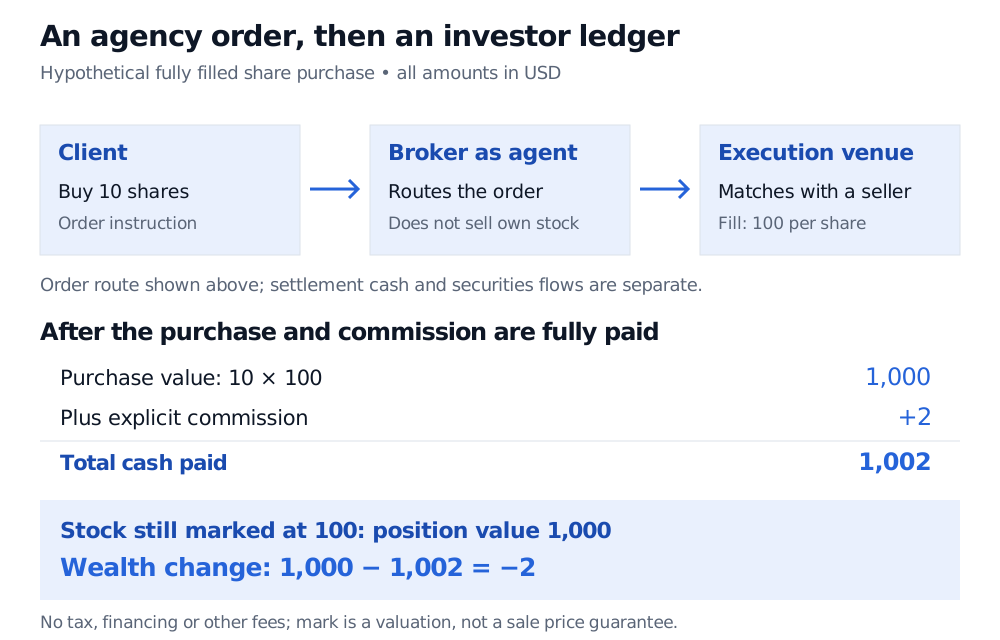
Original synthetic agency-trade example. Arrows show the order route, not settlement transfers. All monetary amounts are USD; the final mark is an accounting valuation.
After payment, the account contains zero cash and 10 shares. If each share is still marked at USD 100, account wealth is USD 1,000, so the wealth change is USD. That is a cost already incurred, although the shares have not been sold. A future sale could incur additional costs and need not achieve the mark.
The cost-ledger lesson develops this accounting for backtests (membership; public preview). Its useful distinction is between costs embedded in a fill price and charges deducted separately: do not deduct the same friction twice.
Evaluate the service and the execution
Brokerage services can involve commissions and other account or service charges; the account agreement determines the offered services and fees. Zero commission alone does not establish zero transaction cost: spread, price movement and incomplete execution can still matter.
For U.S. FINRA members, Rule 5310 requires reasonable diligence to seek the best market under prevailing conditions. Its execution-quality review considers price, speed, execution likelihood, size and transaction costs. That obligation is not a promise of the best price observed later, and applies to covered agency and principal transactions.
For a strategy, compare the actual fills, fees and unfilled quantity with the intended order. The broker's role is to provide the agreed market service; it does not turn a forecast into a profitable trade.
Sources
- SEC: Guide to Broker-Dealer Registration, sections II.A–B — U.S. agency/principal distinction; older guidance used here for that distinction.
- SEC Investor.gov: Brokers — brokerage services, compensation and account agreements.
- FINRA Rule 5310: Best Execution and Interpositioning — current rule text, especially paragraphs (a), (e) and Supplementary Material .09.
- Rishi K. Narang, Inside the Black Box: A Simple Guide to Quantitative and High-Frequency Trading, 2nd edition, Wiley, 2013, Chapter 5, pp. 80–81 — commissions and fees as distinct trading-cost components. Numerical example is original and synthetic.