A clearing house is a shared institution or processing arrangement through which participants exchange and process instructions for payments, securities or derivatives transactions. It helps establish what must be delivered before settlement. For a trading desk, that distinction matters: an agreed, checked payment obligation is not yet cash received.
Some clearing houses also provide settlement services. Some act as a central counterparty, taking on obligations to the trading parties. Those are additional functions, rather than consequences of the name alone. The ECB’s clearing-house definition explicitly distinguishes a common processing mechanism from one that acts as a CCP.
From trade records to payment instructions
Several different jobs can sit inside a clearing workflow:
| Job | Question it resolves | What the result establishes |
|---|---|---|
| Confirmation | Do the parties agree on the transaction’s terms? | Verified terms, such as amount, instrument and settlement date |
| Reconciliation | Do records on each side agree? | Matched records, with discrepancies identified for resolution |
| Netting, where permitted | Which eligible obligations can be offset? | Net positions or payment instructions under the applicable arrangement |
| Settlement | Has the required transfer or discharge actually completed? | Completed delivery or payment, with finality determined by the governing rules and law |
These jobs need not be performed by one institution or as a single uninterrupted sequence. Clearing can prepare gross instructions without netting them. For securities, settlement also involves delivery of the securities, not just the cash leg. The PFMI’s description of securities processing, Annex D, separates matching, clearing and final transfers.
USD 80 against USD 30
Consider two participants, A and B. A owes B USD 80; B owes A USD 30. Assume the amounts are due together, in the same currency, and legally eligible for bilateral payment netting under their agreement. Ignore fees, interest and default. This example isolates one pair of participants; it does not assume a multilateral netting system or a CCP.
Both parties’ ledgers must agree:
| Participant | Payable (USD) | Receivable (USD) | Net cash change after full payment (USD) |
|---|---|---|---|
| A | 80 | 30 | −50 |
| B | 30 | 80 | +50 |
Gross settlement would transfer USD across the two payments, counting each outgoing payment once. Eligible payment netting instead produces one USD 50 payment from A to B. A pays ; B receives .
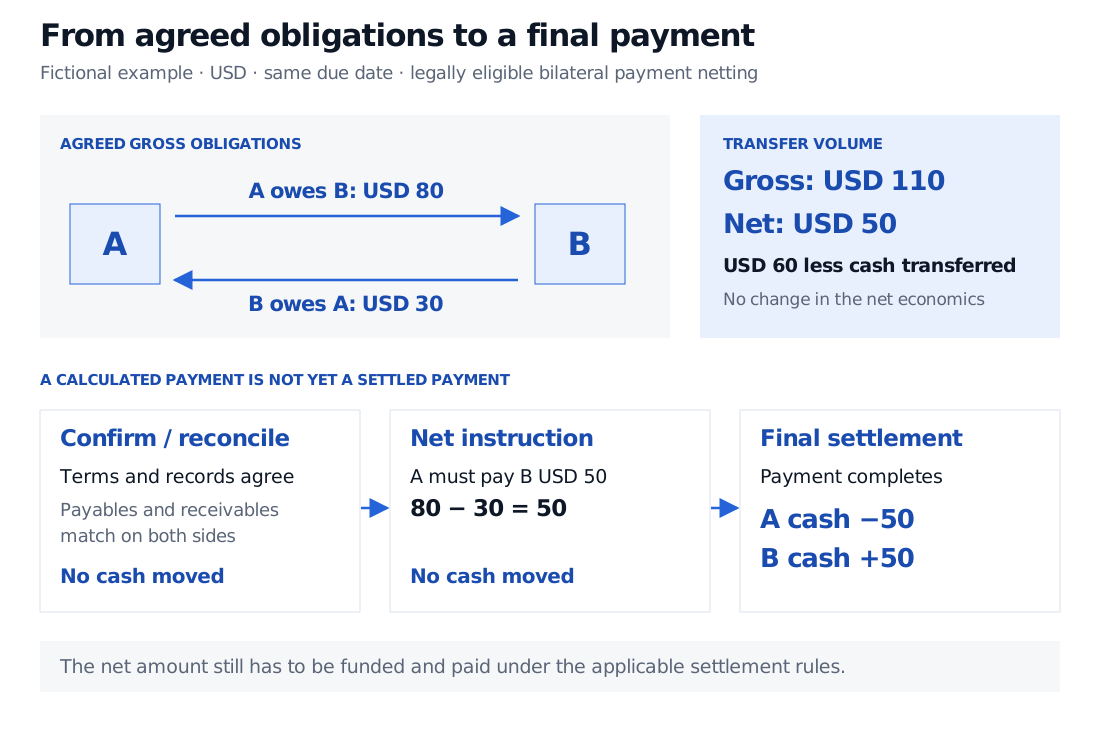
Original illustrative ledger. Same currency, common due date and legally eligible bilateral payment netting are assumed. The USD 50 instruction still has to be funded and settled; calculation alone does not transfer cash.
Payment volume falls by USD 60, but neither participant earns USD 60. Their net economics are unchanged. Nor is USD 110 necessarily the initial funding needed for gross settlement: that depends on payment order, whether incoming money can be reused, and available intraday credit. Payment volume and liquidity requirements are different quantities.
The eligibility assumptions do real work. Different currencies, different payment dates or different legal netting sets cannot simply be combined because a spreadsheet contains opposite signs. Payment netting also differs from close-out netting, which applies after specified termination events and concerns the resulting close-out obligations. PFMI Principle 1, §3.1.7 stresses the legal enforceability of netting arrangements.
When the clearing house is also a CCP
A CCP becomes a counterparty to accepted contracts: it stands between the selling and buying sides rather than merely comparing their instructions. That role requires controls for the resulting credit risk, including margin and default-management arrangements. Hull’s futures-market discussion describes this clearing-house role and how brokers access it through members.
The wider clearing-house concept also covers payment infrastructure. For example, the Federal Reserve’s FedACH Origination and Receipt service distributes ACH files and provides file-status, amount and item-count checks, together with settlement information. Processing a payment instruction is a different function from becoming the buyer or seller of a derivative.
Execution venue is a separate choice again. Exchanges and OTC Markets explains how an OTC trade may be centrally cleared or remain bilateral. The full lesson requires membership; the linked page offers a public preview.
For a quant or operations analyst, the practical safeguard is to keep agreed obligations, pending instructions and settled cash distinct. In the example, calculating USD 50 does not justify recording a completed USD 50 receipt for B. The settlement system’s rules must establish when the payment is final. PFMI Principle 8 treats final settlement as a legally defined moment, rather than a synonym for a successfully matched record.
Check the payment date
A owes B USD 95 today, and B owes A USD 40 tomorrow. Their agreement permits payment netting only for amounts in the same currency due on the same date. There are no other obligations. Can A pay USD 55 today and treat both obligations as settled?
Answer. No. A must pay USD 95 today; B must pay USD 40 tomorrow. The across-date difference is USD 55, but the agreement does not make it today’s payment or discharge tomorrow’s obligation. The date restriction prevents the offset even though the currency matches.
Sources
- John C. Hull, Options, Futures, and Other Derivatives, 9th Global Edition, Pearson, 2018, Chapter 2, §§2.4–2.5, pp. 54–55: the futures clearing house, members, CCPs and bilateral arrangements. The payment ledger and date-check question above are original.
- ECB: Payments and markets glossary — C, entries “clearing”, “clearing house”, “confirmation” and “close-out netting”: processing roles and the distinction between a clearing house and a CCP.
- CPSS–IOSCO: Principles for Financial Market Infrastructures, April 2012, Principle 1 §3.1.7, Principle 8 and Annex D: enforceable netting, settlement finality and the stages of securities processing.
- Federal Reserve Financial Services: FedACH Origination and Receipt: payment-file delivery, reconciliation information and settlement information.