A central counterparty (CCP) is a clearing institution that becomes the counterparty to accepted trades, standing as buyer to the selling side and seller to the buying side. It replaces exposure between the original counterparties with obligations involving the CCP. For a trading desk, this changes whom it faces, how it posts margin, and what happens if a clearing member defaults. It does not remove market losses or make the clearing system risk-free.
The contract changes, not the market exposure
A common legal mechanism is novation: the original contract is discharged and replaced by contracts between the CCP and the respective clearing participants. ASX Clear’s explanation describes this mechanism for Australian cash equities. Other arrangements use an open offer, under which the CCP becomes counterparty when a qualifying trade is executed. The applicable rulebook and legal framework determine when and how the CCP takes on the obligation; “every trade is later novated” is not a universal description. See the PFMI legal-basis guidance, §3.1.8.
Execution and clearing are separate functions. An exchange brings trading interests together; a CCP takes on and manages the relevant post-trade obligations. Central clearing also serves eligible over-the-counter derivatives, so it is not synonymous with exchange trading.
A clearing member is not the same as a client. A member has a direct relationship with the CCP and must meet its participation and payment requirements. A client typically clears through a member, sometimes through further intermediaries. The client’s contractual exposure, collateral protection and ability to transfer positions depend on that arrangement and applicable law. Segregation and portability help protect clients, but central clearing alone does not guarantee uninterrupted access or immediate recovery of their collateral. PFMI Principle 14 addresses those protections and their constraints.
Follow one settlement payment
Consider one fictional, linear, USD cash-settled futures contract representing 100 underlying units. The long enters at 100 USD per unit; the next settlement price is 101. Ignore fees and interest. Isolate this trade from all other positions, assume both sides pay in full, and assume members pass the cash through to clients immediately.
The initial notional amount is USD. The long’s settlement gain is
The short pays USD 100. In the simplified route below, its member pays the CCP, the CCP pays the long’s member, and that member credits the long client. Actual member calls reflect the relevant clearing portfolios, and client payment timing can differ. CME’s mark-to-market introduction explains how futures price changes become daily gains and losses.
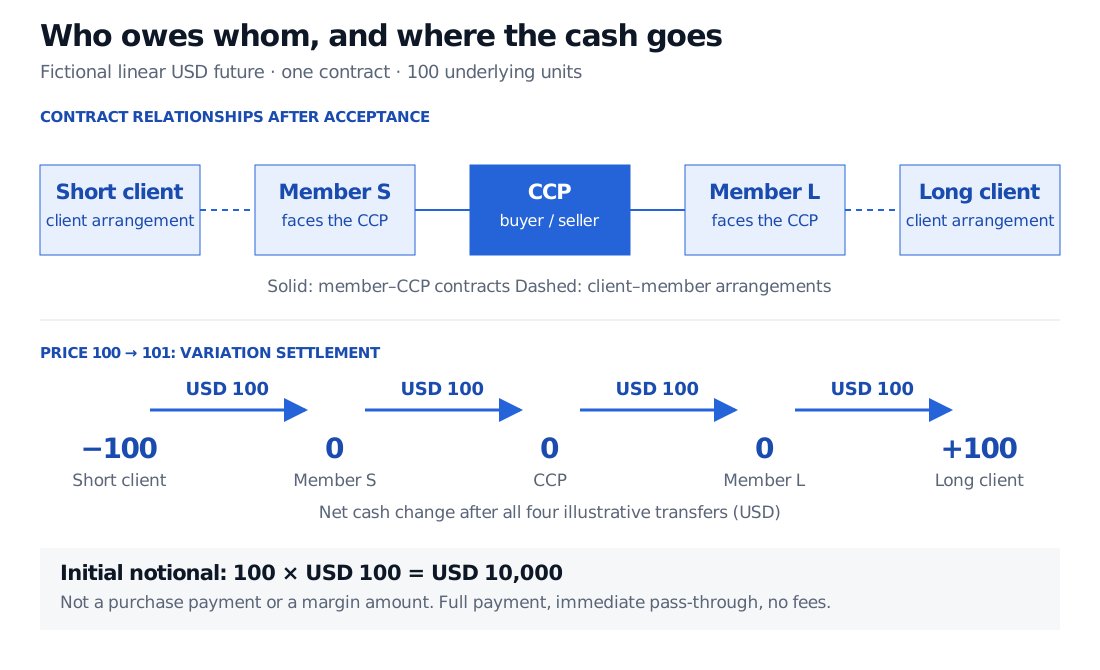
Original illustrative clearing route. Solid links show member–CCP contracts; dashed links show client arrangements. The cash row assumes full payment and immediate pass-through, with no fees. Intermediate zero net transfers do not imply an absence of risk.
The USD 10,000 notional is neither an upfront purchase payment nor the amount of initial margin. No margin requirement has been specified here. The USD 100 is the day’s variation margin, or settlement variation, for this fictional future. Collateral against future close-out losses and cash settling today’s gain or loss serve different purposes.
For more detailed account mechanics, Margin and Collateral develops futures funding, bilateral collateral and CCP protection. The full lesson requires membership; its public page provides a preview.
What if the short member cannot pay?
The CCP cannot rely solely on receiving the matching payment. After a member defaults, it may need to hedge, auction, transfer or close out positions while meeting obligations to surviving members. Market moves during that process can consume collateral, and payments can come due before assets can be turned into cash. The RBA’s account of CCP financial risks separates these credit and liquidity exposures.
Risk controls therefore work together: membership standards, position monitoring, initial and variation margin, liquid resources and default-management procedures. A default waterfall specifies how available resources bear losses. It can include the defaulter’s margin and default-fund contribution, CCP capital and mutualised member resources; the exact order and further obligations are rulebook-specific. Member contributions to a default fund are distinct from the CCP’s own capital, often called its skin in the game. The RBA’s discussion of CCP incentives explains that distinction.
For a quant, the implication is practical: model the cleared exposure and its funding demands. Credit risk is managed and redistributed; margin calls create liquidity needs, and client, member, settlement-bank and operational dependencies remain. A CCP’s normally matched trading obligations are a starting point for risk management, not proof that it cannot suffer losses.
Sources
- John C. Hull, Options, Futures, and Other Derivatives, 9th Global Edition, Pearson, 2018, Chapter 2, §§2.4–2.5, pp. 54–55: clearing members, margin, guaranty funds and client access. The numerical example and diagram above are original.
- CPSS–IOSCO: Principles for Financial Market Infrastructures, April 2012, §3.1.8 and Principles 6, 13, 14 and 19: legal interposition, margin, default management, client protections and tiered participation.
- ASX: Clearing: novation and the distinction between trading and clearing participants.
- CME Group: Mark-to-Market: settlement prices and daily futures cash flows.
- RBA: Sources of Financial Risk for Central Counterparties, September 2016: liquidity mismatches, close-out exposure and dependencies on other institutions.
- RBA: Skin in the Game — Central Counterparty Risk Controls and Incentives, June 2015: participant resources, CCP capital and loss-allocation incentives.