An over-the-counter (OTC) market is a market in which participants trade through a network of counterparties, often dealers, rather than through an organised exchange. For a company hedging a particular payment, the useful feature is the ability to agree an amount, delivery date and settlement terms that fit its exposure. For the quant valuing that hedge, those terms and the counterparty arrangement are part of the position.
OTC describes a market structure, not one asset class. Bonds, foreign exchange and derivatives can trade OTC. Nor does the label mean that every transaction is bespoke or arranged by telephone: standard products can trade on electronic platforms. The BIS’s account of FX execution describes dealer platforms, requests for quotes and anonymous order books within the OTC FX market.
Start with the cash flow that needs a match
Suppose a US company must pay a supplier EUR 1 million on a particular future date. It agrees a synthetic, deliverable forward contract with a bank to buy exactly that amount on that date at 1.12 USD per EUR. These are illustrative contract terms, not a live quote or a claim that 1.12 is today’s fair forward rate.
The company’s delivery ledger is fixed:
| Currency | Company’s contractual flow | Bank’s opposite flow |
|---|---|---|
| EUR | Receives 1,000,000 | Pays 1,000,000 |
| USD | Pays 1,120,000 | Receives 1,120,000 |
The notional amount of EUR 1 million sets the scale. Multiplying it by the delivery rate gives the dollars owed; it does not calculate the contract’s value at inception. That valuation would require the relevant market forward rate, discounting and contractual assumptions.
At delivery, suppose the spot exchange rate is 1.15 USD per EUR. The euros received are then worth USD 1,150,000 at spot. Relative to buying them at that rate, the company benefits by
This is the delivery-date economic benefit before fees, funding costs and counterparty loss. The contract still requires the two gross currency deliveries; the company does not merely receive USD 30,000 under these deliverable terms.
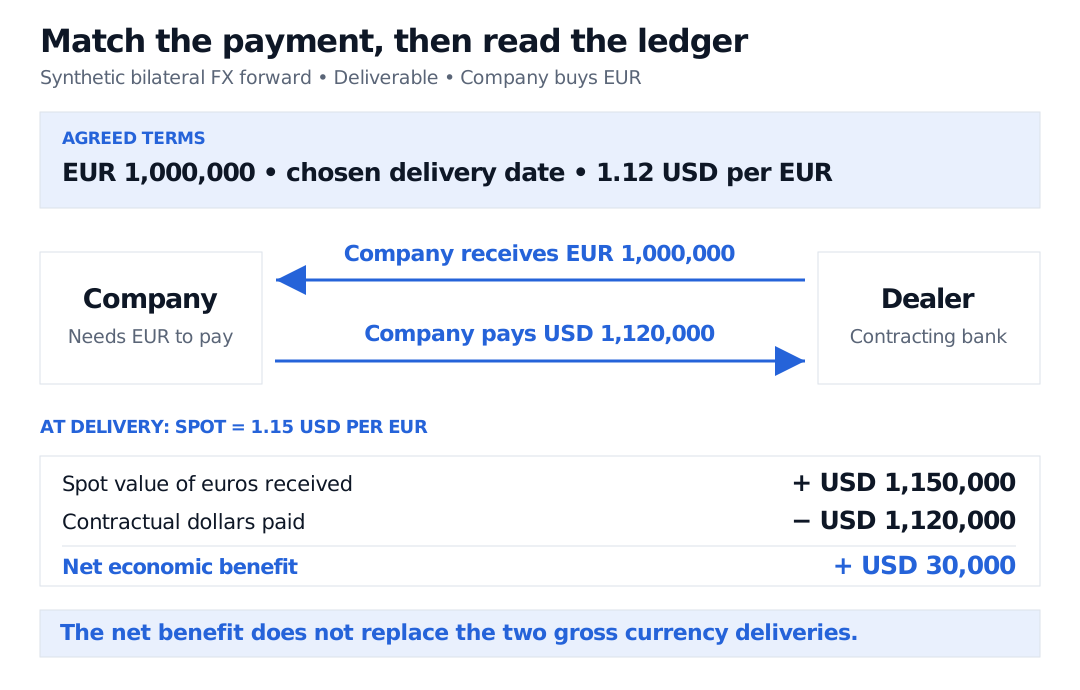
Original synthetic delivery ledger. A spot-valued net benefit and the contractual currency payments answer different questions.
If spot instead finishes at 1.10 USD per EUR, the company pays USD 20,000 more than the spot cost of the euros. A forward is a binding obligation, not an option to choose the better rate later. The hedge’s purpose is to fix the dollars required for the supplier payment. The free-account lesson Forwards and Futures develops this payoff and cash-flow timing; the full lesson requires a signed-in free account.
The dealer need not want the company’s opposite exposure
The company does not have to find another business with an equal and opposite supplier payment. A dealer can take the other side, quote a price and manage its resulting inventory or hedge elsewhere. The dealer’s own hedge is a separate transaction; it does not rewrite the company’s agreed payment.
Customisation can reduce the mismatch left by fixed futures contract sizes and dates. It can also make an exact offset harder to find later. A company comparing offers should therefore compare the same amount, date, quote direction and settlement terms, then consider the bid–ask spread, collateral funding and cost of terminating or replacing the trade. A tailored hedge can fit precisely while remaining expensive to unwind.
Follow the obligation after the trade
Execution agrees the transaction. Clearing determines how the resulting obligations are managed. An electronic OTC trade can remain bilateral; an eligible OTC derivative can be centrally cleared.
| Arrangement | What the risk analysis must follow |
|---|---|
| Bilateral derivative | The contractual counterparty, enforceable netting terms, collateral, exposure changes and close-out provisions |
| Centrally cleared derivative | The central counterparty, clearing member or intermediary chain, margin calls and default procedures |
In the EU, for example, ESMA describes clearing obligations for certain OTC derivative classes and risk-mitigation requirements for non-centrally cleared contracts. Which requirements apply depends on the product, counterparties and relevant rules; “OTC” alone cannot determine the answer. This example’s bilateral route is a stated scenario, not a universal rule for FX transactions.
Counterparty risk matters when the promised performance is valuable to you. Collateral and netting can reduce exposure; central clearing changes where risks and funding demands sit. Neither arrangement prevents the market from moving against the hedge. The membership lesson Exchanges and OTC Markets examines this choice between contract fit, trading cost and management of the resulting obligations.
Sources
- John C. Hull, Options, Futures, and Other Derivatives, 9th Global Edition, Pearson, 2018, §1.2, pp. 25–27, and §1.3, pp. 28–29: OTC participants, bilateral and central clearing, forward delivery and terminal payoff. The EUR/USD example here is original and synthetic.
- Randall Dodd, IMF: Financial Markets—Exchange or Over the Counter: dealer networks and customer/interdealer markets.
- BIS: The FX Trade Execution Landscape through the Prism of the 2025 BIS Triennial Survey: electronic and voice execution, platforms and counterparty exposure in OTC FX.
- ESMA: Clearing Obligation and Risk Mitigation Techniques under EMIR: EU central-clearing and non-cleared risk-mitigation framework; applicable classes and counterparties require separate identification.