See how a dealer trades as principal, read its bid and ask from the correct side, and distinguish a matched spread gain from exposed inventory and net profit.
Dealer
A dealer is a market intermediary that buys and sells financial instruments for its own account, acting as principal. When you trade with a dealer in that capacity, the dealer becomes your counterparty. For a quant, this changes the accounting: fills alter the dealer’s own cash, inventory and risk, rather than merely generating a fee for arranging someone else’s trade.
A role in the transaction
A broker acts as an agent for a client; a dealer trades as principal. One securities firm can perform both roles, so the label broker-dealer does not tell you the capacity in a particular transaction. Nor must a dealer keep the position for a long time: it can offset or hedge a trade quickly.
Market making—offering prices at which others can trade—is an important dealer activity. But “dealer” and “continuously quoting market maker” are not interchangeable descriptions of every business or transaction. A dealer can transact in response to a request for a quote rather than maintain a continuously displayed market.
The SEC’s registration guide explains the U.S. securities distinction and separates dealing as a business from ordinary investing or trading for one’s own account. Simply owning a portfolio does not make an investor a dealer. Legal definitions and obligations depend on jurisdiction, instruments and activities.
The Market Participants lesson puts these roles alongside venues, clearing and custody (membership; public preview).
Read the quote from the dealer’s side
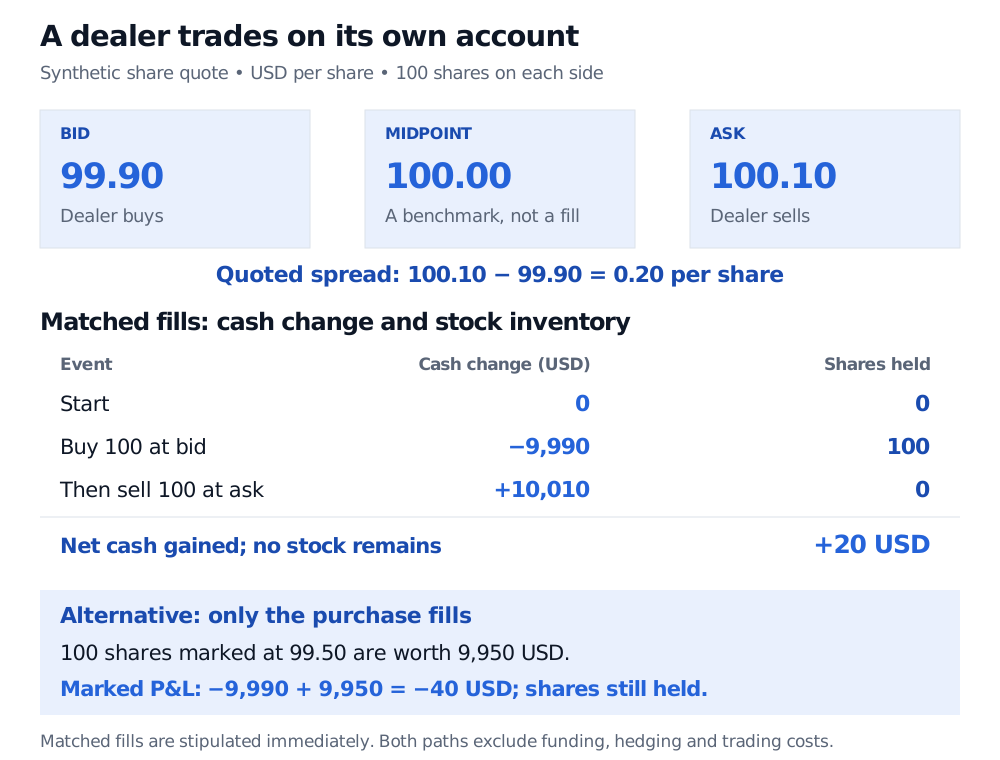
Suppose a dealer quotes a hypothetical stock at USD 99.90 bid / USD 100.10 ask, for 100 shares on each side.
Bid: the dealer is willing to buy. A customer selling to this quote receives USD 99.90 per share.
Ask, or offer: the dealer is willing to sell. A customer buying from this quote pays USD 100.10 per share.
The bid-ask spread is 100.10−99.90=0.20 USD per share. The midpoint is (99.90+100.10)/2=100.00 USD. It is a reference price; this quote does not promise a trade at the midpoint.
Now stipulate that the dealer buys 100 shares at its bid and immediately sells the same quantity at its ask. There is enough executable quantity for both trades, and we exclude fees, funding and hedging costs.
Synthetic dealer bid 99.90, midpoint 100 and ask 100.10 USD per share. Buying and then immediately selling 100 shares gives a gross USD 20 cash gain and zero inventory. If only the purchase fills and the mark falls to 99.50, marked P&L is minus USD 40 with 100 shares still held.
Original synthetic dealer ledger in USD. Matched fills are stipulated immediately, with enough quantity on each side. The alternative branch has no sale. Both exclude trading, funding and hedging costs; cash figures are changes from opening cash.
The purchase uses USD 9,990 and the sale brings in USD 10,010. The difference is USD 20 gross, with no shares left from these trades. The negative purchase cash change is a debit relative to opening cash, not a claim that the dealer can buy without capital or funding.
The second customer may never arrive
The ledger’s matched sale is an assumption, not something a positive quoted spread guarantees. A customer may sell to the dealer while no customer buys from it. The dealer then owns inventory whose value can fall.
In the figure’s alternative branch, only the purchase fills. If the 100 shares are subsequently marked at USD 99.50, their marked value is USD 9,950. Gross marked P&L is
100(99.50−99.90)=−40 USD.
The shares are still held: this is an unrealised valuation loss, and a later sale need not achieve that mark. The displayed USD 0.20 spread has not become USD 20 of profit.
Inventory risk can arise from ordinary price moves. Adverse selection adds a different problem: the people choosing to trade may have information that makes the dealer’s quote stale. A dealer can buy below the old midpoint and still pay too much relative to updated value. Receiving a fill can itself be informative.
Net results also reflect transaction costs, funding and hedging. The BIS account of market-making economics separates facilitation revenue from inventory returns and explains why inventory, funding and hedging conditions affect quotes. Quoted spread, gross trading gain and net profit answer different questions.
Put the quote on your own account
The Market-making game lets you practise the principal’s decision using a fictional contract based on dice or cards. Quote bid and ask, then watch whether a fill makes you longer or shorter. Adjust as information arrives and inspect the settlement breakdown.
This is an information and inventory exercise, not a replay of the stock ledger above or an equity order book. Guests can preview play until the second public reveal; a free signed-in account unlocks the game through settlement.
Sources
SEC: Guide to Broker-Dealer Registration, sections II.A–B — U.S. broker/dealer distinction and the distinction between dealing as a business and ordinary own-account trading. Older guidance used for these concepts, not as a complete statement of current registration requirements.
Rishi K. Narang, Inside the Black Box: A Simple Guide to Quantitative and High-Frequency Trading, 2nd edition, Wiley, 2013, Chapter 7, pp. 122–123 — passive fills, execution uncertainty and adverse selection. Numerical scenarios are original and synthetic.