The economic service is immediacy: a customer can trade against the maker without waiting for another customer with exactly the opposite requirement. In return, the maker seeks compensation for supplying that immediacy, carrying inventory and sometimes trading against better-informed counterparties. A positive quoted spread is an opportunity to earn revenue, not a guarantee of profit.
A quote is not a completed round trip
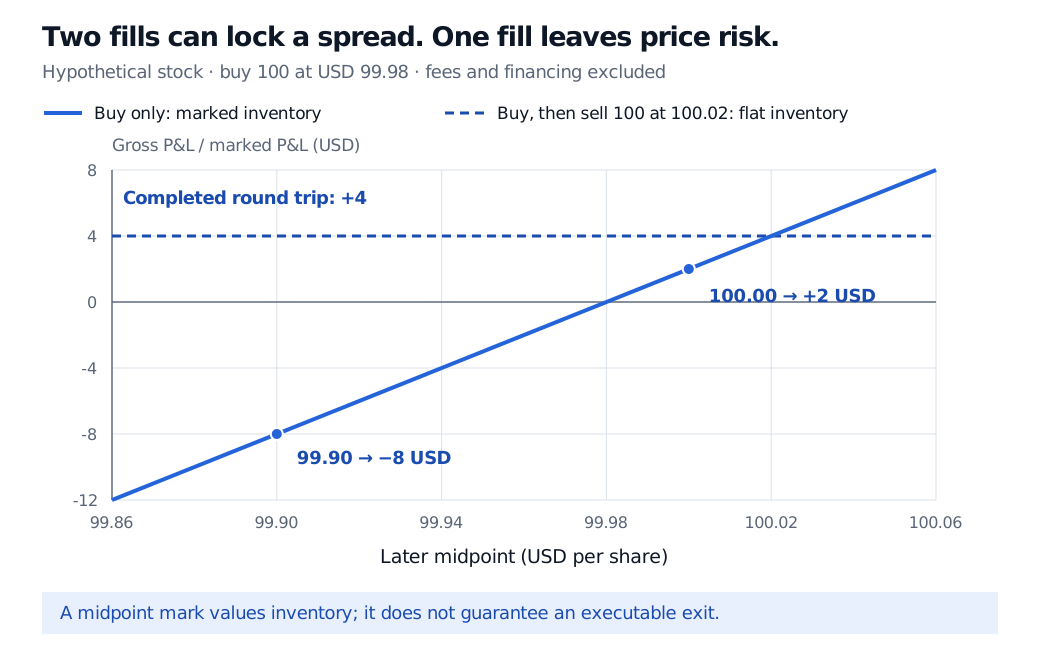
Two different outcomes illustrate the business:
| What actually happens | Cash change (USD) | Final shares | Gross result |
|---|---|---|---|
| Buy 100 at the bid, then sell 100 at the ask | −9,998 + 10,002 = +4 | 0 | USD 4 realised trading profit |
| Buy 100 at the bid; still hold them when the midpoint becomes 99.90 | −9,998 | 100 | USD −8 marked trading P&L |
In the first case, both specified fills occur. The matching quantities give
The second case has no completed sale. The maker owns stock marked at dollars after paying 9,998. Its marked profit and loss is therefore
The ask quote did not force somebody to buy. A resting limit order can remain unfilled, fill partially or become unattractive as the market moves. An actual sale to unwind the stock could occur at a different price from the midpoint, with further costs.
Keep a cash ledger and an inventory ledger
For an initially flat maker, let be cumulative trading cash flow, its signed share inventory and the current midpoint. Before costs, the incremental marked trading result is
A purchase of shares at bid reduces cash by and increases inventory by . A sale at ask adds to cash and reduces inventory by . For other instruments, contract multipliers and settlement conventions must also enter the accounting.
This is why trading volume, spreads and net profits must be measured separately. More fills can increase revenue while increasing exposure to unfavourable price moves.
Why a fill can be bad news
The one-sided purchase initially looks favourable against the 100.00 midpoint: it buys two cents below that benchmark. Its later loss can be decomposed as
per share, with the decision-time information and bid held fixed. Multiplying an unconditional average price change by an assumed number of fills misses the selection mechanism.
Adverse selection occurs when the counterparties choosing to trade are systematically more favourable to themselves than the maker's valuation allowed for. For example, a trader with faster information about a fall in value may sell into a bid that has not yet adjusted. The maker bought below the old midpoint but above the value implied by the new information.
An unfavourable markout on one trade does not prove that the seller had private information. Public news, ordinary price uncertainty and hedging activity can also produce losses. Inventory risk exists even against uninformed flow: the maker can accumulate a position and then suffer an unrelated market move.
Quote width, quote centre and size do different jobs
A maker can respond to its state along several dimensions:
- Width: moving quotes farther apart seeks more compensation per fill, usually at the cost of less attractive prices and fewer executions. The relationship depends on competing quotes and order flow.
- Centre: a long maker may lower both quotes to make further buying less attractive and selling more attractive. A short maker may lean the other way. New information can also move the centre independently of inventory.
- Size: reducing the quantity offered on the side that increases an unwanted position limits additional exposure without requiring the same change in price.
Explore the information problem in the quoting game
Then try Standard or Toxic flow: their insider-arrival probabilities are 40% and 60%, versus 25% for Calm. Wider quotes reduce the game's uninformed trading probability, so protection can also reduce business. Outcomes remain random, and changing the flow starts a new game rather than replaying identical arrivals.
Guest play is limited; a free signed-in account unlocks completion through settlement. This is an interview-style information and inventory exercise. Its contract sizes and mechanics differ from the 100-share stock ledger above; it does not model exchange queues, equity funding or a full exchange market.
Sources
- John C. Hull, Options, Futures, and Other Derivatives, 9th edition, Global Edition, §10.5, “Trading”, subsection “Market Makers”. Used for bid/offer orientation and the intermediation role, not as a statement of current venue rules or a guarantee of continuous execution.
- Rishi K. Narang, Inside the Black Box, 2nd edition, Chapter 7, “Aggressive versus Passive”, and Chapter 15, “Contractual Market Making”. Used for passive-order uncertainty, allocation differences and inventory intermediation. The stock scenario and figure here are original.
- Lawrence R. Glosten and Paul R. Milgrom (1985), “Bid, ask and transaction prices in a specialist market with heterogeneously informed traders”, Journal of Financial Economics 14(1), 71–100. The checked publisher abstract establishes that asymmetric information can create a spread without positive expected dealer profits.
- Marco Avellaneda and Sasha Stoikov (2008), “High-frequency trading in a limit order book”, Quantitative Finance 8(3), 217–224, especially §§2.1–2.4. The model separates inventory-sensitive valuation from the likelihood of quote execution under stylised price and arrival assumptions.