A counterparty is the other party to a financial transaction or contract. If a company enters a swap with a bank, the bank is the company’s counterparty, and the company is the bank’s. The identity matters because an attractive contractual payoff is useful only if the obligations are performed.
The word identifies a relationship, not a type of institution. A bank, fund, company or individual can be a counterparty. It also does not mean “the person who introduced the trade.” A broker acting only as an agent may arrange a transaction without becoming the principal that owes its contractual payments. The Market Participants lesson separates these roles; its full text requires membership, with a public preview available.
The promise and the receipt can differ
Suppose A has an unsecured contractual claim on B for USD 100 payable in one year. For this synthetic example, stipulate:
- B has a 2% physical, or real-world, probability of default over the year.
- If B defaults, A recovers 40% of the claim, paid at the year-end date.
- Otherwise B pays in full. Ignore discounting, fees, collateral and A’s own default.
The recovery is USD 40, so the loss conditional on default is USD 60. The probability-weighted shortfall is
Equivalently, the expected receipt is
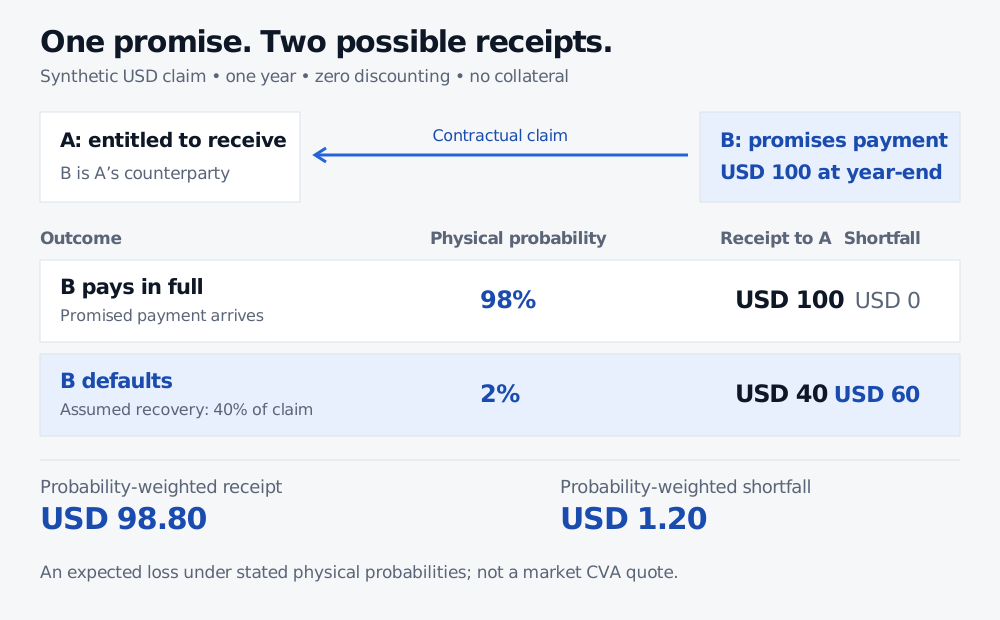
Synthetic one-year payment model with a stipulated 2% physical default probability and 40% recovery. Zero discounting makes the year-end amounts directly comparable.
The expected loss is an average across possible outcomes. In this model A receives either USD 100 or USD 40, never USD 98.80. Nor is USD 1.20 automatically a credit valuation adjustment (CVA), an accounting allowance or a quoted credit charge. Market valuation needs an appropriate pricing framework, including pricing probabilities and exposure timing; this example uses stipulated physical probabilities to explain a loss mechanism.
Counterparty quality is only one part of the risk
Counterparty credit risk concerns loss arising when the other party defaults or its creditworthiness deteriorates before the transaction is finally settled. In derivatives, the amount at risk can change with markets. The OCC’s supervisory explanation highlights that this risk can run in both directions.
Consider an uncollateralised forward contract. Its value may move in A’s favour after the trade is agreed. If B then defaults, A may lose the benefit of replacing that favourable contract. Before collateral and other adjustments, a simple current replacement-exposure measure is
where is the contract’s value to A. A negative value means A owes economic value on this contract rather than holding a positive replacement claim on B. It does not cancel A’s payment obligation or guarantee that all its other exposures are zero.
This separates three questions: who owes performance, how much is exposed, and how much would be recovered after default? The notional amount scales a derivative’s payments; it is not generally its current replacement exposure.
Market risk and counterparty risk interact but are different. An adverse market move can cause a trading loss even if everyone pays. A favourable move can increase the amount lost if a counterparty subsequently fails. When exposure tends to be high precisely when the counterparty is more likely to default, that dependence is called wrong-way risk.
For a concrete payment example, the Swaps lesson follows fixed and floating obligations and explains why an unchanged notional can accompany a changing contract value. The full lesson is available with a free signed-in account; visitors can read its public preview.
Protection changes the exposure; it does not remove the relationship
| Arrangement | What it changes | What still matters |
|---|---|---|
| Enforceable close-out netting | Combines covered positive and negative contract values into a net close-out amount | Which legal entities and trades are covered, and enforceability in the relevant jurisdictions |
| Collateral | Supplies assets against an exposure | Valuation, haircuts, transfer delays, access to assets and market moves before close-out |
| Central clearing | Interposes a central counterparty for accepted trades | The CCP, clearing-member and client arrangements, margin funding and default-management resources |
These protections reduce or redistribute risk. They do not justify assuming that every transaction with the same banking group can be netted, that collateral can always be liquidated immediately, or that a CCP cannot fail. Actual rights depend on the contract, governing law, insolvency regime and clearing rules.
The RBA describes a CCP as becoming the legal counterparty, typically through novation. A client’s precise contractual chain still depends on its clearing arrangement. Basel’s final counterparty-risk guidelines pair exposure mitigation with continuing due diligence and multiple risk measures. Knowing the counterparty remains necessary after a hedge is placed or collateral is collected.
Sources
- John C. Hull, Options, Futures, and Other Derivatives, 9th Global Edition, Pearson, 2018, §24.7, pp. 577–580: positive replacement exposure, CVA probabilities, netting, collateral and wrong-way risk.
- OCC, Counterparty Credit Risk Management: Interagency Supervisory Guidance: counterparty credit risk and bilateral loss exposure; US bank supervisory context.
- Basel Committee, Final guidelines for counterparty credit risk management, December 2024: due diligence, exposure mitigation and complementary risk measures.
- Reserve Bank of Australia, About Financial Market Infrastructure: the role of a CCP and the resilience of market infrastructure.