Collateral supports a financial obligation. Separate market value from haircut-adjusted value, calculate a top-up and see why collateral still leaves credit and funding risks.
Collateral
Collateral is cash or other assets made available as security for a financial obligation. If the party owing the obligation defaults, the collateral taker may use enforceable rights over those assets to recover what is owed. For a quant or treasury team, the practical question is how much usable protection the collateral provides—and how much funding its provider must find to maintain it.
Collateral appears in secured loans, repurchase agreements and derivatives margin arrangements. Its form matters: cash, government bonds and other assets are not interchangeable merely because their current market values are equal. An agreement specifies what is acceptable and how it is valued.
Three amounts that should not be confused
Suppose a hypothetical lender has a USD 9,500 exposure, secured by an asset with USD 10,000 market value. The agreement recognises this asset after a 5% haircut, applied to its current market value. Ignore interest, fees and currency changes throughout the example.
The collateral haircut is a valuation deduction intended to provide a buffer against value changes and liquidation uncertainty. As the ECB explains, the collateral may have to be sold after the borrower defaults, at a price different from its earlier mark.
For market value C and haircut h, define the amount recognised toward coverage as
A=(1−h)C.
Here A=0.95×10,000=9,500 dollars. The asset's market value is still USD 10,000; USD 500 is excluded from the coverage calculation. The exposure remains USD 9,500. Neither the haircut nor posting the asset repays that obligation.
Check the denominator. A 5% haircut means subtracting 5% of collateral value. It does not mean requiring collateral equal to the exposure plus 5% of the exposure. ICMA's repo explanation distinguishes a haircut quoted against collateral from an initial-margin ratio quoted against the cash advance.
A price fall creates a funding demand
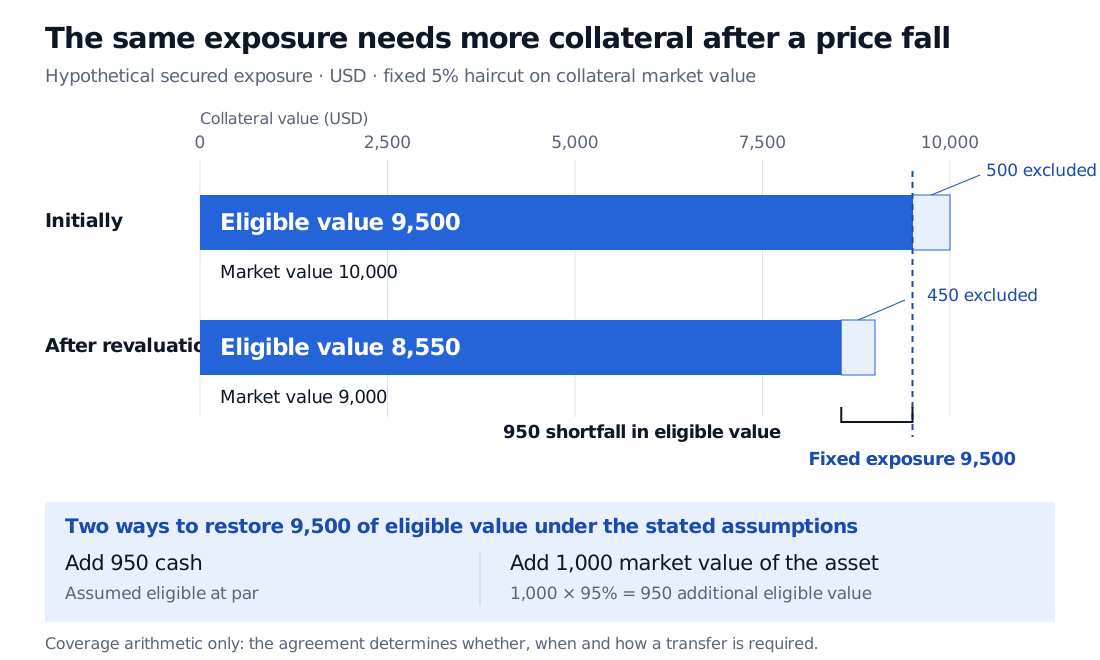
Now the pledged asset falls to USD 9,000, while the exposure and haircut remain unchanged.
Coverage ledger, USD
Initially
After revaluation
Collateral market value
10,000
9,000
Haircut deduction
500
450
Eligible value after haircut
9,500
8,550
Exposure to cover
9,500
9,500
Shortfall in eligible value
0
950
The shortfall is 9,500−8,550=950 dollars. If the agreement requires full restoration at this valuation, the provider could supply either:
USD 950 cash, assuming it is accepted at par without a haircut; or
USD 1,000 of additional asset market value, if the added asset receives the same 5% haircut: 1,000×0.95=950 dollars of eligible value.
These alternatives restore the same eligible amount. Adding USD 950 of the haircut asset would be insufficient. A collateral call's timing, threshold, minimum transfer amount, accepted assets and settlement rules depend on the agreement; a shortfall in this ledger is not a universal instruction to transfer cash immediately.
Fixed USD 9,500 exposure is initially covered by USD 10,000 assets after a 5 percent haircut. When market value falls to USD 9,000, eligible value falls to USD 8,550. The USD 950 shortfall can be filled by USD 950 par cash or USD 1,000 additional asset market value with the same haircut.
Original hypothetical coverage ledger, in USD. Exposure and haircut stay fixed; no interest, fees or exchange-rate changes. The transfer alternatives assume accepted collateral and no intervening value change.
The USD 950 is a coverage shortfall, not a realised default loss. Even before selling costs, the gap between the exposure and the asset's current market value is USD 500. Actual recovery depends on sale proceeds, enforceability and the rest of the default process.
To compare this secured-funding arithmetic with futures margin and bilateral derivatives collateral, see Margin and Collateral. The full lesson requires membership, with a public preview.
Protection depends on the asset and the agreement
A collateral process must track the exposure alongside valuations, haircuts and settled transfers. Exposure can rise while collateral prices fall; a call sent is not the same as collateral received. Assets that become harder to sell precisely when their provider becomes distressed create wrong-way risk.
The RBA's collateral standard for central counterparties addresses asset quality, stressed liquidation values, concentration and timely access. These are useful dimensions of collateral quality, although a particular loan or derivatives agreement has its own rules. A larger haircut reduces recognised value for a fixed holding and can increase the provider's funding requirement.
Ownership also depends on the legal structure. Under a pledge, the provider generally retains title subject to the security interest; under a title-transfer arrangement, legal ownership passes and the provider has a claim for the agreed return. Reuse and segregation are further contractual and legal questions. UNIDROIT's commentary distinguishes these arrangements; the word “collateral” alone does not settle them.
Collateral therefore manages credit risk, without eliminating it. Prices can move during close-out, transfers can fail or be disputed, and legal rights may be difficult to exercise. The provider also faces liquidity risk: having valuable assets does not guarantee that acceptable collateral can be delivered when required.
Sources
John C. Hull, Options, Futures, and Other Derivatives, 9th edition, Global Edition (Pearson Education Limited, 2018), Chapter 2, §2.5, pp. 55–57 — bilateral collateral, haircuts and the funding pressure of collateral transfers. The example here is original and hypothetical.
ECB: What are haircuts?, updated 30 June 2023 — haircut-adjusted collateral values and liquidation buffers.