A repurchase agreement, or repo, is an arrangement to sell securities for cash and repurchase equivalent securities later at an agreed price. Economically, it provides secured funding: a dealer can finance a bond position while keeping the obligation to buy the securities back. The financing cost can turn an otherwise profitable position into a losing trade.
In the private-market convention used here, the repo seller borrows cash and supplies securities; the buyer lends cash and takes the securities as collateral. The buyer describes the same transaction as a reverse repurchase agreement. “Reverse” identifies the other perspective; it does not, by itself, mean that an earlier trade has been unwound. ICMA’s definition explains this sale-and-repurchase structure.
Two exchanges, one funding cost
Consider a hypothetical USD term repo lasting 10 actual days. The seller receives USD 1,000,000 and delivers securities whose initial market value is USD 1,020,000. The parties agree on a simple annual repo rate of 1.8%, using ACT/360: actual elapsed days divided by 360. Assume normal settlement, no fees, no coupon payments and no interim collateral transfers.
The repurchase price is the cash advanced plus interest:
Here is the cash advance, the stipulated simple annual rate and the actual days. The seller pays USD 500 for funding. Repo interest accrues on the cash advanced. The repurchase cash price also does not promise that the securities’ market value will stay unchanged.
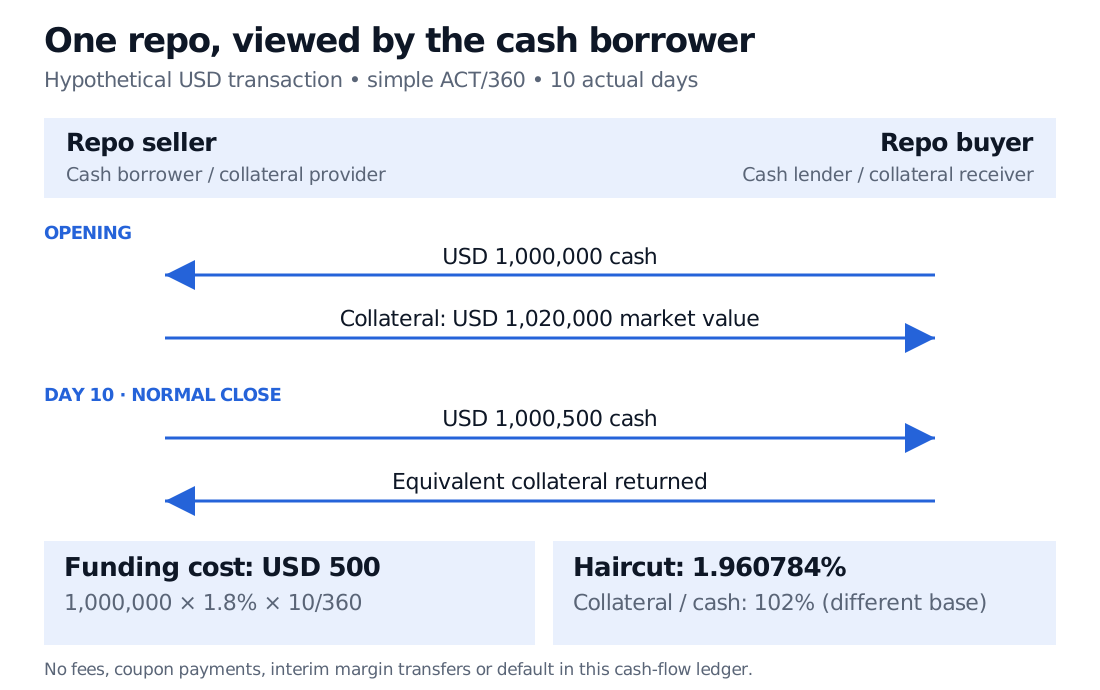
Original hypothetical USD funding ledger, viewed by the repo seller. Simple ACT/360 over 10 actual days; no fees, coupon payments, interim margin transfers or default. Arrows show transfer directions, not accounting debits and credits.
The rate and day-count convention belong to this example, not to every repo market. With a negative repo rate, the formula can produce a repurchase price below the initial cash advance. The Money Markets lesson connects this funding formula with bills and other short-dated instruments; its preview is public and the full lesson requires membership.
The haircut has a different denominator
A collateral haircut discounts collateral market value when determining cash advanced. Defining it as , where is collateral market value:
The same trade has collateral equal to 102% of cash. That is a 2% uplift on the cash amount, not a 2% haircut on collateral value. Neither percentage is the annual repo rate. ICMA’s haircut explanation distinguishes these quotation bases.
The buffer can disappear. If collateral falls 3% to USD 989,400 and the borrower defaults at maturity, hypothetical immediate liquidation at that value leaves USD 11,100 below the USD 1,000,500 due, before costs. This stress assumes no intervening margin transfers; it is not a prediction of a default recovery.
Secured funding still needs a survival plan
Collateral reduces exposure without removing counterparty risk. A lender needs accurate valuations, enforceable rights and a market in which to sell the collateral. A quoted value may exceed executable sale proceeds, particularly when the borrower and collateral issuer deteriorate together. ICMA’s risk discussion stresses these conditions.
The borrower faces liquidity risk, too. Revaluation can require additional collateral or cash at short notice. Repeated overnight funding can become expensive or unavailable before a longer-term bond position can be sold. A lender’s failure to return equivalent securities can also leave replacement exposure. A low agreed repo rate does not pay these contingent funding needs in advance.
“Sale” describes a legal mechanism, not an automatic accounting conclusion. Title-transfer arrangements commonly used in Europe differ from the legal protections used under New York law; the agreement and relevant jurisdiction matter. ICMA compares the two frameworks. Standard repos are generally accounted for as secured borrowing, with the securities remaining on the seller’s balance sheet, rather than as an ordinary disposal. The applicable accounting standard and transaction terms determine the treatment; ICMA’s accounting explanation separates that treatment from legal title.
Sources
- ICMA, “What is a repo?”: structure, perspectives and equivalent securities.
- ICMA, “What is a haircut?”: valuation base and buffer purpose.
- ICMA, “Is repo riskless?”: counterparty selection, collateral management and liquidation risks.
- ICMA, “Is repo in Europe the same as repo in the US?”: jurisdictional differences.
- ICMA, “Is repo used to remove assets from the balance sheet?”: financing accounting versus legal sale.
- John C. Hull, Options, Futures, and Other Derivatives, 9th edition, Global Edition, Pearson Education Limited, 2018, Chapter 4, §4.1, p. 101, “Repo Rates”: the basic secured-funding mechanism. The numerical example here is original.