A reverse repurchase agreement, or reverse repo, is a transaction in which a party buys securities for cash and simultaneously agrees to resell equivalent securities at a future date or on agreed demand terms. Economically, that party lends cash against collateral. A cash manager must assess both the cash return and protection against counterparty default.
The same agreement is a repurchase agreement from the securities seller’s perspective and a reverse repo from the securities buyer’s perspective. “Reverse” identifies the side of the trade; it does not mean that someone is unwinding an earlier repo. Under a title-transfer structure such as the Global Master Repurchase Agreement (GMRA), the buyer obtains legal ownership, subject to its obligation to deliver equivalent securities when the transaction ends. The economics resemble secured lending, while the legal form is a sale and later repurchase. ICMA explains this distinction.
Follow the lender’s cash
Consider a synthetic agreement with the following stipulated terms: USD 1,000,000 advanced today, securities with an initial market value of USD 1,020,000 received in exchange, and USD 1,000,500 paid back after 10 actual days. Assume performance as agreed, no fees, no collateral income and no intermediate margin transfers.
| Event | Cash lender / reverse buyer | Cash borrower / repo seller |
|---|---|---|
| Today: cash | Pays USD 1,000,000 | Receives USD 1,000,000 |
| Today: securities | Receives collateral worth USD 1,020,000 | Delivers that collateral |
| Day 10: cash | Receives USD 1,000,500 | Pays USD 1,000,500 |
| Day 10: securities | Returns equivalent securities | Receives equivalent securities |
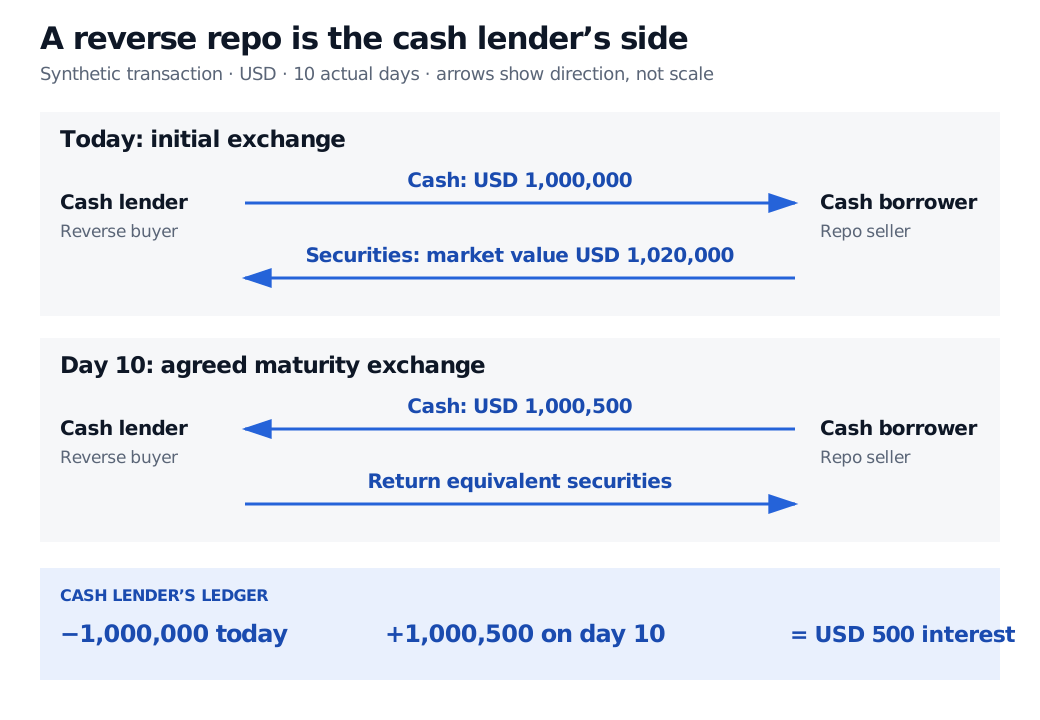
Original synthetic transaction in USD. Arrows show transfer direction, not size. The initial collateral value is separate from the agreed maturity cash payment; no unchanged future collateral price is assumed.
The lender’s net cash receipt is USD 500. Relative to the cash advanced, this is a 0.05% return over ten days. Under the agreement’s stipulated simple ACT/360 convention, the annual rate is
Equivalently, the interest is USD 1,000,000 multiplied by 1.8% and by 10/360. The interest base is the cash advanced, rather than the collateral’s market value. The day-count basis must be specified: ICMA’s 2025 guide, §2.4 relates it to the wholesale money-market convention in the cash currency, commonly actual/360 or actual/365 fixed. Our 1.8% is an illustrative contract rate, not a current market quote.
The extra collateral is a buffer, not income
Here the initial collateral exceeds the cash advanced by USD 20,000. Defining the haircut as the discount from collateral market value gives
Calling this a 2% haircut would use the wrong denominator. The collateral is 2% above cash, because USD 20,000 divided by USD 1,000,000 is 2%; the haircut divides that same buffer by USD 1,020,000. These are two ways of describing overcollateralisation, with different numerical values. ICMA’s haircut FAQ distinguishes the collateral-value deduction from an initial-margin ratio.
If the agreement performs, the lender returns equivalent securities and receives the agreed cash. It does not retain the USD 20,000 buffer as additional profit. To compare this buffer with futures margin and bilateral collateral, the Margin and Collateral lesson develops those mechanisms side by side. A public preview is available; the full lesson requires membership.
What can still go wrong?
Collateral reduces potential loss; it does not prevent default. Its protection depends on valuation, liquidity, timely margin transfers, settlement operations and enforceable close-out rights. A security can fall in value while the borrower deteriorates, creating wrong-way risk. Liquidating a large position during stress may also realise less than its last quoted value. ICMA’s risk FAQ explains why collateral complements counterparty credit analysis.
For a separate stress outcome of our example, suppose the borrower defaults when USD 1,000,500 is due and liquidation raises only USD 990,000 net of costs, with no earlier collateral top-ups. The shortfall against the contractual cash claim is USD 10,500, before any further counterparty recovery. The original USD 20,000 valuation buffer has not guaranteed full payment. Actual close-out amounts and recovery rights depend on the agreement and applicable law.
Read central-bank labels with the cash flows
The New York Fed calls its securities-sale-and-later-repurchase operations reverse repo operations. In those operations, an eligible counterparty supplies cash to the Fed and receives securities temporarily. The operation’s name should therefore be read with its stated institutional convention: identify who pays cash first. The Fed’s FAQ also says the temporarily sold securities remain SOMA assets under its accounting treatment. Legal transfer, economic funding and accounting presentation answer different questions. New York Fed: Reverse Repurchase Agreement Operations.
Sources
- John C. Hull, Options, Futures, and Other Derivatives, Ninth Edition, Global Edition, Pearson Education Limited, 2018, §4.1 “Repo Rates”, p. 101. Local grounding for the secured-funding cash-flow interpretation; current conventions and risk qualifications checked against the sources below.
- ICMA: What is a repo? — legal form, equivalent securities and the reverse-buyer perspective.
- ICMA: What is a haircut? — valuation base and collateral buffers.
- ICMA: Is repo riskless? — counterparty, collateral, operational and legal risks.
- ICMA ERCC Guide to Best Practice in the European Repo Market, March 2025, §2.4 — repo-rate day-count and annual-basis conventions.
- New York Fed: Reverse Repurchase Agreement Operations FAQ — the Desk’s operation terminology, cash direction and balance-sheet presentation.