Market value is the current monetary value of an asset or holding on a stated market valuation basis. For a holding of ordinary shares, it is usually calculated as the number of shares held times the chosen current price per share. It tells a portfolio manager how much capital is exposed to that holding; it does not tell the owner how much remains after borrowing is repaid.
The scope belongs with the number. “Market value” can describe one security, your holding, or all of a company's outstanding shares. FINRA's guide to investment value distinguishes market value from accounting and intrinsic valuations. A market valuation is not an analyst's conclusion about what an investment ought to be worth.
Put a time, quantity and price basis beside it
For a straightforward share position,
where is the number of shares and is the selected market price in currency per share at valuation time . The units cancel to leave a currency amount.
A useful valuation record identifies the security, share count, currency, date and price source or convention: for example, an official closing price rather than an intraday last trade or midpoint. Prices and holdings must refer to the same valuation time. A quote in cents needs conversion before the result is reported in dollars.
This is a marked value, not guaranteed sale proceeds. Selling a large position may consume several price levels, move the market and incur transaction costs. Stale prices can also misrepresent current conditions. For an illiquid asset without a reliable current quote, report the estimation method and uncertainty. For bonds and derivatives, check the quotation unit, contract multiplier and valuation convention before applying a quantity-times-price calculation.
The asset value is larger than the owner's stake
Consider a hypothetical account whose only asset is 200 shares. Use stipulated official closing marks of USD 25 per share on 22 October 2026 and USD 24 on 23 October 2026. The account has USD 1,000 of fixed borrowing at both dates. There are no trades, dividends, interest, fees, taxes or other cash flows.
| Account ledger, USD | 22 October | 23 October |
|---|---|---|
| Shareholding's market value | 5,000 | 4,800 |
| Borrowing owed | 1,000 | 1,000 |
| Owner's equity: asset value less debt | 4,000 | 3,800 |
The holding loses USD 200 of market value: . Because borrowing is unchanged, the owner's equity also falls by USD 200. These are the same dollar loss measured against different starting amounts: 4% of the asset value, but 5% of the owner's equity. Leverage increases the percentage effect on the owner's capital.
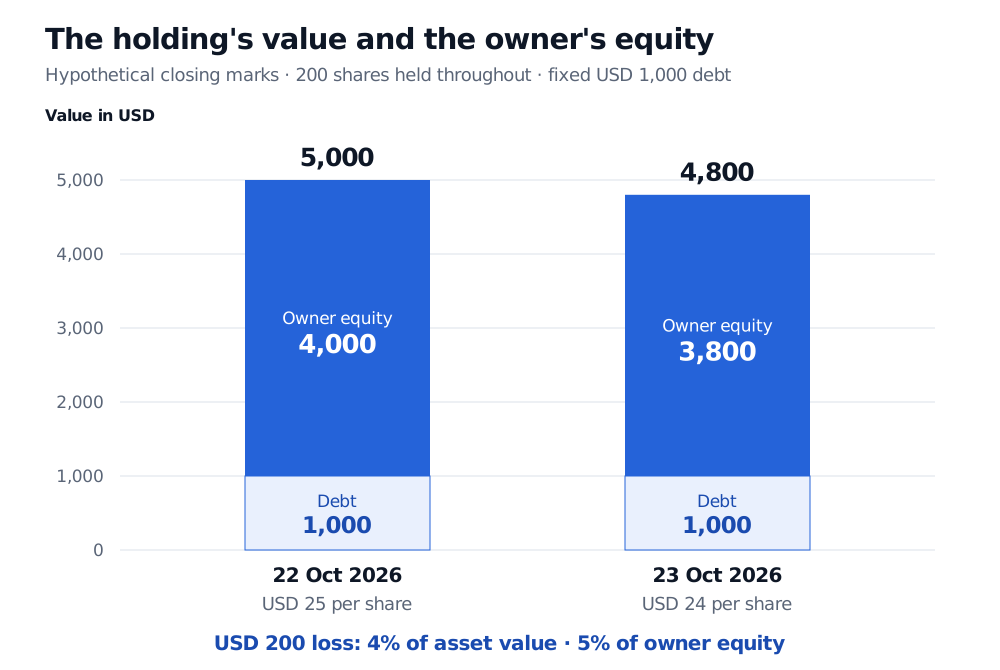
Original hypothetical closing-value ledger in USD. The same shares are held at both dates; borrowing is fixed and no other assets, liabilities or cash flows are present.
Borrowing does not reduce the market value of the shares themselves. It reduces the owner's residual claim on this account. The distinction becomes operational when holdings support financing: Margin and Collateral explains haircuts, collateral valuation and funding demands. The full lesson requires membership, with a public preview.
Which value are you comparing?
| Measure | What is being valued? |
|---|---|
| Holding's market value | The units you hold at the selected market valuation basis |
| Company's market equity value | All outstanding equity; for a single ordinary share class, share price times outstanding shares |
| Book equity | Recognised assets less liabilities using the accounting amounts in the financial statements |
| Enterprise value | A business valuation measure spanning financing claims, commonly equity value plus debt less cash in a simple capital structure |
Company market equity value is market capitalisation, as described by Investor.gov. Your own loan used to buy some shares is not the company's debt and does not enter its enterprise-value bridge.
Book equity uses accounting measurement rules; it need not equal what investors currently pay for the shares or what liquidation would actually realise. The SEC's balance-sheet guide explains the assets–liabilities–equity relationship. For enterprise value, Damodaran's financing bridge separates equity, debt and cash. More complex capital structures require additional adjustments and a stated convention. Calling each of these simply “the company's value” hides which claims and assets are included.
Sources
- Elton, Gruber, Brown and Goetzmann, Modern Portfolio Theory and Investment Analysis, 9th edition (Wiley, 2014), Chapter 3, pp. 27–28 — market value, borrowing and net worth in a long securities account. The dates and numbers above are original hypothetical assumptions, not market observations or current margin rules.
- FINRA: Defining the Value of an Investment — market, book and intrinsic value distinctions.
- SEC Investor.gov: Market Capitalization — company equity value from share price and outstanding shares.
- SEC: Beginners’ Guide to Financial Statement — Balance Sheets — accounting assets, liabilities and shareholders' equity.
- Aswath Damodaran, NYU Stern: Corporate Finance Spring 2020 emails — the distinction between market equity value, firm value and enterprise value in the March financing discussion.