See how borrowing magnifies gains and losses on equity, why financing shifts break-even, and why a leverage ratio must specify its exposure and capital measures.
Leverage
Leverage means taking financial exposure that is large relative to the capital supporting it. Borrowing to buy assets is one way to create leverage. Derivatives can also create substantial exposure from a comparatively small initial cash outlay. Gains and losses then matter relative to that smaller capital base.
A ratio such as “3× leverage” needs a definition. Does it mean assets divided by equity, gross long-plus-short exposure divided by equity, or derivative notional divided by capital? These quantities answer different questions. Start by naming the numerator and denominator.
Three times the assets, one equity cushion
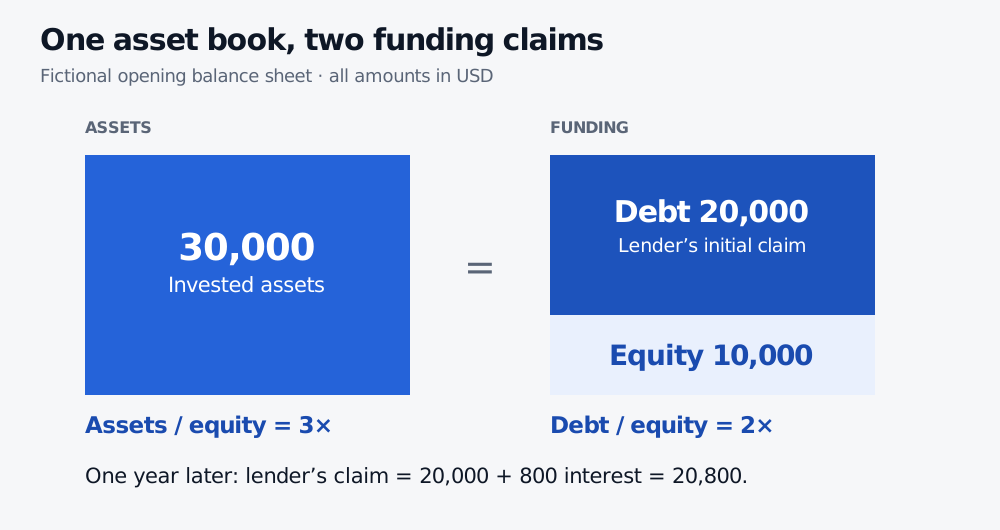
An analyst commits 10,000 USD of her own money, borrows 20,000 USD and invests 30,000 USD. The assets belong on one side of the opening balance sheet; the debt and her equity fund them:
A0=D0+E0=20,000+10,000=30,000 USD.
Here, asset-to-equity leverage is
L=E0A0=10,00030,000=3.
The debt-to-equity ratio is D0/E0=2, not 3. Both ratios describe the same opening balance sheet. Confusing them changes the exposure implied by a stated limit.
A fictional opening balance sheet has USD 30,000 of assets funded by USD 20,000 of debt and USD 10,000 of equity. Asset-to-equity leverage is 3 times and debt-to-equity is 2 times. One-year debt interest of USD 800 raises the lender's claim to USD 20,800.
Original fictional balance sheet. Asset-to-equity and debt-to-equity have different numerators; each uses the same initial equity denominator.
Suppose she holds the assets for one full year, with no intermediate income, contributions, repayments or trades. The debt has a 4% effective rate for that year, so interest is 800 USD and the ending debt claim is 20,800 USD. All figures are hypothetical. Ignore transaction costs and taxes, and postpone the question of early liquidation for the moment.
The lender's claim stays; equity absorbs the move
If the assets earn a one-year total return rA, their ending value is 30,000(1+rA). Subtracting the debt claim gives ending equity:
E1=30,000(1+rA)−20,800.
Her return on initial equity is therefore
RE=10,000E1−10,000=3rA−0.08.
The subtraction of 0.08 means eight percentage points, because the 800 USD interest is 8% of her 10,000 USD equity. It does not mean the borrowing rate was 8%.
One-year asset return
Ending assets
Ending equity after debt
Equity profit or loss
Return on initial equity
+10%
33,000 USD
12,200 USD
+2,200 USD
+22%
−10%
27,000 USD
6,200 USD
−3,800 USD
−38%
−40%
18,000 USD
−2,800 USD
−12,800 USD
−128%
The +10% asset move creates 3,000 USD of asset profit. After paying 800 USD interest, the equity holder keeps 2,200 USD. The −10% move loses 3,000 USD on the assets and incurs the 800 USD interest charge. Financing explains why the two equity returns are +22% and −38% rather than a symmetric +30% and −30%.
The last row assumes recourse borrowing: the borrower remains responsible for the debt shortfall. Negative equity of 2,800 USD means that selling the assets at that ending value would leave 2,800 USD still owed after the initial equity has been lost. This is not a statement that every leveraged contract has identical liability. A fully paid purchased option, for example, has different loss limits from a margin loan or a short option position.
The SEC's margin-account bulletin explains this amplification, the effect of loan interest, and how a margin-account loss can exceed the investor's original contribution. The table above uses an original scenario rather than its example.
Financing moves both thresholds
In the same fixed-holdings model, let the debt's effective rate over the holding period be i. Since D0/E0=L−1,
RE=LrA−(L−1)i.
“Three times the asset return” is the before-financing shortcut for this example. The slope is still three: an additional one percentage point of asset return adds three percentage points to the equity return. But the return line starts below zero because the borrowing must be paid for.
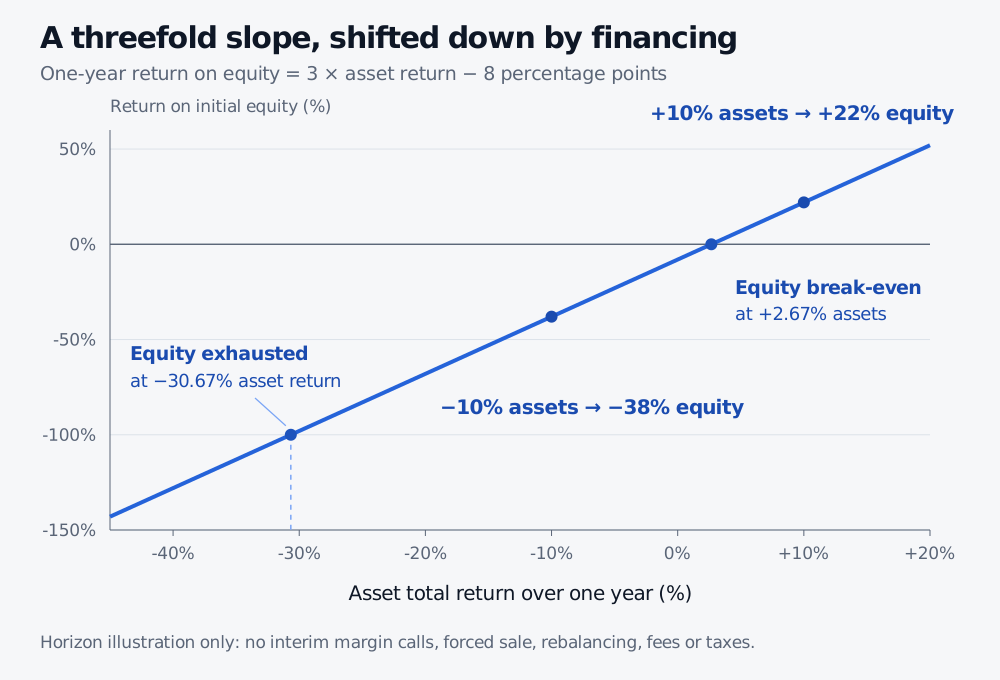
The fictional one-year equity-return line has slope three and a minus eight percentage point financing offset. A minus 10 percent asset return gives minus 38 percent equity return and a plus 10 percent asset return gives plus 22 percent. Equity reaches zero at a minus 30.67 percent asset return and the equity return breaks even at a plus 2.67 percent asset return.
Original one-year fixed-holdings scenario, not market data. The line excludes interim margin calls, forced sale, rebalancing, transaction costs and taxes.
Two thresholds answer different questions:
No profit or loss on equity: the assets must earn the 800 USD interest bill. The required asset return is 800/30,000≈2.67%.
No equity left: ending asset value equals the debt claim. Solving 30,000(1+rA)=20,800 gives rA≈−30.67%, at which point the equity return is −100%.
A one-third asset loss would exhaust the original equity if borrowing were free. With this year's interest included, equity is exhausted sooner. Conversely, a flat asset value produces an equity return of −8%.
These are horizon calculations. In a real margin account, falling collateral value can trigger a margin call or a forced sale before the final date. An eventual recovery is no help if the position has already been closed. Financing rates, collateral eligibility and funding availability can also change. The starting leverage is not a promise that the investor can maintain the position through every path.
SelfMadeQuant's Margin and Collateral lesson develops the intervening cash demands through futures settlement, repo haircuts and collateral arrangements. Its public page is a preview; the full lesson requires membership.
One ratio cannot describe every book
Gross-exposure leverage is useful for a long–short portfolio: it adds the magnitudes of long and short positions and divides by equity. Net exposure subtracts one side from the other. Offsetting dollar amounts can produce low net exposure while leaving substantial positions, funding demands and risk on both sides.
Derivative notional leverage compares a contract's reference amount with supporting capital. Notional is not always the amount that will be lost for a given market move. An option's sensitivity changes with the underlying price and other inputs; its payoff is not the straight line used for the borrowed asset book above. Initial margin is collateral, not the purchase price of the entire underlying exposure or a universal cap on loss. Hull's discussion of futures and options makes this distinction between the initial cash outlay and the exposure it supports.
For a risk limit, record the exposure measure, equity or capital denominator, valuation date, financing assumptions and relevant stress losses. For a backtest, separate the asset return from financing and other costs, and check whether the simulated position could meet its cash demands along the way. A leverage number helps size a trade; it does not replace the trade's payoff and funding model.
Practice
You invest 8,000 USD of your own money and borrow another 8,000 USD to buy 16,000 USD of assets. Over one full year the assets lose 5%. The debt charges a 3% effective rate for that year. Assume no intermediate cash flows, trading, forced liquidation, fees or taxes. What are ending equity and the return on initial equity?
Answer. Assets end at 16,000(0.95)=15,200 USD. The debt claim is 8,000(1.03)=8,240 USD, leaving 15,200−8,240=6,960 USD of equity. The return is (6,960−8,000)/8,000=−13%. Doubling the −5% asset return gives −10% before financing; the 240 USD interest adds a further three percentage points of loss relative to initial equity.
John C. Hull, Options, Futures, and Other Derivatives, 9th Global Edition: Chapter 1, speculation using futures and options; Chapter 2, operation of margin accounts. Grounds the distinction between initial cash, derivative exposure and subsequent funding demands.