Margin is the equity or collateral required to support a trading position or credit exposure. It lets a broker or clearing system demand resources against the obligation. For a trading strategy, this creates a cash requirement that can arrive before an offsetting hedge pays out.
The word has two related uses. Buying securities on margin involves borrowing from a broker through a margin account. Margin on a futures contract supports performance of the contract; it is not a cash purchase of the underlying asset.
First ask what is being financed
| Setting | What margin supports | What the trader must track |
|---|---|---|
| Securities bought with a margin loan | Credit extended against securities in the account | Securities value, debt, interest and the required account equity |
| Futures | The obligation to meet contract losses | Settlement cash flows, collateral balance and additional funding requirements |
For a simple securities account, equity is securities market value minus the amount owed to the broker. A price decline reduces equity while the debt remains payable. This is the borrowing mechanism described in the SEC's margin-account bulletin; requirements depend on the applicable rules and the firm's terms.
A futures trader does not borrow the difference between contract notional and posted margin simply by opening the contract. The CME explanation distinguishes this performance deposit from securities financing. A separate loan used to raise the deposit would be an additional funding arrangement.
A threshold is different from a restoration target
Consider one synthetic linear, cash-settled futures contract, bought at 100 USD per unit with a multiplier of 1,000 units. Its entry notional value is USD 100,000. This measures the position's scale; it is not USD 100,000 paid to buy an asset.
Stipulate these rules for the entire position:
- Initial margin: deposit USD 5,000.
- Maintenance margin: USD 4,500.
- A balance strictly below maintenance triggers a margin call to restore USD 5,000.
- No interest, fees or withdrawals; all required deposits are paid promptly.
The next settlement price is 99 USD per unit. For this long position, the signed settlement is
The variation margin loss reduces the cash account from USD 5,000 to USD 4,000. It is now USD 500 below maintenance, but the required deposit is USD 1,000: the target is USD 5,000. Depositing only USD 500 would reach the threshold without satisfying the stated restoration rule.
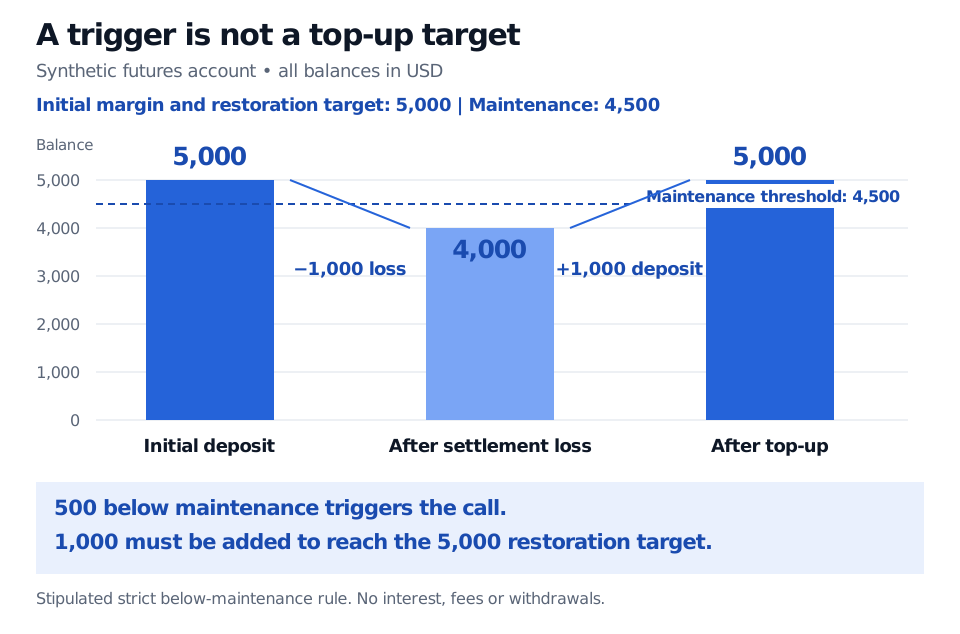
Original synthetic cash-margin example. All amounts are USD. A strict below-maintenance trigger and restoration to initial margin are stipulated broker rules; no fees, interest or withdrawals.
The distinction also separates trading loss from cash transferred into collateral. Suppose the trader immediately closes at the same 99 settlement price and receives the remaining account balance back:
| Event | External bank cash flow (USD) | Margin-account balance (USD) |
|---|---|---|
| Initial deposit | −5,000 | 5,000 |
| Settlement loss | 0 | 4,000 |
| Restoration deposit | −1,000 | 5,000 |
| Close at unchanged price and release balance | +5,000 | 0 |
External cash sums to USD, agreeing with the trading loss. The additional deposit did not create another loss or undo the first one; it moved the trader's cash into the account.
Why a profitable strategy can run out of cash
Margin is a condition for maintaining exposure, not a maximum possible loss. An adverse move can exceed the deposit. A hedge may offset that loss economically yet produce its cash receipts later, leaving a liquidity problem today.
The example's levels and timetable are assumptions, not market minimums. Actual brokers and clearing arrangements can change requirements and close positions when funding is insufficient. Do not infer the rules for direct clearing members or bilateral derivatives from this simplified customer account. The CFTC overview explains customer futures margin and notes that brokers can require more than exchange levels.
To carry the calculation into repo haircuts and bilateral collateral, the owned Margin and Collateral lesson offers a public preview; the full lesson requires membership.
Practice
A separate fictional futures account has initial margin of USD 8,000 and maintenance of USD 6,500. A call triggers only below maintenance and restores initial margin. With no fees, interest, withdrawals or earlier deposits, a settlement loss of USD 1,500 is followed by another loss of USD 100. When is a call triggered, and how much must be deposited?
Answer. After the first loss, the balance is USD 6,500, exactly at maintenance: no call under the stated strict rule. The next loss leaves USD 6,400 and triggers a deposit of USD. USD 100 would only return the balance to maintenance; the target remains USD 8,000.
Sources
- John C. Hull, Options, Futures, and Other Derivatives, ninth Global Edition, Pearson (2018), §2.4, pp. 51–54: customer margin accounts, daily settlement and clearing-member distinctions.
- CME Group — The Benefits of Futures Margins: futures collateral versus securities borrowing and initial/maintenance levels.
- SEC Investor.gov — Understanding Margin Accounts: securities credit, account equity, interest and broker liquidation rights in the US context.
- CFTC — Economic Purpose of Futures Markets and How They Work: futures performance margin and customer funding mechanics.