A margin account is a brokerage account that permits borrowing against eligible securities. When an investor buys shares on margin, the broker lends part of the purchase price and holds securities as collateral. The investor receives the price exposure but owes the loan even if the shares fall in value. This leverage makes the percentage change in the investor's equity larger than the percentage change in the shares.
A cash brokerage account requires purchases to be paid in full rather than financed by a loan from that broker. A margin account permits borrowing; the account label alone does not mean a loan is currently outstanding. Investor.gov distinguishes the two account types.
Read the account as a balance sheet
Consider a hypothetical purchase of 100 shares at USD 100 per share. The investor contributes USD 6,000 and borrows USD 4,000. Assume no other positions or cash, no dividends, no interest, no fees, and an unchanged loan principal during the price move.
The USD 10,000 shareholding is the asset. The USD 4,000 loan is a liability. Account equity is the residual belonging to the investor:
where is the current market value of the shares and is the debt. This use of equity means the investor's net account value, rather than the entire stockholding.
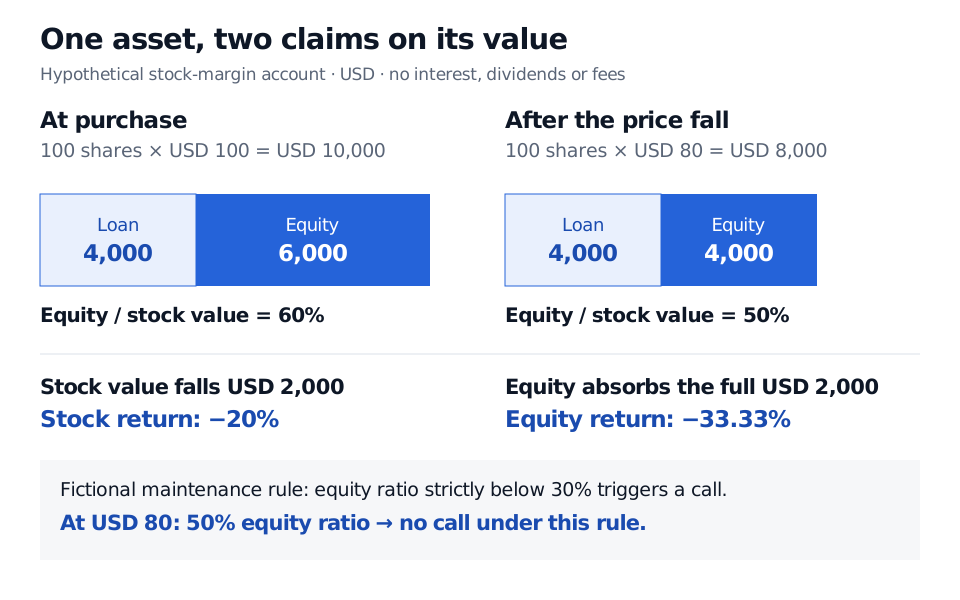
Original hypothetical stock-loan ledger in USD, with no interest, dividends or fees. Debt is unchanged; the full decline in the shares’ value reduces account equity. The 30% maintenance requirement is stipulated for this example.
At USD 80 per share, the assets are worth USD 8,000. After deducting the USD 4,000 debt, equity is USD 4,000. The stock has lost USD 2,000, and the investor has absorbed that entire loss:
The percentage loss is larger because the same dollar loss is measured against a smaller amount of the investor's own capital. Initial asset-to-equity leverage is . Under these assumptions, multiplying the stock return by that initial leverage gives the equity return. Actual financing interest and transaction costs reduce the result further.
A loss does not automatically mean a margin call
Suppose the fictional broker requires equity of at least 30% of current share value and calls for additional funds only when the ratio is strictly below that level. This is a simplified maintenance rule, not a statement of any current broker's policy or a universal regulatory minimum.
At the new price, the equity ratio is . There is no margin call under this stipulated rule, despite the substantial equity loss. The initial ratio was ; maintenance is measured using today's values, not the original purchase price.
With shares, share price , fixed debt and maintenance fraction , the boundary is
Here it is
Under the stated strict-below rule, equality meets the requirement and prices below the exact boundary breach it. The rounded quote USD 57.14 is slightly below and therefore already breaches; USD 57.15 is above it. Rounding the boundary does not change the contractual inequality.
A margin requirement constrains the account while it is open; it does not cap losses or guarantee an orderly exit. A price gap can leave sale proceeds insufficient to repay the loan. In the extreme accounting scenario of the shares becoming worthless before liquidation, the investor would still owe USD 4,000, having lost the original USD 6,000 equity and incurred a further USD 4,000 shortfall.
The agreement matters as much as the arithmetic
For US securities accounts, FINRA explains that firms can impose house requirements above regulatory requirements, change those requirements, and liquidate securities without first contacting the customer. The customer can remain liable for a shortfall. The agreement also specifies interest and other charges. Other jurisdictions and account arrangements have their own rules; the worked example fixes its rule so the mechanics can be seen clearly.
A financed stock purchase and a futures contract use the word margin differently. In this stock example, borrowed cash helped purchase an asset, and account equity supports a loan. Futures margin provides performance collateral, with trading gains and losses settled through the account; the deposit is not a part-payment for owning the underlying. Option positions and short sales introduce further obligations, so the simple long-stock formula is not an account-wide margin model.
For the collateral side of that distinction, SelfMadeQuant's Margin and Collateral lesson follows a futures margin call and compares repo haircuts, bilateral collateral and central clearing. The public page is a preview; the full lesson requires membership.
Practice: adding equity by repaying debt
An account holds 200 shares worth USD 30 each, owes USD 4,500, and has no other assets or liabilities. A fictional broker requires a 30% equity ratio. Ignoring interest and fees, what is the smallest external cash payment that restores the requirement if the entire payment immediately repays the loan and all shares are retained?
Answer. Share value remains USD 6,000. Current equity is USD 1,500, or 25%. Required equity is , so a USD 300 repayment is sufficient. Debt falls to USD 4,200 and equity becomes USD 1,800, exactly 30% of the unchanged share value. This assumes repayment of debt: leaving the payment as additional cash collateral would also change total account assets and would require a separately specified margin calculation.
Sources
- Investor.gov: Brokerage Accounts — cash accounts, margin accounts and collateral-backed broker lending.
- FINRA: Brokerage Accounts — margin lending, equity, house requirements, interest and liquidation risks for US securities accounts. Checked 25 October 2026; the article's numerical rule is fictional.
- John C. Hull, Options, Futures, and Other Derivatives, Ninth Edition, Global Edition, Pearson Education Limited, 2018, §10.7, pp. 246–247, and §2.4, pp. 51–52 — the distinction between buying shares on margin and futures margin-account mechanics. Historical textbook thresholds are not used as current rules here.