A cash account is a brokerage account in which securities purchases are paid for in full without borrowing from the broker. This funding constraint matters when implementing a trading strategy: an attractive position still needs an eligible source of payment. A margin account, by comparison, permits broker credit under its lending terms. FINRA explains the distinction.
“Cash” describes how purchases are funded. The account can hold stocks, bonds and other permitted securities as well as uninvested cash. Nor does the label establish where the investor obtained the money before depositing it: the restriction concerns borrowing from the broker within this account.
Follow the money through a purchase
Start with USD 1,000 of settled cash and no holdings. Buy five shares at USD 100 each, paying USD 500. Assume the trade completes, the shares are immediately valued at the purchase price, and there are no fees, interest, distributions, taxes or external cash flows.
| Hypothetical account, USD | Before purchase | After purchase | After a 20% share-price fall |
|---|---|---|---|
| Cash | 1,000 | 500 | 500 |
| Shares at the stated price | 0 | 500 | 400 |
| Total account value | 1,000 | 1,000 | 900 |
| Broker borrowing | 0 | 0 | 0 |
Buying the shares converts cash into a holding. At that instant, total value remains USD 1,000 before costs. The account's USD 500 cash balance is only one component of its wealth.
For this simple cash-and-shares account,
where is cash in USD, is shares held and is the valuation price in USD per share. The shares' market value is . There is no broker loan to subtract in this example.
If the share price falls by 20% to USD 80, the five shares are worth USD 400. Cash remains USD 500, so account value falls to USD 900. The USD 100 loss is 10% of the starting account: half the starting wealth was exposed to the shares. The unchanged cash cushions this particular loss; it does not insure the shares against falling prices.
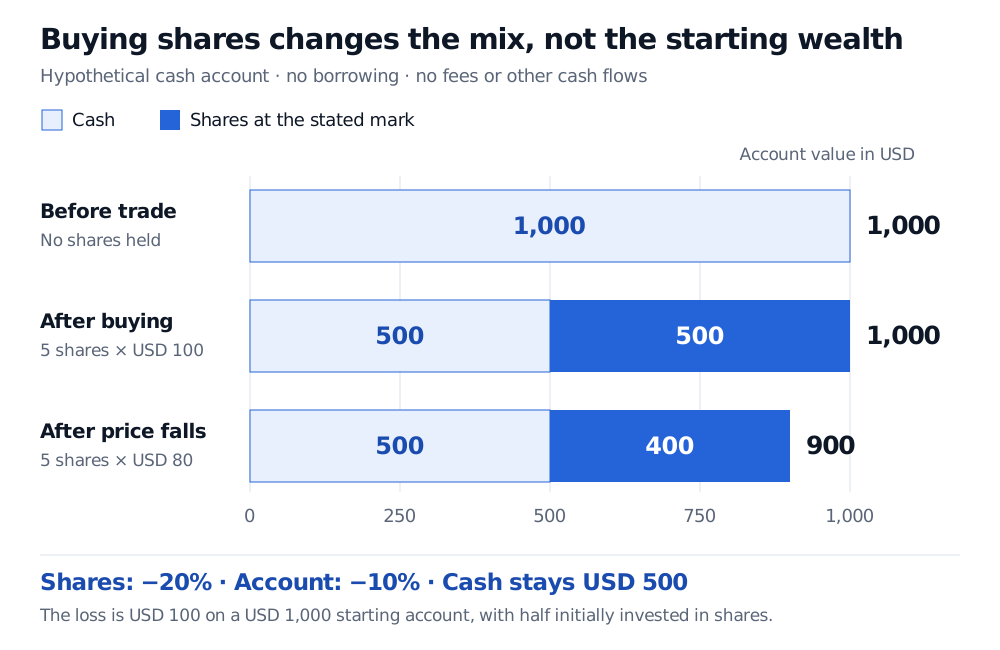
Original hypothetical USD ledger. The purchase preserves total value at its execution mark before costs; a later price change affects the shares while cash stays fixed.
For a fuller trading ledger, Positions, Trades, Fills and P&L derives how actual fills, execution prices and fees update cash and holdings. The full lesson requires membership, with a public preview.
A displayed balance may not be spendable cash
An executed sale and its settlement are separate events. Proceeds can appear in an account before the cash transfer completes. A broker's “available to trade” figure can therefore differ from settled cash or cash available to withdraw. Fidelity's balance definitions illustrate these distinctions; check how your own broker defines each balance.
For U.S. securities subject to the standard settlement cycle, settlement is generally T+1, meaning one business day after the trade date. This cycle took effect on 28 May 2024, with exceptions; it is not a timetable for every instrument or jurisdiction. See the SEC's settlement bulletin.
The SEC's cash-account bulletin, updated August 2026, shows that some purchases funded by pending sale proceeds are permissible, subject to payment and resale conditions. Buying and quickly selling a security before properly paying for it can instead create a trading violation and restrictions. A cash account is therefore not a promise of unrestricted turnover. Check the applicable settlement calendar, the source of payment, the broker's current rules and any deposit holds before reusing proceeds.
Full payment still leaves investment risk
The account label does not turn stock holdings into guaranteed bank deposits. In the United States, SIPC distinguishes restoring missing customer assets after a member broker fails from protecting investment value. It does not reimburse ordinary market losses such as the USD 100 decline above. Funding arrangements, custody protection and the risk of the assets held are separate questions.
Sources
- Elton, Gruber, Brown and Goetzmann, Modern Portfolio Theory and Investment Analysis, 9th edition (Wiley, 2014), Chapter 3, pp. 27–28 — cash versus financed securities purchases and the assets–borrowing–net-worth ledger. The example here is original and hypothetical; current settlement rules come from the official sources below.
- FINRA: Brokerage Accounts — full payment, broker credit and securities holdings in cash accounts.
- SEC Investor.gov: Trading in Cash Accounts — Investor Bulletin, updated 7 August 2026 — U.S. cash-account payment conditions, permissible trades and trading restrictions.
- SEC Investor.gov: New T+1 Settlement Cycle — What Investors Need To Know — U.S. standard settlement timing and scope.
- Fidelity: Trading FAQs — About Your Account — one broker's distinctions between trading cash, settled cash and withdrawal availability.
- SIPC: What SIPC Protects — custody protection and exclusion of market losses.