Identify when a transaction is agreed, distinguish execution from an order or settlement, and reconcile trade dates across time zones.
Trade date
The trade date is the date on which counterparties agree a financial transaction, or an order is executed into a trade. It anchors the transaction record: which price and quantity were agreed, when the commitment arose, and which date starts the contractual settlement calculation. Sending an order does not by itself establish that a trade occurred.
The ECB's definition centres on agreement between counterparties. The settlement date answers a different question: when the resulting payment and delivery are due, or, in a completion record, when they actually happened. Same-day settlement is possible; a delay between trade and settlement is not part of the definition of a trade date.
Read the execution record, not the order button
An order instructs a broker or trading system to seek a transaction. It can remain unfilled, fill partially, execute in several pieces, or be cancelled before execution. Record the executions separately from the order's submission and cancellation events. An acknowledgement that an order was received is not an execution confirmation.
This distinction also matters when the price is to be determined later. For its covered OTC equity reporting, FINRA's FAQ 100.8 ties execution time to agreement of essential terms, including the actual price and share quantity. A request to transact at a future benchmark is not automatically an execution at the time of the request; the applicable market and contract rules matter.
Consider this synthetic purchase, with New York local date stipulated as the trade-date convention:
Record field
Agreed or observed information
Order submitted
Friday 9 January 2026, 15:29, America/New_York
Execution / trade agreement
Friday 9 January 2026, 15:30, America/New_York
Instrument and side
Buy shares in a fictional company
Quantity and execution price
100 shares at USD 25 per share
Gross contractual cash
USD 2,500, excluding fees and taxes
Scheduled settlement
Monday 12 January 2026, under the stipulated T+1 weekend-only calendar
Actual payment and delivery
Not established by this record
The trade date is 9 January, when the purchase was agreed. The gross cash amount is 100 × USD 25 = USD 2,500. Under this example's Monday–Friday calendar with no holidays, T+1 falls on Monday 12 January. That schedule does not prove that settlement completed, and T+1 is an example convention rather than a universal rule for financial instruments.
One instant can have two calendar dates
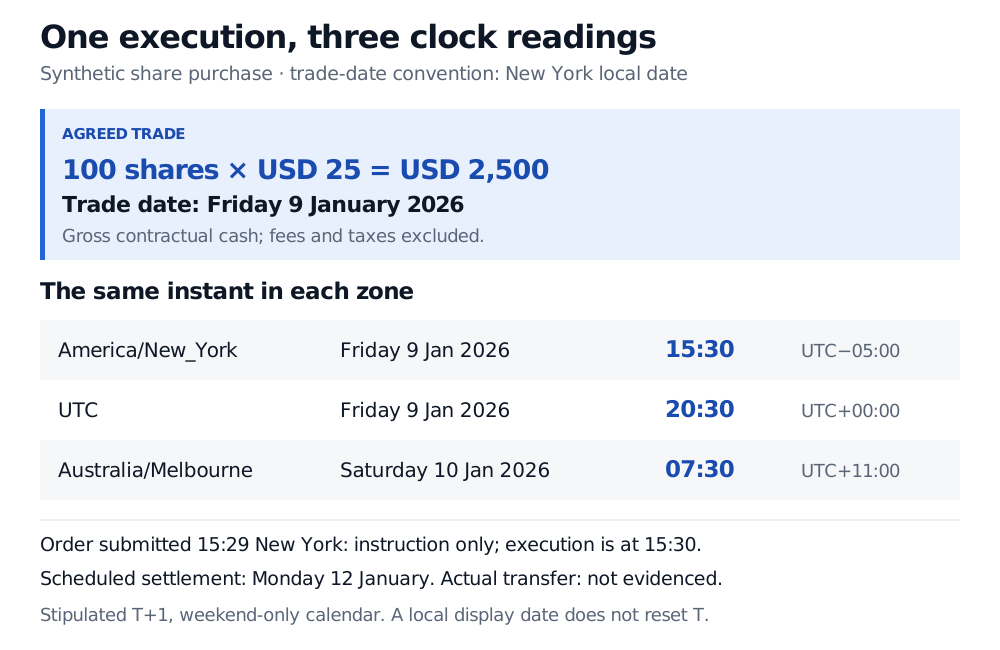
At execution, New York is on UTC−05:00. The same instant is 20:30 UTC on Friday 9 January, and 07:30 on Saturday 10 January in Melbourne, which is on UTC+11:00. A Melbourne display therefore shows Saturday even though the stipulated trade-date field is Friday.
Synthetic purchase agreed Friday 9 January 2026 at 15:30 in New York: 100 shares at USD 25 gives USD 2,500. The same instant is Friday 20:30 UTC and Saturday 10 January 07:30 in Melbourne. Stipulated settlement is due Monday 12 January; actual transfer is not evidenced.
Original synthetic trade record. All three clock readings identify one execution. The trade-date convention and settlement calendar are stipulated; fees and taxes are excluded.
For reconciliation, retain the timestamp with its time zone or UTC offset, the applicable trading-session convention, and the trade-date field supplied by the relevant system. Do not derive every market's trade date from the date on the analyst's laptop. Overnight sessions and different reporting rules make that shortcut unreliable. FINRA's FAQ 101.1, for example, specifies Eastern Time for reports to its facilities except where a rule expressly requires another time.
What the record establishes
A useful trade record identifies the instrument, buy or sell direction, quantity, price and currency, execution date and time, parties or account references, settlement terms, and a transaction identifier. Reconcile corrections and cancellations against that identifier; the time a report was received or a confirmation printed should not silently replace the execution time.
For covered US broker-dealer customer transactions, Rule 10b-10(a)(1) requires disclosure of the transaction date and time, or notice that the time is available on written request, together with security identity, price and quantity. These are evidence of the transaction's terms. A confirmation alone does not establish that the cash and securities transfers have completed.
An agreed purchase can create exposure before delivery: if the buyer is committed to a fixed price, subsequent market moves can change the economic value of that commitment. How the position enters a risk system, when legal title passes, and when accounting recognises the asset depend on the instrument, contract, reporting framework and jurisdiction. Do not interpret “trade date” as a universal declaration of immediate ownership or as a complete accounting policy.
For a specific accounting example, Australian AASB 9, paragraphs B3.1.3–B3.1.6, distinguishes commitment, delivery and recognition. It allows trade-date or settlement-date accounting for regular-way financial-asset purchases and sales, with consistent application within the specified classifications. An accounting recognition date and an operational trade date can therefore serve different purposes without contradicting each other.
For the institutions that carry the agreement through to transfer and custody, Market Participants separates execution, clearing, settlement and custody. A public preview is available; the full lesson requires membership.
Practice: how many shares actually traded?
A fictional investor submits an order for 90 shares on Monday 2 February 2026. On Tuesday 3 February, 40 shares execute at USD 18.50 each. The remaining 50 shares never execute and are cancelled on Wednesday 4 February. All dates use the same stipulated market time zone. Ignoring fees and taxes, what quantity, trade date and gross cash amount belong in the purchase record?
Answer. Record 40 shares, trade date Tuesday 3 February, and gross contractual cash USD 740: 40 × USD 18.50. Monday records the order instruction, not an execution. Wednesday records cancellation of the unfilled balance, not a second trade. Assigning all 90 shares to Monday would invent both an execution date and a purchase of the 50 unfilled shares.
Sources
Frank J. Fabozzi and Francesco A. Fabozzi, Bond Markets, Analysis, and Strategies, 10th edition, MIT Press, 2021, Chapter 2, “Calculating Accrued Interest”, local ebook PDF page 71. Used for the execution/settlement distinction; its historical settlement-cycle examples are not treated as current rules.