The settlement date on a trade confirmation is the agreed date on which payment and delivery are due. In an ordinary purchase of securities, the buyer must provide cash and the seller must deliver the securities. This date drives funding and delivery planning; a completed trade on a screen is not evidence that either transfer has finished.
The trade date records when the transaction was agreed or executed. Settlement fulfils the resulting obligations through transfers of funds and/or assets. Clearing can reconcile instructions and determine obligations between those events; calculating what is owed does not itself move the assets.
Friday plus one is not Saturday
Suppose a fictional securities trade is executed on Friday 9 January 2026, with a stipulated T+1 business-day settlement cycle. Here T means the trade date. Use a synthetic weekend-only calendar: Monday through Friday are business days and there are no holidays. Start counting after the trade date.
| Date | Count under this calendar |
|---|---|
| Friday 9 January | Trade date, T |
| Saturday 10 January | Not a business day; skipped |
| Sunday 11 January | Not a business day; skipped |
| Monday 12 January | First business day after T: T+1 |
| Tuesday 13 January | Second business day after T: T+2 |
The agreed T+1 settlement date is Monday 12 January. A different contract stipulated to settle T+2 would be due Tuesday 13 January under the same calendar. T+1 means one eligible business day after the trade, not one calendar day or a fixed number of elapsed hours.
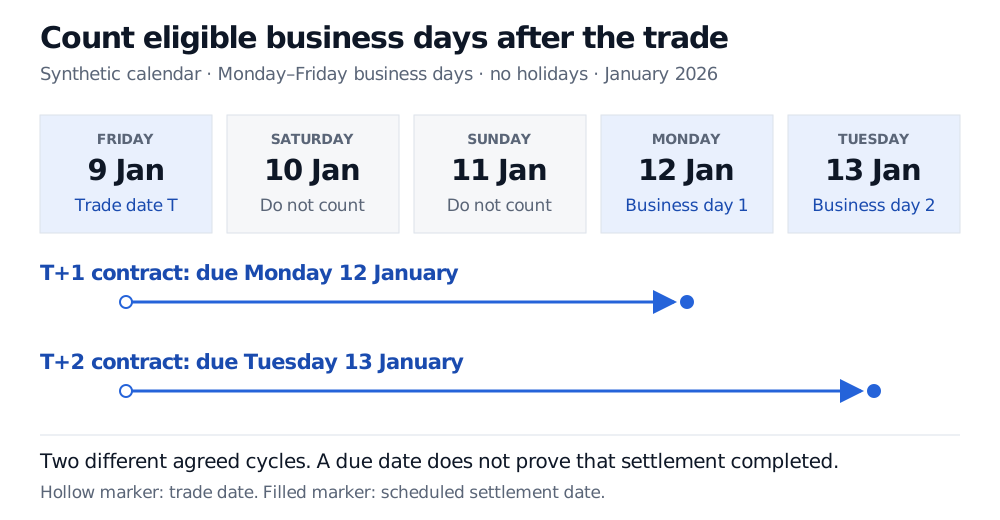
Original synthetic calendar. Monday–Friday business days, no holidays. The two arrows compare separate agreed settlement cycles; neither guarantees actual completion.
A real calculation needs the instrument's applicable cycle, calendar and any contractual exceptions. A business day convention adjusts an otherwise scheduled date when required; it does not, by itself, specify the trade-to-settlement lag.
For a jurisdiction-specific comparison, US Rule 15c6-1(a) generally restricts covered broker-dealer securities contracts to payment and delivery no later than the first business day after the contract date, unless the parties expressly agree otherwise at the transaction. The rule contains exclusions and exceptions. The SEC's T+1 guidance explains its scope and the 28 May 2024 implementation. That is a qualified US rule, not a universal cycle for every bond, currency, derivative or market.
Due and completed are different fields
Keep a contractual or scheduled settlement date separate from an actual settlement date. Terminology varies: the ECB glossary, for example, uses settlement day for the day settlement actually takes place. A confirmation's due date and an operations system's completion field can therefore answer different questions even when both are labelled “settlement date”.
If the T+1 trade above misses Monday's settlement and completes on Tuesday, its original due date remains Monday. It was late; it does not retrospectively become an originally agreed T+2 trade. The ECB defines a failed transaction by failure to settle on the contractual date and recognises that settlement may occur later. An explicit amendment is a separate event from simply missing a deadline.
For a securities purchase, delivery versus payment links the securities transfer to the corresponding funds transfer. Its purpose is to prevent one leg from completing without the other under that mechanism; it does not promise that both legs will complete on schedule. Missing securities, missing cash or processing problems can still create settlement risk. Cash-settled contracts instead discharge their specified cash obligation without delivery of an underlying security.
For the institutions around these transfers, Market Participants traces execution, clearing, settlement and custody. The full lesson requires membership; a public preview is available.
Practice: a holiday and a fail
A fictional trade executes on Thursday 5 March 2026 with agreed T+1 business-day settlement. Weekends are closed, Friday 6 March is a synthetic holiday, and all other weekdays are eligible. The trade actually completes on Tuesday 10 March. What was its original due date, and was completion on time?
Answer. The original due date was Monday 9 March. Friday is ineligible and the weekend is skipped. Tuesday completion was late; the fail does not change the original agreed due date. Using Friday ignores the stipulated holiday, while calling Tuesday the original T+1 date confuses actual completion with the contractual schedule.
Sources
- Frank J. Fabozzi and Francesco A. Fabozzi, Bond Markets, Analysis, and Strategies, 10th edition, MIT Press, 2021, Chapter 2, “Price Quotes and Accrued Interest”, “Calculating Accrued Interest” (local ebook PDF page 71). Used for the trade/payment/delivery distinction and calendar counting; current market-cycle claims are checked separately below.
- 17 CFR 240.15c6-1: Settlement cycle, especially paragraph (a) and its exclusions and exceptions; checked 25 October 2026 against the eCFR displayed as up to date through 22 October 2026.
- SEC: Shortening the Securities Transaction Settlement Cycle — FAQs, scope, compliance date and expressly agreed settlement terms.
- ECB Payments and markets glossary — S, settlement, actual settlement day and settlement risk; F, failed transaction; D, delivery versus payment.