A business day convention is the rule for adjusting a scheduled date when it falls on a non-business day under the contract's specified calendar. It determines when a payment or another contractual event is due. A wrong date can produce a wrong cash forecast, discounting date or interest calculation even when the quoted rate is correct.
The convention and the calendar answer different questions: which direction should the date move, and which dates are eligible? A weekday is not necessarily a business day. The relevant financial centres, payment systems and holidays come from the contract. FpML explicitly represents the convention together with the financial business centres.
The month-end test
Suppose a fictional payment is scheduled for Saturday 31 January 2026. Use a synthetic weekend-only calendar: Monday through Friday are business days, with no holidays. Friday 30 January is eligible; Sunday 1 February is not; Monday 2 February is eligible. This is neither a USD nor a EUR holiday calendar.
| Convention | Rule when the scheduled date is not a business day | Adjusted date in this example |
|---|---|---|
| Following | Move to the first following business day. | Monday 2 February 2026 |
| Modified following | Try following; if it enters the next calendar month, use the first preceding business day instead. | Friday 30 January 2026 |
| Preceding | Move to the first preceding business day. | Friday 30 January 2026 |
| No adjustment | Keep the scheduled date for the purpose to which this instruction applies. | Saturday 31 January 2026 |
These definitions are consistent with OpenGamma Strata's date conventions. A date already eligible under the specified calendar stays unchanged under following, modified following and preceding.
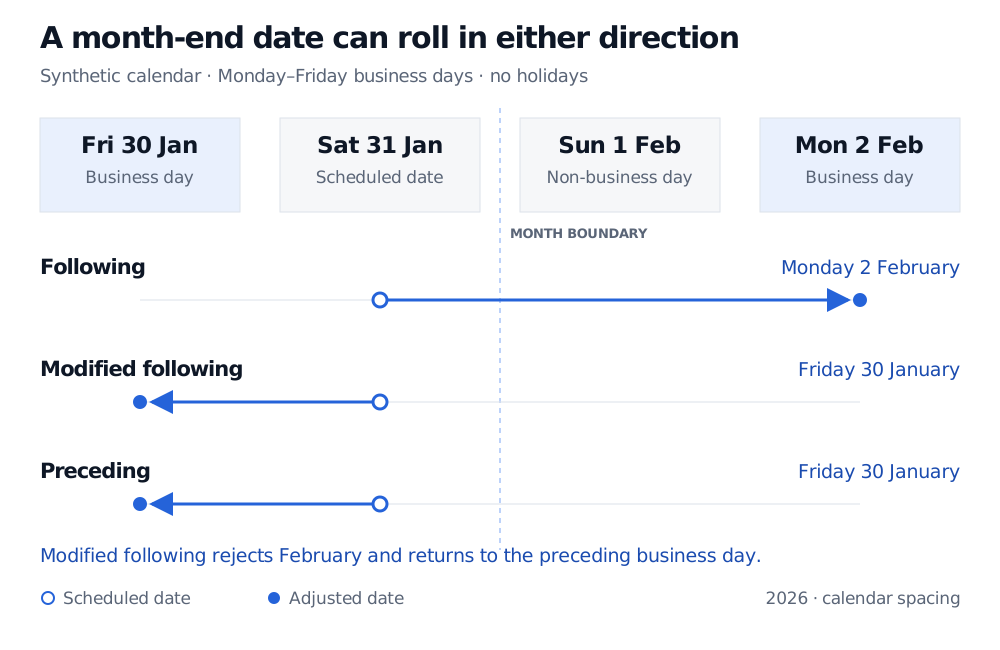
Original synthetic date-roll diagram. No holidays or real financial-centre calendar; hollow markers show the scheduled date and filled markers the adjusted date.
“Modified” is a month-boundary condition, not a search for the nearest business day. Following can cross the boundary; modified following reverses direction here. Their agreement with preceding in this example does not make the rules equivalent.
Keep the accrual schedule separate
A payment date tells you when cash is due. An accrual boundary tells you which interval earns interest. Moving one does not, by itself, tell you whether the other moves.
For example, a hypothetical contract could stipulate unadjusted accrual boundaries and a following-adjusted payment date. Its January accrual period would still end on 31 January, although the payment would be due on 2 February in the synthetic calendar above. Another contract could require adjusted accrual boundaries. The contract must resolve that distinction before a day-count convention can turn the relevant interval into a year fraction.
FpML's separate adjustment fields for calculation-period, payment and reset dates reflect this distinction. “No adjustment” for an accrual boundary also does not automatically instruct a payment system to transfer cash on a weekend.
Similarly, choosing modified following does not by itself specify the whole schedule: frequency, end-of-month generation, payment lag and any final-date exceptions require their own instructions. The DSV circular dated 24 October 2024, for example, defines business days using specified centres, allows different conventions for different dates, and contains a particular final-interest-date exception for SOFR notes. Those are that document's terms, not universal bond rules.
In a swap confirmation or bond terms, read the calendar, the applicable convention and the affected date together. Preserve both the original scheduled date and its adjusted result so the cash-flow calculation can be checked.
Practice: change the calendar
A fictional payment is scheduled for Sunday 15 March 2026. Saturdays and Sundays are non-business days, and Monday 16 March is additionally declared a synthetic holiday. All other weekdays are business days. Where do modified following and preceding place the payment?
Answer. Modified following gives Tuesday 17 March 2026: Monday is ineligible, and Tuesday remains in March, so there is no month-boundary reversal. Preceding gives Friday 13 March 2026. Choosing Monday ignores the holiday; choosing Friday for modified following mistakes that rule for preceding.
Sources
- John C. Hull, Options, Futures, and Other Derivatives, 9th Global Edition, Pearson, 2018, §7.3, pp. 181–182, including footnote 4 and the hypothetical confirmation in Business Snapshot 7.1.
- FpML 5.7 confirmation schema: BusinessDayAdjustments, including the convention enumeration and distinct calculation-period, payment and reset adjustment fields.
- OpenGamma Strata: BusinessDayConventions, primary implementation documentation for the date-adjustment rules.
- DSV Base Offering Circular, 24 October 2024, printed pp. 32–33, definitions of Business Day and Business Day Convention. A contract-specific illustration, not a statement of universal or current market defaults.