A security is an investment instrument representing financial rights, such as an ownership interest in a company or a claim on a borrower's promised payments. For valuation, the useful question is what those rights deliver, when they deliver it and what can prevent payment. The word security alone tells you very little about risk.
Start with the claim
An ordinary stock represents an ownership interest. Its holder participates in the company's economic fortunes; dividends depend on the applicable share rights and corporate decisions. Common shareholders generally stand behind creditors in a liquidation.
A bond represents a debt claim. The issuer owes payments according to the bond's terms, subject to the possibility of default. Bondholders do not become owners merely by lending to the company. The SEC's glossary explains these different rights.
Those are familiar examples, rather than an exhaustive classification. Even securities from the same company can have different currencies, payment schedules, voting rights or priority. Identifying the issuer is only the beginning of identifying the investment.
One security, several units
Consider a synthetic bond issued at par with USD 1,000 face value and a 4% annual coupon rate, paid once a year. Assume purchase at issuance, no fees or taxes, holding through maturity and full payment by the issuer.
Each bond promises USD 40 at each annual coupon date and USD 1,000 principal at maturity. The maturity payment includes the final coupon, so the final receipt per bond is USD 1,040.
Investing USD 5,000 buys five bonds of the same issue. Together they promise USD 200 of coupon income each year and USD 5,000 principal at maturity; the final receipt is USD 5,200. That principal repayment is the return of the amount lent, not an additional USD 5,000 of profit.
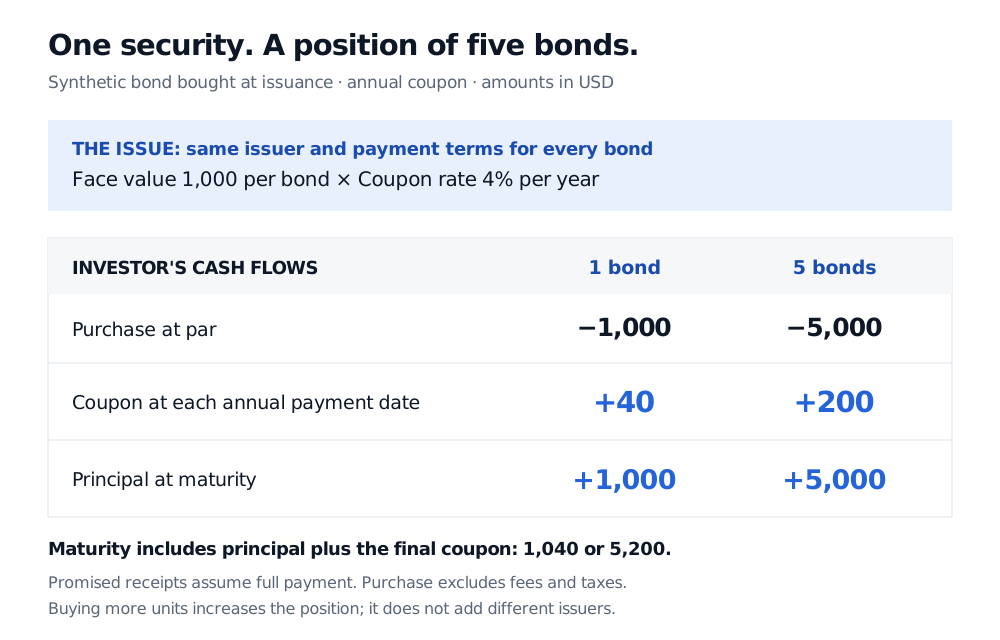
Original synthetic ledger, in USD. Negative amounts are purchase outflows; positive amounts are promised receipts. Principal and final coupon arrive together at maturity. No fees or taxes.
The security specifies the claim; the position specifies how much of it you hold. Five bonds of one issue increase exposure to that issuer. They do not provide the issuer diversification that five different borrowers might offer.
These promised payments also differ from the bond's current market value. A later buyer may pay more or less than par. SelfMadeQuant's Bonds and Yields lesson takes the next step from payment rights to discounted value; its public page is a preview and the full lesson requires membership.
A legal category with a wider boundary
Market shorthand is not a universal legal definition. For example, the U.S. Securities Act's statutory definition includes stocks, bonds and investment contracts, among other instruments. A product need not be an ordinary listed share or bond to fall within that definition.
Whether a particular arrangement is legally a security depends on the applicable jurisdiction, law and facts. Neither “it earns a return” nor “it can be traded” is a sufficient universal test. Nor should every financial contract automatically be labelled a security across all legal systems. Classification matters because it can affect disclosure, offering and trading obligations.
Finally, security does not mean safety or collateral. A security can lose value, default or be difficult to sell. As the SEC explains for corporate bonds, a secured bond has specific collateral pledged under its terms; the broader word security does not create those rights. Read the actual claim before choosing a valuation model or assuming protection.
Sources
- SEC, Glossary, entries “Security,” “Stock” and “Common Stock”: securities and the economic and voting rights of equity holders.
- U.S. Government Publishing Office, 15 U.S.C. §77b(a)(1), 2024 edition: an explicitly U.S. statutory definition, rather than a worldwide classification rule.
- SEC Investor.gov, Bonds — FAQs: debt claims, principal and coupon payments, default and market risks.
- SEC Investor.gov, Corporate Bonds: equity versus debt, claim priority and secured versus unsecured bonds.
- Bruce Tuckman, Fixed Income Securities: Tools for Today's Markets, 2nd ed., Wiley, 2002, Chapter 1, pp. 3–5: payment claims, face value, coupon rates and the distinction between promised payments and default-free receipts. The annual-pay example here is original and does not use the book's Treasury payment convention.