A capital gain is an increase in an asset's value relative to the amount used as its cost reference. In a simple investment calculation, it is the sale price minus the purchase price, multiplied by the quantity sold. For a quant, separating this price gain from income and sale proceeds prevents an inflated profit report.
The term has two uses that need care: economic price appreciation, which can be measured while an asset is still held, and a tax capital gain, calculated under the applicable jurisdiction's rules. The cost reference used for tax can differ from the original purchase price.
Separate the gain from the money returned
Suppose an investor buys 100 shares at USD 20 and later sells them at USD 22. During the holding period, the investor receives a USD 0.50 cash dividend per share. This is a synthetic, single-currency example with no fees, financing, taxes or other corporate actions. The dividend is kept as cash earning zero interest.
| Item | Calculation | Amount |
|---|---|---|
| Purchase cash flow | −USD 2,000 | |
| Sale cash flow | +USD 2,200 | |
| Gross realised capital gain | USD 200 | |
| Dividend income | USD 50 | |
| Total economic profit | USD 250 |
The USD 2,200 sale proceeds include the return of the USD 2,000 purchase outlay. Treating all proceeds as profit would count the original investment as earnings. Equally, adding the USD 50 dividend to the capital-gain line would hide the distinction between price appreciation and income. Investor.gov identifies those as separate reasons investors hold shares.
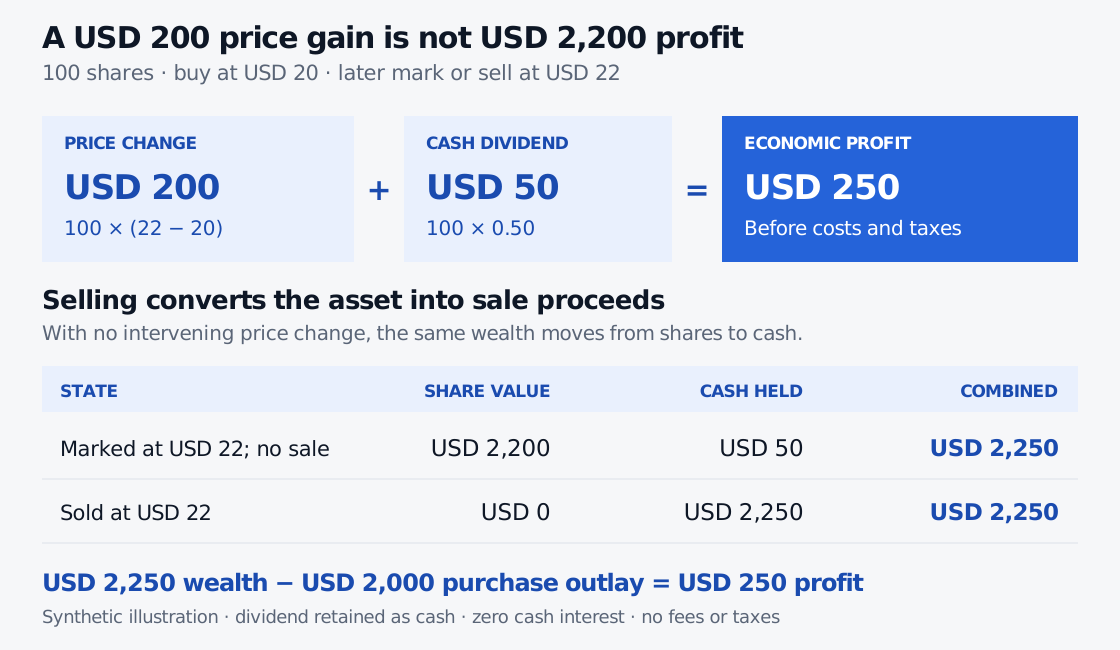
Original synthetic USD ledger. The dividend is retained as cash at zero interest; there are no costs or taxes. A sale at the marked price changes the form of wealth, not its amount at that instant.
The gross price return is . The gross total return, including the dividend, is . These are returns over the stated holding period, with no annualisation.
The Equities lesson extends this distinction to price and total-return indices. Its public preview is available; the full lesson requires membership.
A mark is not a sale
If the investor still holds the shares when the price reaches USD 22, the USD 200 price gain is unrealised in this economic ledger. The investor holds USD 2,200 of shares and USD 50 of dividend cash, rather than USD 2,250 entirely in cash.
Selling the shares at USD 22 converts the unrealised price gain into a realised one. It does not create another USD 200 of economic profit on top of the marked gain. Before sale, the share value can move again, and a quoted mark is not a guarantee that the whole holding can be sold at that price. Transaction costs, market impact and the available buyers matter when converting a valuation into cash.
A price decline is a capital loss under the same simple convention. Selling below the purchase price can produce a price loss even when dividends make the overall investment profitable; “received income” and “made a profit” answer different questions.
Costs and tax need their own ledger
If the example instead includes a USD 5 purchase charge and a USD 5 sale charge, the net economic gain from buying and selling is USD 190, and total economic profit after those charges is USD 240. The gross price gain remains USD 200. Label the cost convention so two reports can be compared fairly.
A tax calculation requires an additional step. As a US federal tax example, the IRS describes the gain on a capital-asset sale as the amount realised minus adjusted basis. Its definition is not simply “latest quote minus original quote”: basis can need adjustment, and special acquisition circumstances can change it. This example does not calculate anyone's taxable gain or tax bill.
Classification, recognition timing, allowable adjustments, loss relief and rates depend on the jurisdiction, asset, account and taxpayer. The economic labels “realised” and “unrealised” used above do not establish a universal rule about when tax is due. Keep the trade and income ledger, the performance calculation and the tax calculation identifiable, rather than assuming one number serves all three purposes.
Practice: sell only part of the holding
An investor buys 40 shares at USD 30, receives USD 0.25 cash dividend on each share, then sells 10 shares at USD 28. The remaining 30 shares are marked at USD 28. Assume one purchase lot, no other transactions, no costs or taxes and zero interest on retained cash. What are the realised price gain or loss, unrealised price gain or loss, and total economic profit?
Answer. The sale realises a USD 20 loss, since . The remaining position has a USD 60 unrealised loss, since . Dividend income is , so total economic profit is −USD 70. A separate wealth check gives USD 280 sale cash, USD 10 dividend cash and USD 840 of shares, against the USD 1,200 purchase outlay: . Counting only the realised loss would omit the decline in the shares still held.
Sources
- SEC Investor.gov — Stocks: capital appreciation, dividends and trading fees.
- IRS — Topic no. 409, Capital gains and losses: US federal capital-asset sale gains, adjusted basis and qualification of the tax treatment. Checked 25 October 2026; no tax rates are used here.
- Edwin J. Elton, Martin J. Gruber, Stephen J. Brown and William N. Goetzmann, Modern Portfolio Theory and Investment Analysis, 9th edition, Wiley, 2014, Chapter 2, printed pp. 21–22, and Chapter 4, Problem 2, printed p. 63: price appreciation versus dividend-inclusive returns. The figures and numerical examples above are original.