Short selling borrows and sells shares, then buys replacements to return. Follow a complete cash ledger, rising-price losses, collateral accounting and stock-loan risk.
Short selling
Short selling means selling shares you do not own, normally by borrowing them first, with an obligation to return equivalent shares later. A stock price decline can make those shares cheaper to replace. A price rise makes replacement more expensive.
The borrowing is a share loan: if you borrow 200 shares, you owe 200 equivalent shares, not the dollar value they had when you borrowed them. That distinction explains both the trade's profit calculation and its risk.
Consider a fictional cash-equity short arranged through a broker:
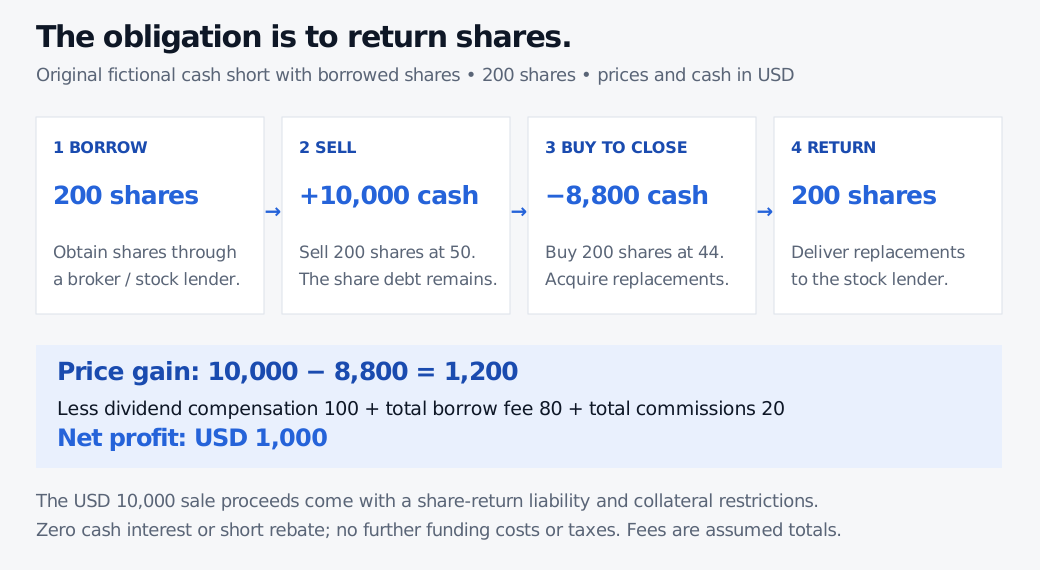
Borrow 200 shares. The stock loan creates the obligation to return equivalent shares of the same security.
Sell them at USD 50 each. The sale raises USD 10,000. Those proceeds come with the share-return liability and brokerage collateral restrictions; they are not profit or unrestricted spending money.
Buy 200 replacement shares at USD 44 each. This costs USD 8,800.
Return the replacement shares. This closes the share loan.
The difference between sale and repurchase is a USD 1,200 price gain. There are still other cash flows to settle.
Borrow 200 shares, sell them at USD 50 for USD 10,000, buy 200 at USD 44 for USD 8,800, and return the shares. The USD 1,200 price gain becomes USD 1,000 after USD 100 dividend compensation, USD 80 total borrow fee and USD 20 total commissions.
Original fictional illustration. The loan is discharged by returning shares. Sale proceeds accompany a liability and collateral restrictions; they do not become an immediate trading gain.
The price difference is only the starting point
Suppose the stock pays a USD 0.50 dividend per share during the holding period. The short seller owes the lender an equivalent payment of USD 100. Also assume a total stock-borrow fee of USD 80 and total entry-and-exit commissions of USD 20. The USD 80 is a stipulated aggregate charge for this example, not an annual borrowing rate.
Assume zero interest or rebate on the sale proceeds, no other financing costs or taxes, and enough funding to make each payment when due. The closed-position cash ledger is:
Cash flow
Amount in USD
Sell 200 shares at 50
+10,000
Buy 200 shares at 44
−8,800
Compensate lender for dividend
−100
Total borrow fee
−80
Total commissions
−20
Net profit
+1,000
For N shares, sale price S0, buyback price ST, total dividends per share D, total borrow fee B and total commissions C, these assumptions give
Π=N(S0−ST)−ND−B−C.
Thus
Π=200(50−44)−200(0.50)−80−20=USD 1,000.
A real stock borrow fee can vary with availability, time and the broker's charging basis. Cash collateral can also have interest, rebate or funding effects. Keep those items separate before combining them into profit and loss.
With the example's non-repurchase costs fixed at USD 200, break-even is a buyback price of USD 49, not USD 50:
200(50−ST)−200=0⇒ST=49.
What if the stock rises?
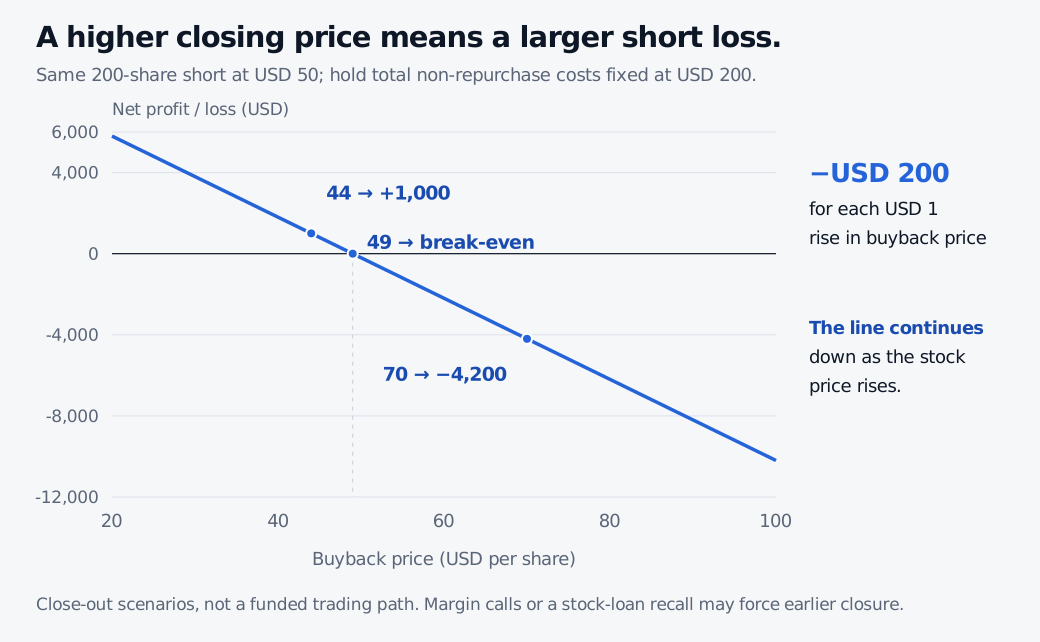
If the same short instead closes at USD 70, replacing the shares costs USD 14,000. Holding the same USD 200 other costs fixed gives
Π=10,000−14,000−200=−USD 4,200.
Every additional USD 1 in the buyback price reduces this 200-share position's profit by USD 200. The shorted stock can rise without a fixed theoretical upper bound, so the short's loss has no fixed theoretical ceiling. By comparison, an unlevered buyer of ordinary shares can lose the amount paid if the shares become worthless.
Net profit for 200 shares sold at USD 50, with USD 200 fixed other costs. Buyback at USD 44 gives USD 1,000 profit, USD 49 is break-even, and USD 70 produces a USD 4,200 loss. Each further USD 1 rise reduces profit by USD 200.
Original close-out scenarios, not a forecast or a path that is guaranteed to remain funded. Costs are held constant to isolate price exposure. The plotted line ends at USD 100; the stock price and potential loss are not capped there.
Return on whose money?
A short's sale proceeds are an unsuitable substitute for its equity capital. To make the accounting explicit, suppose a hypothetical broker arrangement requires the trader to post USD 5,000 of their own cash alongside the restricted USD 10,000 sale proceeds. This USD 5,000 is an illustrative assumption, not a universal minimum or regulatory requirement.
Initially the account has USD 15,000 cash and a USD 10,000 marked share-return liability, leaving USD 5,000 equity. With no additional deposits or withdrawals, the two close-out scenarios are:
Buyback price
Cash after repurchase and all stated costs
Profit relative to original USD 5,000 equity
Return on initial equity
USD 44
USD 6,000
+USD 1,000
+20%
USD 70
USD 800
−USD 4,200
−84%
This is a simplified funded-endpoint comparison. It assumes the trader can maintain the position and settle the stated costs until closing. In practice, rising prices or a broker's collateral requirement can require extra money or an earlier close. Once external cash flows occur, a return calculation must state how it treats them.
The trade may end before the price thesis does
Margin and collateral protect the broker or lender; they do not cap the trader's loss. An adverse price move may trigger a margin call or forced closure. The SEC's margin-account bulletin explains funding demands and the broker's ability to liquidate positions under the account agreement.
The share loan creates another constraint. A lender may recall shares; if replacement borrow cannot be arranged, a buy-in can close the short before the trader intended. Scarce borrow can also become expensive. A correct long-run price prediction does not ensure a profitable, executable short.
When many short sellers try to buy back simultaneously, their demand can add to an upward price move: a short squeeze. A model that records only entry and eventual exit prices misses the possibility that funding or borrow availability ends the trade between them.
SelfMadeQuant's Short Selling lesson develops the cash ledger, dividend compensation and recall risk. Margin and Collateral explains why collateral transfers create a funding problem as well as a risk buffer. Both have public previews; full lessons require membership.
Practice
1. What is the net profit and break-even price? A fictional trader borrows 120 shares, sells them at USD 30 and later buys them back at USD 27. While the short is open, the stock pays USD 0.25 per share in dividends. The total borrow fee is USD 45 and total commissions are USD 15. Assume zero cash interest or rebate, no other financing costs or taxes, and sufficient funding throughout.
Answer. Sale proceeds are USD 3,600 and repurchase costs USD 3,240. Dividend compensation is 120(0.25)=USD 30, making total other costs 30+45+15=USD 90. Net profit is 3,600−3,240−90=USD 270. With those costs fixed, break-even buyback price is 30−90/120=USD 29.25. Using USD 30 ignores the costs.
2. Has the cash balance protected the account? A separate hypothetical account posts USD 2,000 of its own cash and receives USD 4,000 from shorting 100 shares at USD 40. Cash stays restricted at USD 6,000. Before any dividends, fees or interest, the stock rises to USD 55. What is account equity? Assume the position is still open; no broker liquidation rule is specified.
Answer. Replacing the 100 shares now costs 100(55)=USD 5,500. Marked equity is therefore 6,000−5,500=USD 500, a USD 1,500 unrealised loss from the original USD 2,000. The unchanged cash balance has not prevented a loss: the share-return liability has increased. This calculation alone does not establish whether the account meets its broker's margin requirement.
John C. Hull, Options, Futures, and Other Derivatives, 9th edition, Global Edition, Section 5.2, pp. 127–128. Share loans, return obligations, dividend compensation, recall and margin mechanics; checked against the local source.
All numerical scenarios, figures and practice questions are original illustrations. They describe no prevailing borrow rate or broker offer.