The ex-dividend date is the first trading day on which a share is bought without entitlement to a specified dividend. For an ordinary cash dividend, buying on the ex-date is normally too late to receive that payment. The cutoff matters for trading, cash forecasts and return calculations: owning a share before the payment date is not enough.
The entitlement applies to this declared distribution, not to every future dividend. A buyer on the ex-date can still qualify for later distributions under their own schedules. Investor.gov's explanation describes the ordinary buyer–seller distinction.
Four events, two different clocks
The declaration starts the schedule. The ex-date determines whether the dividend travels with a trade; the record date identifies entitled holders in the issuer's records; the payment date is when the distribution is paid. Ex-date and record date can coincide while serving different purposes.
Consider a fictional regular-way cash dividend of 0.40 USD per share. The event terms explicitly stipulate that purchases before Day C carry this dividend and purchases on or after Day C do not. Trades settle normally, with no stock lending, special distribution or due-bill arrangement.
| Event | Fictional schedule | What happens |
|---|---|---|
| Declaration date | Day A | Board announces the dividend and schedule. |
| Last cum-dividend trading day | Day B | A purchase still includes this dividend entitlement. |
| Ex-dividend date | Day C, start of trading | A new buyer no longer acquires this dividend entitlement. |
| Record date | Day C | The issuer's record-date process identifies entitled holders. |
| Payment date | Day D | The dividend is paid; entitlement becomes cash. |
Nia buys 100 shares on Day B, then sells all 100 to Omar on Day C. Under these stipulated terms, Nia retains the dividend entitlement even though she no longer owns the shares when payment occurs. Her gross payment on Day D is USD. Omar receives 0 USD from this distribution. Neither receives dividend cash on Day C.
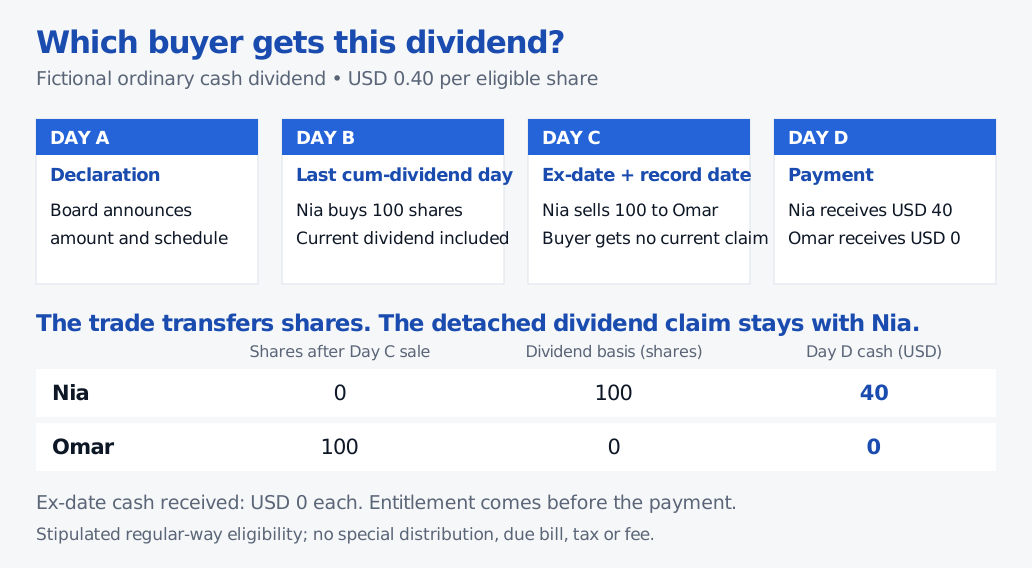
Original fictional calendar. Ex-date and record date share Day C; the dividend cash arrives on Day D. Eligibility is stipulated, not inferred from a universal settlement formula.
Use the announced ex-date, not an old shortcut
The settlement date helps explain why a trade-date cutoff is necessary, but its relationship to the record date depends on the market and event. Most U.S. broker-dealer securities transactions moved to T+1 settlement on 28 May 2024, subject to exceptions, as the SEC's settlement bulletin explains.
Under current FINRA Rule 11140(b)(1), distributions below 25% of the security's value, with sufficiently timely definitive information, normally have an ex-date on the record date when it is a business day. A record date on a designated non-delivery day instead uses the preceding business day. This is a U.S. rule context, not a worldwide calendar convention. FINRA Rule 11140
Special events can reverse the familiar ordering. Rule 11140(b)(2) sets the ex-date for distributions of 25% or more of the security's value on the first business day after the payable date. Due-bill arrangements can transfer a distribution entitlement through trades even after the record date. Check the actual corporate-action notice and applicable market rules; “I held on the record date” alone can be misleading. Investor.gov's special-dividend discussion
The detached claim is not free money
Use a separate, idealised investor who keeps 100 shares throughout. Assume zero interest, no tax, fees or other price-moving news. Just before the ex-date the shares trade at 20 USD. Stipulate a mechanical ex-price adjustment of exactly 0.40 USD and no subsequent price change through payment.
| Stage | Share value | Separate dividend asset | Combined wealth |
|---|---|---|---|
| Before ex-date | 100 × 20 = 2,000 USD | Included in the share claim | 2,000 USD |
| On ex-date | 100 × 19.60 = 1,960 USD | 40 USD receivable | 2,000 USD |
| On payment date | 1,960 USD | 40 USD cash; receivable extinguished | 2,000 USD |
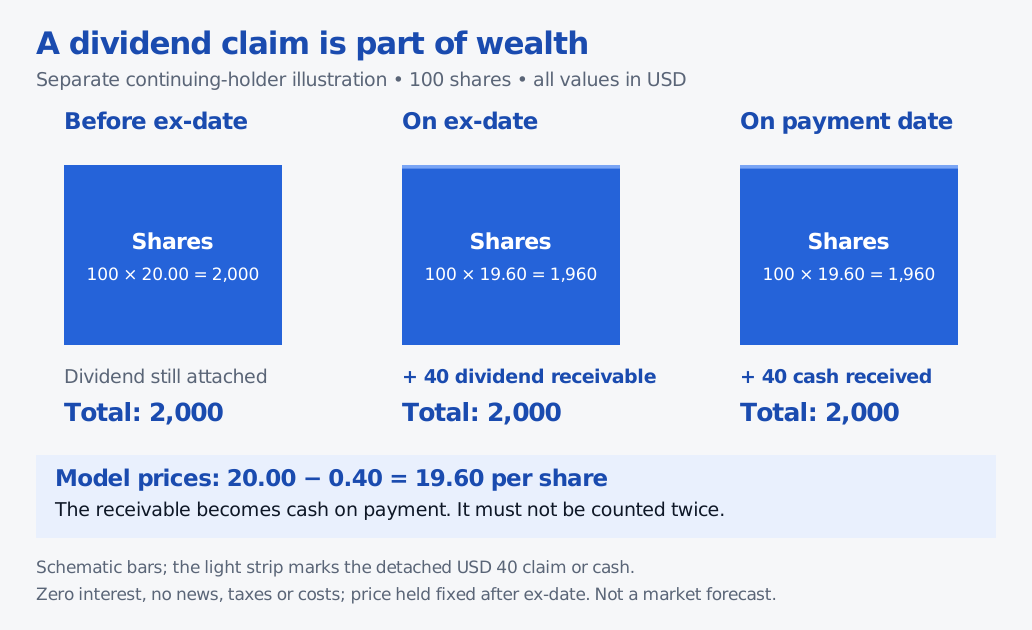
Original idealised wealth ledger. The 20-to-19.60 USD price change is stipulated; it is not a prediction of the actual market move. The light strip represents the detached claim, then cash.
Actual prices also respond to news, trading conditions and tax effects. The observed ex-date fall need not equal the dividend and the price can rise. Hull's dividend treatment illustrates the pricing adjustment and qualifies the effect of taxes; its simplified modelling convention does not make the actual payment date identical to the ex-date.
For total return, count the dividend once. In this idealised example the share-price return is −2%, while the gross return including the 40 USD entitlement is 0%. A backtest that ignores the dividend invents a loss; one that adds both the receivable and the later cash invents a gain. The ex-date does not make the receivable spendable cash; payment is a later event.
For the broader treatment of corporate actions and adjusted price data, see Equities, Indices and Corporate Actions (public preview; full lesson requires membership).
Sources
- SEC Investor.gov — Ex-Dividend Dates: When Are You Entitled to Stock and Cash Dividends: ordinary entitlement and special-distribution cautions; checked 25 October 2026.
- FINRA — Rule 11140: current ex-date designation rules, including the 25% threshold and late-information provisions; checked 25 October 2026.
- SEC Investor.gov — New T+1 Settlement Cycle: U.S. settlement change effective 28 May 2024.
- John C. Hull, Options, Futures, and Other Derivatives, 9th Global Edition, Pearson, 2018, Chapter 11, “Amount of Future Dividends,” pp. 259–260, and §15.12, “Dividends,” p. 365, including footnote 11. Used for the idealised price adjustment and its limitations, not current settlement rules.