Non-controlling interests (NCI) are the equity stakes in a consolidated subsidiary held by investors outside the parent’s group. Under full consolidation, the group reports the subsidiary’s results line by line after consolidation adjustments, then attributes profit or loss to the parent’s owners and to the outside owners. For an analyst, that means consolidated profit measures the group’s performance, while profit attributable to the parent’s owners measures their share. IFRS 10, Appendix A and paragraphs B86, B88 and B94
Follow the outside share from profit to equity
Suppose a parent controls a subsidiary and owns 80% of its single class of ordinary shares. All shares have equal rights to earnings and distributions. The subsidiary earns USD 50 million after the parent obtains control, and there are no consolidation adjustments to that profit. The subsidiary contributes the entire USD 50 million to the consolidated income statement. Of that amount, million is attributable to the parent’s owners and million to outside owners. Both amounts are included in consolidated profit. IFRS 10, paragraphs 20, B86, B88 and B94
On the consolidated balance sheet, NCI sits within equity, separately from equity attributable to the parent’s owners. Start with an opening NCI balance of USD 40 million. If the subsidiary pays a USD 10 million dividend, USD 8 million goes to the parent and is eliminated in consolidation. The USD 2 million paid to outside owners leaves the group and reduces NCI equity. With no other movements, the closing NCI balance is million. The dividend is an equity distribution. The period’s profit attribution stays at USD 10 million. IFRS 10, paragraphs 22, B86(c) and B94 and the IFRIC agenda decision following paragraph 24
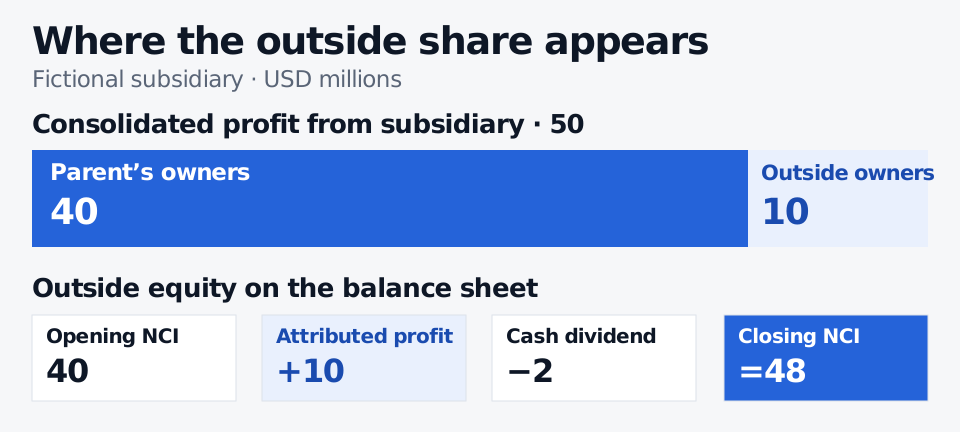
The outside share of profit increases non-controlling equity by USD 10 million. The cash dividend to those owners reduces it by USD 2 million.
For a subsidiary with material NCI, look in the notes for outside ownership and voting percentages, profit or loss allocated to outside owners, closing NCI and dividends paid to them. Other comprehensive income can also change the equity balance. The straight 80/20 split assumes equal rights per share. For example, cumulative preference shares classified as equity and held by outside investors affect the profit split even if their dividends have yet to be declared. IFRS 12, paragraphs 12 and B10, IFRS 10, paragraphs B94–B95
Where the opening equity balance comes from
Under IFRS 3, when an acquirer obtains control of a business, it can measure eligible NCI at acquisition-date fair value or at the outside holders’ proportionate share of the recognised identifiable net assets. That choice applies per business combination to existing ownership interests that carry a pro rata claim to net assets on liquidation. Other components generally use acquisition-date fair value unless another IFRS requires a different basis. The measurement sets the opening NCI balance and can change recognised goodwill. Look for the basis used in the acquisition note. If the parent later buys out some outside owners while keeping control, the group accounts for the purchase within equity. IFRS 3, paragraphs 19, 32 and B64(o), IFRS 10, paragraphs 23 and B96
Match the outside stake to consolidated EBITDA
Consolidated EBITDA includes the operating result of the entire subsidiary. The parent’s market capitalisation covers only the parent’s equity claim, including its stake in the subsidiary. In the enterprise value numerator of consolidated EV/EBITDA, add the current market value of the outside equity claim to match the scope of the denominator. For a listed subsidiary with a single quoted share class, multiply the current share price by the number of shares held outside the group. A private stake requires an estimate. The balance-sheet figure reflects acquisition accounting and subsequent equity movements, so it can differ from the current market value. Damodaran, EV Multiples and Cross Holdings, Holdings in Other Firms
Sources
- IFRS Foundation, IFRS 10 Consolidated Financial Statements, IFRS 3 Business Combinations and IFRS 12 Disclosure of Interests in Other Entities.
- Aswath Damodaran, NYU Stern, EV Multiples and Cross Holdings and Holdings in Other Firms.