Goodwill is the residual asset recorded in a business combination when the consideration and any other ownership interests included in the calculation exceed the recognised identifiable net assets acquired. Identifiable intangible assets are non-monetary assets without physical substance, such as a registered trademark or a patent, that can be identified separately from goodwill. The split matters for earnings forecasts. A finite-life intangible generates an amortisation charge over its useful life, while goodwill under full IFRS is subject to impairment testing. IFRS 3, paragraph 32 and B63(a), IAS 38, paragraphs 8–12 and 88–89
Why a brand can appear on the balance sheet after a sale
An acquired intangible is identifiable if it can be separated and sold, licensed or otherwise transferred, on its own or with a related item. It also qualifies if it arises from contractual or other legal rights, even when those rights cannot be transferred. A registered trademark can qualify through the rights it confers. The acquirer generally records the identifiable intangible at acquisition-date fair value. Goodwill can reflect expected benefits from combining the businesses, such as using the acquirer's distribution network to sell the target's products. Its recorded amount is a residual, so it cannot tell you how much those synergies are worth on their own. IFRS 3, paragraphs 10–18 and B31–B34, IAS 38, paragraphs 11–12 and 33–35
IAS 38 prohibits a company from recognising its own internally generated brand or goodwill. When that company is acquired, its identifiable brand can appear in the buyer's consolidated statements even though the target never reported it as an asset. Other kinds of internal spending have different rules. For instance, development costs are capitalised once they meet the applicable recognition criteria. IFRS 3, paragraph 13, IAS 38, paragraphs 48–50, 57 and 63–65
A USD 500 million acquisition
In this fictional purchase price allocation, the buyer pays USD 500 million in cash for 100% of a business it had no prior stake in. The identifiable assets have an acquisition-date fair value of USD 600 million, including a USD 40 million brand. The buyer assumes USD 200 million of liabilities. Assume no other consideration or acquisition-date deferred tax adjustment. In USD millions, the identifiable net assets are , so goodwill is
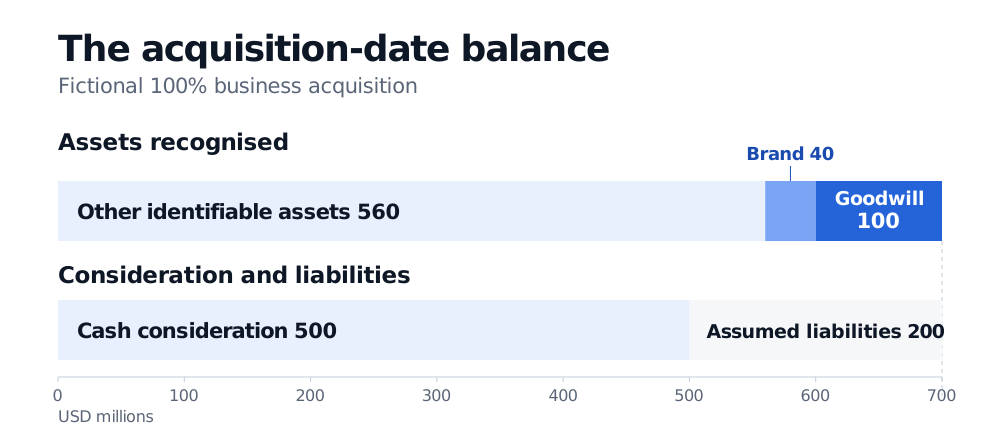
The brand is part of the USD 600 million of identifiable assets. Goodwill is the separate USD 100 million that balances the acquisition entry.
The calculation uses the recognised acquisition-date amounts, which can differ from the target's old book values. A deal with outside shareholders or an earlier stake also brings the measured non-controlling interest or the acquisition-date fair value of the prior stake into the goodwill calculation. IFRS 3, paragraphs 18–19, 24 and 32
What reaches earnings after the deal
- Finite-life intangible. The acquirer starts amortising it when it is available for use. Suppose the brand is ready on day one, has a ten-year useful life and zero residual value, and the pattern of consumption cannot be measured reliably. Straight-line amortisation charges USD 4 million to earnings in the first full year, leaving USD 36 million on the balance sheet before any impairment. IAS 38, paragraphs 97–100
- Indefinite-life intangible. If the relevant evidence points to no foreseeable limit to the period of net cash inflows, the asset carries no scheduled amortisation. The company tests it for impairment annually and whenever there is an impairment indicator, and reassesses its useful life each reporting period. IAS 38, paragraphs 88–89 and 107–110
- Goodwill. Under full IFRS, goodwill has no scheduled amortisation. The cash-generating unit or group of units to which it is allocated is tested annually and when there is an impairment indicator. A write-down can therefore hit earnings years after the deal. The goodwill impairment entry explains how the test works. IFRS 3, B63(a), IAS 36, paragraphs 80, 90 and 104
For an earnings forecast, start with the acquisition note for the amounts recognised and management's explanation of goodwill. Then check the intangible assets note for useful lives and amortisation by class. When goodwill moves between reporting dates, read the goodwill reconciliation to distinguish new acquisitions and impairments from disposals or currency movements. Two companies with economically similar brands can report different assets and earnings if one built its brand and the other bought it. IFRS 3, B64(e), B64(f), B64(i) and B67(d), IAS 38, paragraph 118