Purchase price allocation (PPA) is the acquisition-date accounting that assigns opening amounts to the identifiable assets and liabilities of a newly controlled business, measures any outside equity and determines the residual goodwill or bargain purchase gain. The allocation sets the new carrying amounts in the buyer’s consolidated balance sheet. It can also change future earnings when the buyer starts amortising an acquired patent that the target had never recorded. IFRS 3, paragraphs 4–5, 10–19 and 32–36, IAS 38, paragraphs 33–35 and 97
What gets recognised when control passes
Under the acquisition method, the buyer consolidates the whole business, even when it acquires less than all the shares. It recognises identifiable assets and assumed liabilities, generally at their acquisition-date fair values, subject to exceptions. If the acquired set falls short of the definition of a business, an asset acquisition generally allocates cost using relative fair values and gives rise to no goodwill. IFRS 3, paragraphs 2(b), 3, 8–10 and 18–24, ASC 805-10-25-1 and 805-50-30-3
The recognised net assets include any qualifying deferred tax assets or liabilities. Under IFRS, for example, marking up an acquired asset while its tax base stays lower can create a deferred tax liability. The liability reduces identifiable net assets and increases goodwill, holding the other inputs fixed. In a business combination, advisory and legal fees are expensed as the services are received. Debt and equity issuance costs follow the applicable financing rules. IFRS 3, paragraphs 24–25 and 53, IAS 12, paragraphs 19 and 66, ASC 805-10-25-23
One cash price, two opening entries
A buyer pays USD 360 million in cash for 80% of a fictional business and obtains control. It held no shares before the deal. The business has USD 600 million of identifiable assets and USD 200 million of assumed liabilities at acquisition-date fair values. Assume no additional consideration or deferred tax adjustment. The opening accounts include all USD 400 million of identifiable net assets.
Under U.S. GAAP, ASC 805 requires acquisition-date fair value for the non-controlling interest (NCI). IFRS 3 allows a choice for each deal for existing ownership interests that give holders a proportionate claim on net assets at liquidation. The buyer can measure those interests at fair value or at their share of recognised identifiable net assets. Other NCI components use acquisition-date fair value unless another IFRS standard requires a different basis. ASC 805-20-30-1 and 805-30-30-1, IFRS 3, paragraph 19
Assume the outside ordinary shares qualify for the IFRS choice and have an independently measured fair value of USD 90 million. On the proportionate basis their opening amount is million. Goodwill is the consideration plus the measured NCI, less all the identifiable net assets. In a staged deal, add the acquisition-date fair value of any previously held equity stake as well. IFRS 3, paragraphs 32 and 42, ASC 805-30-30-1
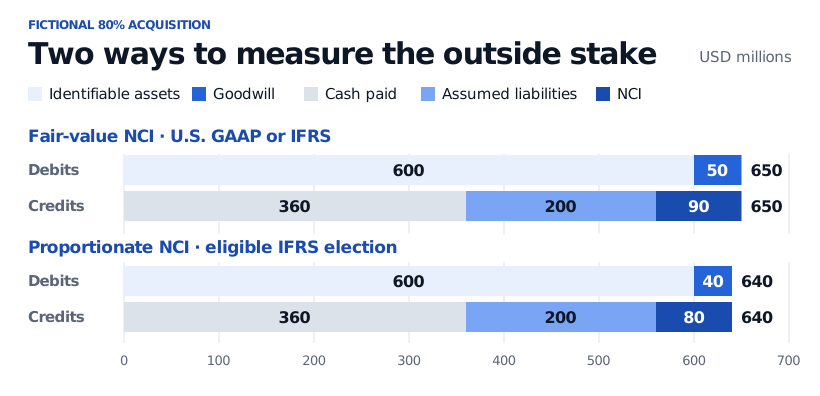
Both entries record the same identifiable assets and liabilities. Measuring NCI at fair value adds USD 10 million to goodwill and USD 10 million to outside equity in this example.
The cash credit is the reduction in the buyer’s cash balance. The outside shareholders keep their shares, so their measured interest goes into consolidated equity. Although USD 90 million happens to equal one-quarter of the buyer’s price for the 80% stake, the price per share can differ between a controlling block and outside shares. If the goodwill calculation produces a negative residual, reassess the identification and measurements before recognising any remaining excess as a bargain purchase gain in earnings. IFRS 3, paragraphs 34–36 and B44–B45, ASC 805-30-25-2 through 25-4
Reading the acquisition note
Start with consideration, the amounts recognised by asset and liability class, and the basis used for NCI. If the initial figures are provisional, check what is still being valued and look for revisions in later filings. Under IFRS 3, the measurement period is limited to one year after acquisition and adjustments reflect facts that existed when control passed. For a forecast, carry the acquired finite-life intangibles into the amortisation schedule. The amortisation charge can move earnings per share in a later period without a corresponding cash outflow. IFRS 3, paragraphs 45–50, B64(f), B64(i), B64(o) and B67(a), IAS 38, paragraphs 89 and 97–99
Immersion’s final allocation for Barnes & Noble Education shows the bridge from consideration, NCI and net assets to goodwill. A separate table gives the assigned useful lives for the trade name and customer relationships. Immersion Corporation fiscal 2026 Form 10-K, Note 3