A deferred tax liability (DTL) records a future increase in income tax from a taxable temporary difference. A deferred tax asset (DTA) records a future income tax benefit from a deductible temporary difference or eligible unused tax losses or credits. These balances help explain why the tax expense in earnings can move differently from the taxes a company pays. IAS 12, paragraphs 5 and 10
Start with what will happen when the balance clears
A temporary difference is a gap between an asset or liability’s carrying amount in the financial statements and its tax base, the amount attributed to it under tax rules. Ask what happens to taxable profit when the company recovers the asset or settles the liability. If reversing that gap adds to taxable profit, the difference is taxable. If the reversal creates a deduction, the difference is deductible. Under IFRS, taxable temporary differences generally give rise to a DTL, with exceptions including the initial recognition of goodwill. Recognition of a DTA also depends on whether the benefit can be used. IAS 12, paragraphs 5–10, 15 and 24–25
A permanent difference affects the link between book and taxable profit without reversing later. A fine that is never tax-deductible reduces book profit, and paying it later brings no deduction. The fine can raise the effective tax rate without creating a DTA. IAS 12, paragraphs 8 and 84–86
Two differences at the same tax rate
These independent fictional cases show gross balances in USD. Assume an enacted flat income tax rate of 25% applies throughout, including in the periods when the differences reverse. IAS 12 uses the rate expected when the asset is realised or the liability is settled, based on rates and laws enacted or substantively enacted at the reporting date. US GAAP uses enacted rates expected to apply at realisation or settlement. IAS 12 measures the balance without discounting. IAS 12, paragraphs 47–53, US banking agencies on ASC 740 measurement
Machine. A company capitalises a USD 100 machine. In Year 1 it records USD 20 of book depreciation and claims USD 40 of tax depreciation. The carrying amount is USD 80 and the tax base is USD 60, the deductions still available as the machine generates taxable income. The taxable temporary difference is USD 20, so the DTL is . In Years 2–5, book depreciation is USD 20 each year and tax depreciation is USD 15. The smaller tax deduction makes current tax USD 1.25 higher each year than tax at 25% of book profit, while the DTL falls by USD 1.25 each year to zero. IAS 12, paragraphs 7, 16–17 and 47
Warranty. A company records a USD 25 warranty expense and liability in Year 1. The whole cost becomes deductible when the company pays the claims in Year 2. The tax base of the liability is its carrying amount less the future deduction, or . The deductible temporary difference is USD 25, giving a DTA of if the whole deduction can be used. When the company pays the claims and uses the deduction, it reduces Year 2 current tax by USD 6.25. The DTA falls to zero. IAS 12, paragraphs 8 and 24–25
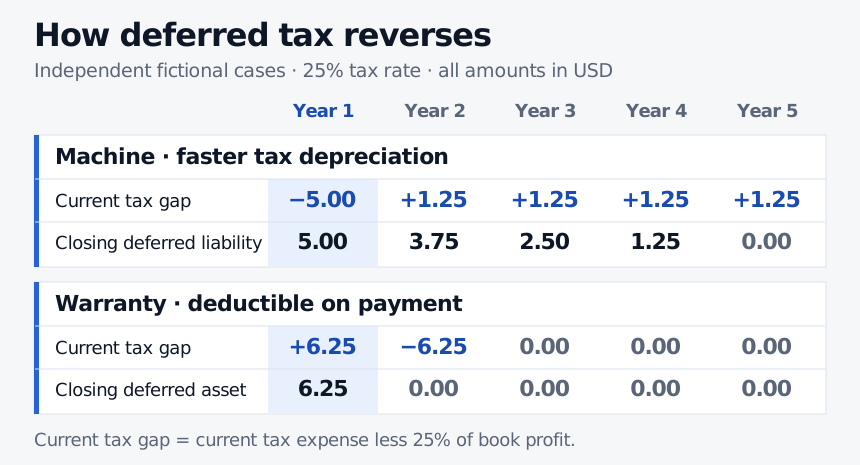
The machine takes part of its tax deduction early. The warranty gets its deduction when the claims are paid. The initial current tax gap reverses in each case.
How much of the tax benefit can the company use?
Under IAS 12, recognise a DTA only to the extent that suitable taxable profit is probable. That can include taxable amounts from other temporary differences reversing in the right tax jurisdiction, entity and period. A tax loss carryforward can also generate a DTA if the company can use it under the applicable tax rules. Under US GAAP, ASC 740 measures the gross DTA and records a valuation allowance against the portion that is more likely than not to go unused, weighing positive and negative evidence. IAS 12, paragraphs 24 and 27–37, FFIEC, September 2026 instructions, Income Taxes
Suppose the warranty company can use only USD 15 of the deduction. It has no other source of taxable profit for the deduction and cannot carry the unused tax loss to another period. At 25%, IAS 12 recognition is limited to USD 3.75. Under ASC 740, a USD 2.50 valuation allowance brings the gross USD 6.25 DTA down to a net USD 3.75. Better evidence of future taxable profit can support a later release of the allowance. A release through earnings lowers reported tax expense and raises net income at that point. The cash saving comes when the company uses the deduction. IAS 12, paragraphs 24, 37 and 56, FASB staff, Topic 740 discussion, paragraphs 31–34
Read the tax note before forecasting cash tax
Start with the tax note’s split between current and deferred tax expense and the balances by source. Separate movements from new and reversing differences, rate changes and revisions to DTA recoverability. Some deferred tax movements follow the underlying item into other comprehensive income or equity, so the change in the balance sheet line alone can misstate the deferred tax expense in earnings. For a free cash flow model, forecast taxable profit and usable deductions by period and jurisdiction. Use the cash flow statement to check taxes actually paid, which can differ from current tax expense because payments and refunds can fall in different periods. IAS 12, paragraphs 57–61A and 79–82, IAS 7, paragraphs 35–36
Sources
- IFRS Foundation, IAS 12 Income Taxes
- IFRS Foundation, IAS 7 Statement of Cash Flows
- FFIEC, September 2026 Instructions for Preparation of Consolidated Reports of Condition and Income
- Federal Reserve, Interagency Statement on Accounting and Reporting Implications of the New Tax Law
- FASB staff, December 2023 Topic 740 board-meeting handout