Depreciation allocates the depreciable amount of a tangible asset, such as equipment, over its useful life. Amortisation does the same for a recognised intangible asset with a finite useful life, such as a purchased licence. Together, they’re often called D&A. Useful-life estimates can change reported operating profit and the balance sheet value of the assets without a new cash payment. IAS 16, paragraphs 6 and 48–51, IAS 38, paragraphs 97–104
Two assets with the same annual charge
Once the company has recognised a cost as an asset, the next question is how much of it to allocate to each period. For a cost-based asset on a straight-line schedule, with unchanged estimates and no impairment, the full-year charge is
Under IFRS, residual value is what the company estimates it could receive today, net of disposal costs, for an asset already at the age and in the condition expected at the end of its useful life. IAS 38 generally assumes a zero residual for finite-life intangibles, with narrow exceptions for a third-party purchase commitment or a qualifying active market. The carrying amount, also called book value, is recorded cost less accumulated D&A and any accumulated impairment losses under the cost model. IAS 16, paragraphs 6, 30 and 50–62, IAS 38, paragraphs 74 and 97–103
A fictional company has equipment that cost 120 with a residual value of 20 and a five-year useful life. It also has a purchased licence that cost 60 with zero residual value and a three-year useful life ending at expiry. All figures are in USD thousands. Both assets are ready at the start of Year 1. The company uses straight-line allocation and charges both amounts to profit. There are no impairments or changes in estimates in the chart.
- Equipment. Year 1 depreciation is . The year-end carrying amount is .
- Licence. Year 1 amortisation is . The year-end carrying amount is .
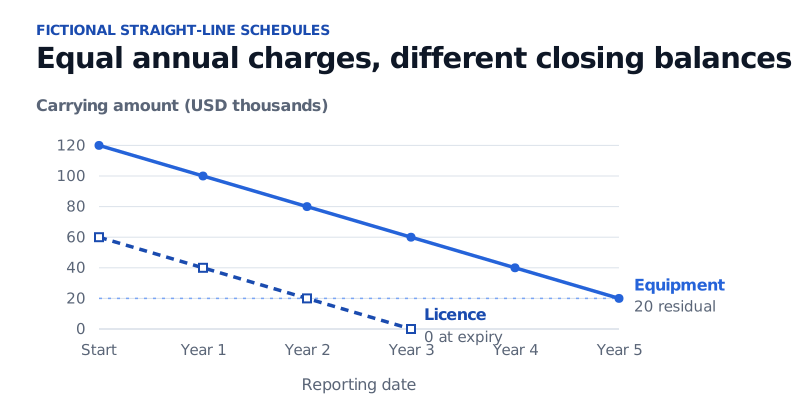
Both balances fall by 20 per year until their schedules end. The equipment still carries its 20 residual value at the end of Year 5.
The charge normally reaches profit or loss. When an asset helps produce inventory, its D&A can instead enter the cost of that inventory. Straight-line allocation gives a constant charge in the example. For an asset whose consumption depends on output, a units-of-production method can make the charge vary with use. IAS 38 requires straight-line amortisation when the consumption pattern cannot be determined reliably. IAS 16, paragraphs 48–49 and 60–62, IAS 38, paragraphs 97–99
What changes the schedule?
The date the asset is ready. Both charges begin when the asset can operate as intended. If the equipment were bought in January but installation made it available on 1 July, six months of straight-line depreciation would give a Year 1 charge of 10 under monthly proration. A later first production run would leave the July start date in place if the equipment was already ready. IAS 16, paragraph 55, IAS 38, paragraph 97
A revised useful life. Take the original schedule and suppose new information at the start of Year 2 extends the equipment’s remaining useful life from four years to five, with the residual value still 20. The company spreads the remaining over those five years. The annual charge drops from 20 to 16, raising Year 2 pre-tax profit by 4, all else equal. The revision applies from the date of the change, so the Year 1 charge stays at 20. IAS 16, paragraphs 51 and 61, IAS 8, paragraphs 36–39
An impairment. D&A allocates the asset’s recorded amount over time. A long-lived asset impairment writes the asset down if its carrying amount exceeds its recoverable amount under IAS 36. That recoverable amount is the higher of value in use and fair value less disposal costs. Future D&A then uses the reduced carrying amount, residual value and remaining useful life. Indefinite-life intangibles have no scheduled amortisation under IAS 38 and are tested for impairment annually and when there is an indicator. IAS 36, paragraphs 18 and 59–63, IAS 38, paragraphs 107–108
Reading earnings and cash flows
If depreciation falls while sales and costs other than D&A are stable, operating profit can rise while EBITDA stays flat. To see where the improvement came from, check the equipment and intangible-asset notes for useful lives, methods and changes in carrying amounts. Under the cost model, those estimates affect the book value. An estimate of the asset’s current market value requires separate evidence. IAS 16, paragraphs 30, 52 and 73, IAS 38, paragraphs 74 and 118
In an indirect cash flow statement reconciliation, add back D&A included in the starting profit figure because the charge itself uses no cash. The cash paid to acquire equipment or a licence belongs with investing cash flows. In a free cash flow forecast, estimate reinvestment separately from the D&A add-back. A book charge reflects earlier capitalised costs. A future replacement depends on what the company needs and what it will pay. Tax deductions follow the applicable tax rules and can run on a different schedule from book D&A. IAS 7, paragraphs 16(a) and 20, IAS 12, paragraphs 7 and 17(b)–(c)