A long-lived asset impairment test determines whether a company must write down the carrying amount of an asset it still uses, such as a production line or a warehouse. The carrying amount is the balance after accumulated depreciation and any prior write-downs. Under the cost model, a write-down reduces both the asset balance and reported earnings. The entry uses no cash, but the weaker operating outlook that prompted the test may change a cash flow forecast. SEC Staff Accounting Bulletin Topic 5.CC, IAS 36, paragraphs 6 and 59–63
Start with the trigger and what you are testing
A breakdown that cuts a line’s output or a steep drop in demand can trigger a test. Under US GAAP, ASC 360 calls for a recoverability test when events or changed circumstances suggest that the carrying amount may be unrecoverable. Under full IFRS, IAS 36 calls for an indicator check at each reporting date for ordinary operating assets and a recoverable amount estimate when an indicator is present. Goodwill, indefinite-life intangibles and intangibles still unavailable for use have annual testing requirements under IAS 36. In the US, ASC 350 governs goodwill and indefinite-life intangibles. Both frameworks use separate rules once an asset is classified as held for sale. ASC 360-10-35-21, SEC Topic 5.CC, IAS 36, paragraphs 2 and 8–14
A single machine may produce nothing the company can sell until several other machines finish the product. Under ASC 360, group assets and relevant liabilities at the lowest level with identifiable cash flows largely independent of other assets and liabilities. Under IAS 36, if the individual asset’s recoverable amount cannot be estimated, test its cash-generating unit (CGU), the smallest group of assets with largely independent cash inflows. For a machine on an integrated line, the production line may be the appropriate unit. ASC 360-10-35-23, IAS 36, paragraphs 66–71
US GAAP checks recoverability before measuring a loss
- Screen using undiscounted cash flows. Add the expected net cash flows from using the asset group and eventually disposing of it. If that total equals or exceeds the carrying amount, the test ends with no impairment charge, even if fair value is lower.
- Measure using fair value. If the group fails the screen, recognise any excess of its carrying amount over fair value. Fair value reflects a market participant’s perspective at the measurement date. The screen uses the company’s own assumptions about its use of the group. SEC Topic 5.CC, ASC 360-10-35-17 and 35-30, FASB’s amendments to ASC 820-10-35-9 through 35-9B
Suppose a fictional asset group carries at USD 100 million and is expected to generate USD 95 million of undiscounted net cash flows. It fails the screen. If fair value is USD 80 million, the company records an impairment loss of million and reduces the group’s carrying amount to USD 80 million.
IAS 36 compares carrying amount with recoverable amount
Recoverable amount is the higher of fair value less costs of disposal and value in use. The first is a market-based sale value net of direct incremental disposal costs. The second is the present value of the cash flows from continued use in the asset’s current condition and eventual disposal. IAS 36 compares carrying amount directly with recoverable amount. If either valuation exceeds carrying amount, the company can stop there. IAS 36, paragraphs 6, 18–20, 28, 39, 44 and 59
Consider a separate fictional CGU with a carrying amount of USD 100 million, fair value less costs of disposal of USD 80 million and value in use of USD 85 million. Its recoverable amount is million. The loss is million, leaving a carrying amount of USD 85 million. Both examples set aside goodwill and tax effects. The USD 80 million represents fair value in the US example and a value net of disposal costs in the IFRS example. The different charges illustrate the steps in each test. Their relative size depends on the inputs and can change across cases.
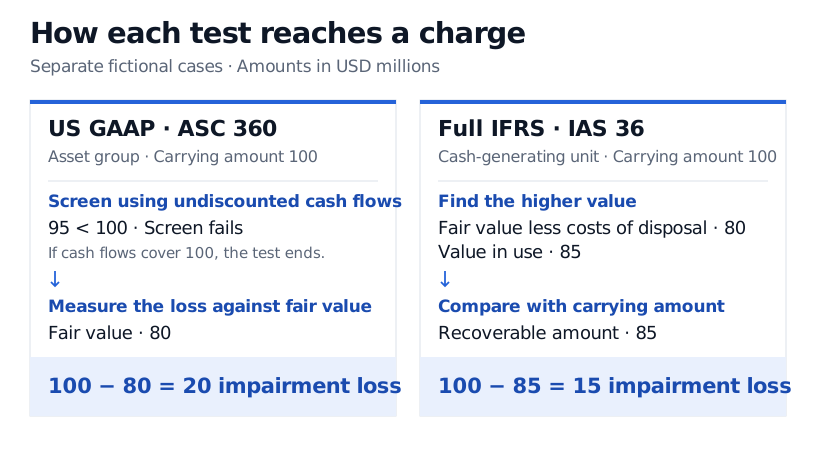
The US screen determines whether to measure a loss. IAS 36 uses recoverable amount to determine both whether there is a loss and how large it is.
What changes after a write-down
Under ASC 360, update other assets and liabilities in the group, apart from goodwill, under the rules that govern them before screening the group. For example, write down inventory under its own rules first. If both the long-lived asset group and reporting-unit goodwill are tested at the same time, record any write-down on the group before testing goodwill. IAS 36 likewise tests separately assessable assets or smaller CGUs first when their tests coincide with that of a larger unit containing goodwill. If a CGU incurs a loss, IAS 36 allocates it to any goodwill first and then to other assets in proportion to their carrying amounts, subject to asset-level floors. ASC 360-10-35-27, FASB’s amendments to ASC 350-20-35-31 and 35-32, IAS 36, paragraphs 97–98 and 104–105
Future depreciation allocates the revised carrying amount, less any residual value, over the remaining useful life. ASC 360 prohibits reversing the loss while the asset remains held and used. Under IAS 36, if changed estimates lift recoverable amount above the carrying amount of a previously impaired asset other than goodwill, reverse the loss. Increase the carrying amount to the new recoverable amount, capped at the depreciated or amortised balance that would have applied without the original write-down. ASC 360-10-35-20, IAS 36, paragraphs 63 and 114–124
In a filing, trace the charge from the impairment note to the income statement and the noncash adjustment in the cash flow statement under the indirect method. Natural Alternatives International’s fiscal 2026 filing shows both entries for the write-down of its Carlsbad facility. For a forecast, update the depreciation schedule from the revised asset balance and revisit the assumptions that drove the test. Adding back the accounting charge leaves any deterioration in expected sales or operating cash flows to be modelled separately. Natural Alternatives International, fiscal 2026 Form 10-K, Note A and consolidated statements
Sources
- SEC Staff Accounting Bulletin Topic 5.CC, Impairments
- FASB ASC 360-10-35, Codification extract reproduced in a Kentucky PSC docket
- FASB ASU 2011-04, amendments to ASC 820 on fair value measurement
- FASB ASU 2017-04, amendments to ASC 350-20 on goodwill impairment
- IFRS Foundation, IAS 36 Impairment of Assets
- Natural Alternatives International, fiscal 2026 Form 10-K