Goodwill impairment is an accounting write-down of goodwill recognised in an acquisition. The test compares the book amount of the business to which goodwill is assigned with a value measured for that business. The charge reduces reported earnings and the goodwill balance. Recording it uses no cash, but the weaker cash-flow outlook that sometimes prompts it can matter to a valuation. ASC 350-20-35-1 to 35-8, IAS 36, paragraphs 90 and 104
The US GAAP test has a ceiling
Under the general ASC 350 model, acquired goodwill has no scheduled amortisation. It is tested annually and between annual tests when events or changed circumstances make it more than 50% likely that the reporting unit's fair value is below its carrying amount. A reporting unit is an operating segment or a qualifying component one level below it. A company can start with a qualitative assessment or go straight to the quantitative comparison. Compare the unit's fair value with the carrying amount of the same unit, including its goodwill. ASC 350-20-35-1 to 35-8 and 35-28 to 35-30, Microsoft, fiscal 2026 Form 10-K, Note 1
Suppose a wholly owned reporting unit has a carrying amount of USD 500 million, including USD 100 million of goodwill, and a fair value of USD 420 million on the test date. Assume no other asset write-down is required before the test and no deferred tax adjustment arises from tax-deductible goodwill. The company charges the positive shortfall to goodwill, up to the unit's goodwill balance. In USD millions,
Goodwill falls to million. The unit's carrying amount falls to million. If a separate asset or asset group must be tested at the same time, ASC 350 calls for that test and any resulting write-down before the goodwill test. ASC 350-20-35-8 to 35-8B and 35-31 to 35-32
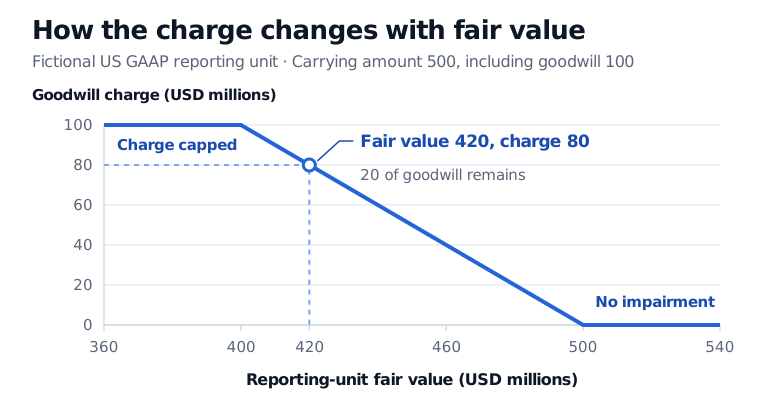
At fair values below USD 400 million, writing goodwill down to zero still leaves USD 400 million of net carrying amount.
Eligible US private companies and not-for-profit entities can elect to amortise goodwill over ten years or a justified shorter life and test it when a triggering event occurs, at either the entity or reporting-unit level according to their policy election. A separate election lets eligible entities evaluate triggering events at the end of each reporting period. ASC 350-20-35-62 to 35-66, ASC 350-20-35-83 to 35-85
IAS 36 changes the unit and the benchmark
Under full IFRS, goodwill is allocated to the cash-generating unit (CGU) or group of CGUs expected to benefit from the acquisition synergies. A CGU is the smallest identifiable set of assets with largely independent cash inflows. The goodwill test takes place at the lowest level where management monitors goodwill, with an operating segment before aggregation as the upper limit. The company tests annually and when there are signs of impairment. IAS 36, paragraphs 6, 80 and 90
The benchmark is recoverable amount, the higher of fair value less disposal costs and value in use. Value in use is the present value of the cash flows expected from the assets in their current condition. If the unit's carrying amount exceeds its recoverable amount, the loss reduces goodwill first. Any excess is allocated to the other assets in proportion to their carrying amounts, subject to asset-level floors. A previously recognised goodwill impairment is irreversible under both frameworks. IAS 36, paragraphs 6, 44, 74, 104–105 and 124, ASC 350-20-35-13
When a charge appears in the income statement, the goodwill note can identify the affected business and explain what changed. A cut to expected cash flows and an increase in the discount rate can both lower the estimated value. For a forecast, separate the noncash charge from the change in assumptions that drove it. ASC 350-20-50-2, The Hain Celestial Group, fiscal 2026 Form 10-K, Critical Accounting Estimates and Note 7