Distinguish a conditional model price from an observed quote and the accounting market-participant exit-price objective, using one certain payment at two stipulated rates.
Fair value
In IFRS financial reporting, fair value is the current exit price for selling an asset or transferring a liability in an orderly transaction between market participants. It is measured at a specified date using market-participant assumptions, including risk. This is the basis described by the IFRS Foundation.
In trading and quantitative analysis, “fair value” is also used more loosely for a model's price estimate. That estimate helps compare a quote with the cash flows and risks being priced. A model estimate, an observed quote and an accounting fair-value measurement are distinct claims. Always identify which one a number represents.
A valuation you can reverse
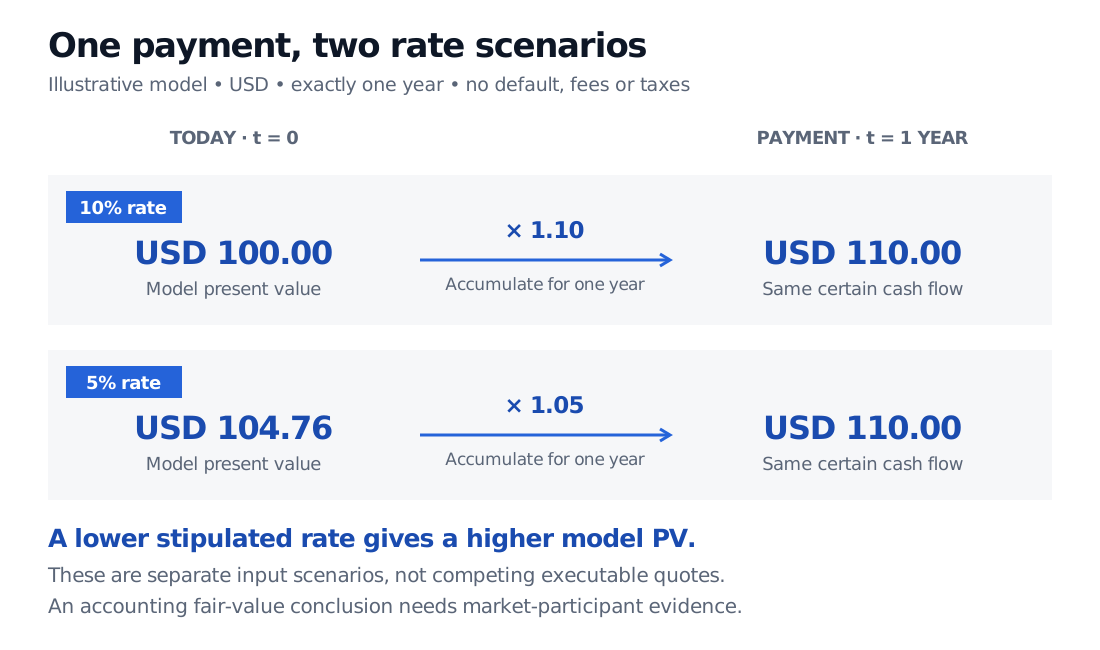
Consider an illustrative claim that pays USD 110 with certainty in exactly one year, with no intermediate payments. Assume a flat 10% annual effective risk-free interest rate appropriate for this currency and horizon. Ignore fees and taxes, and assume frictionless access to the matching risk-free investment.
The calculation works backwards from an alternative that delivers the same payment: invest USD 100 now, earn USD 10 over the year, and receive USD 110. Discounting and accumulation are inverse operations. Under these assumptions, the matching cash flow provides the valuation benchmark; the number is not a guess about the next traded price.
Now consider a separate scenario with an appropriate flat annual effective rate of 5%, keeping the certain payment and its date unchanged:
V0=1+0.05110=212200 USD≈104.76 USD.
The lower rate requires more money today to generate the same payment. Neither scenario supplies a live quote or establishes accounting fair value: the rates and certainty are stipulated inputs.
Two separate annual effective rate scenarios for a certain USD 110 payment in exactly one year. At 10%, model present value is USD 100.00; at 5%, it is approximately USD 104.76. Accumulating each unrounded amount at its scenario rate produces the same USD 110 payment. No observed quote is supplied.
Original illustrative model. Cash amounts are displayed to the nearest cent; accumulation uses unrounded present values. Changing the stipulated rate changes model PV, not the contractual payment.
This simple calculation relies on certainty. A risky promise needs a treatment of credit risk and other relevant risks; inserting its promised payoff into a risk-free discounting formula does not make those risks disappear. SelfMadeQuant's Time Value of Money lesson develops accumulation, discount factors and rate conventions. It has a public preview; the full lesson requires membership.
Which number is on the screen?
Label
What the number tells you
Model value
The output of a stated valuation method and its inputs.
Quoted price
A bid, ask or indicative price, with a timestamp, size and execution conditions to check.
Transaction price
The price actually agreed for a particular transaction.
Historical purchase cost
What the holder paid earlier; it need not equal today's valuation.
A quote below your model value is a reason to investigate the difference. It is not enough to demonstrate an executable arbitrage. Check that both numbers concern the same instrument, cash-flow dates, units and currency. Then examine stale inputs, default assumptions, liquidity, the bid–ask spread, financing and trading constraints.
The accounting objective constrains the model
An accounting valuation must represent market-participant assumptions rather than simply the holder's preferred forecast or intention to hold. IFRS 13 applies when another IFRS Standard requires or permits the relevant measurement, subject to its scope exceptions. The IFRS Foundation's overview explains this distinction.
The corresponding Australian standard, AASB 13, paragraphs 61–90, prioritises observable evidence and distinguishes inputs as follows:
Input level
Evidence
Level 1
Unadjusted quoted prices in active markets for identical items, accessible at the measurement date.
Level 2
Other inputs observable directly or indirectly, such as relevant yield curves or comparable-instrument prices.
The hierarchy ranks inputs, not model names. A present-value technique can produce a Level 2 or Level 3 measurement; classification depends on the lowest-level input significant to the whole measurement. A bid–ask midpoint is not automatically the answer: the standard requires the price within the spread most representative of fair value in the circumstances. These principles do not convert an arbitrary discount rate into acceptable evidence.
For a quant, the useful habit is to record the valuation date, instrument, method, inputs and evidence behind a mark. “Fair” describes a valuation basis; it is not a guarantee of future performance or proof that the model has found an intrinsic truth.
Australian Accounting Standards Board — AASB 13, Measurement: paragraphs 61–90 on valuation techniques, observable inputs, bid–ask prices and the hierarchy; December 2022 compilation applicable to periods beginning from 1 January 2024 and before 1 January 2027.
John C. Hull, Options, Futures, and Other Derivatives, ninth Global Edition, Pearson, 2018, §4.2, pp. 101–104, and §4.3, p. 104: compounding conventions and zero rates. The one-year claim and alternative-rate comparison above are illustrative assumptions.