One bill, six quotes
A fictional 182-day US Treasury bill has a face value USD and sells for USD, a dollar discount of 2,100 USD. Dealers quote bills on a bank discount basis, so the first figure on the screen is often the lowest annualised number in the table below.
| Convention | Formula | Value |
|---|---|---|
| Bank discount yield | 4.1538% | |
| Holding-period return | 2.1450% | |
| Money-market (CD-equivalent) | 4.2429% | |
| Bond-equivalent | 4.3019% | |
| Effective annual rate | 4.3483% | |
| Continuously compounded | 4.2564% |
The holding-period return is the only row that is not annualised. It is the actual return on the 97,900 USD invested over 182 days. Every other row annualises the same growth factor, , with a different convention. The continuous rate reproduces it exactly:
Fabozzi gives two reasons the bank discount yield is not a return measure. It is based on face value rather than the cash invested, and it uses a 360-day year, while Treasury notes and bonds pay interest on a 365-day basis. The money-market (CD-equivalent) yield keeps the 360-day year but divides by the price. Fabozzi's form returns the same 4.2429%.
Horizon changes what is risk-free
Priya is the treasurer of a manufacturer with 10,000,000 USD of surplus cash. She must hold it for 182 days and has two options.
Here is the overnight rate on day , and interest is . Three illustrative paths, which are scenarios rather than forecasts, give:
| Path | Overnight rate | Interest, USD | Versus bill, USD |
|---|---|---|---|
| Flat | 4.20% on all 182 days | 214,590.99 | +86.40 |
| Two cuts | 4.20% on days 1–60; 3.95% on days 61–120; 3.70% on days 121–182 | 201,548.80 | −12,955.80 |
| One hike | 4.20% on days 1–91; 4.45% on days 92–182 | 221,047.31 | +6,542.72 |
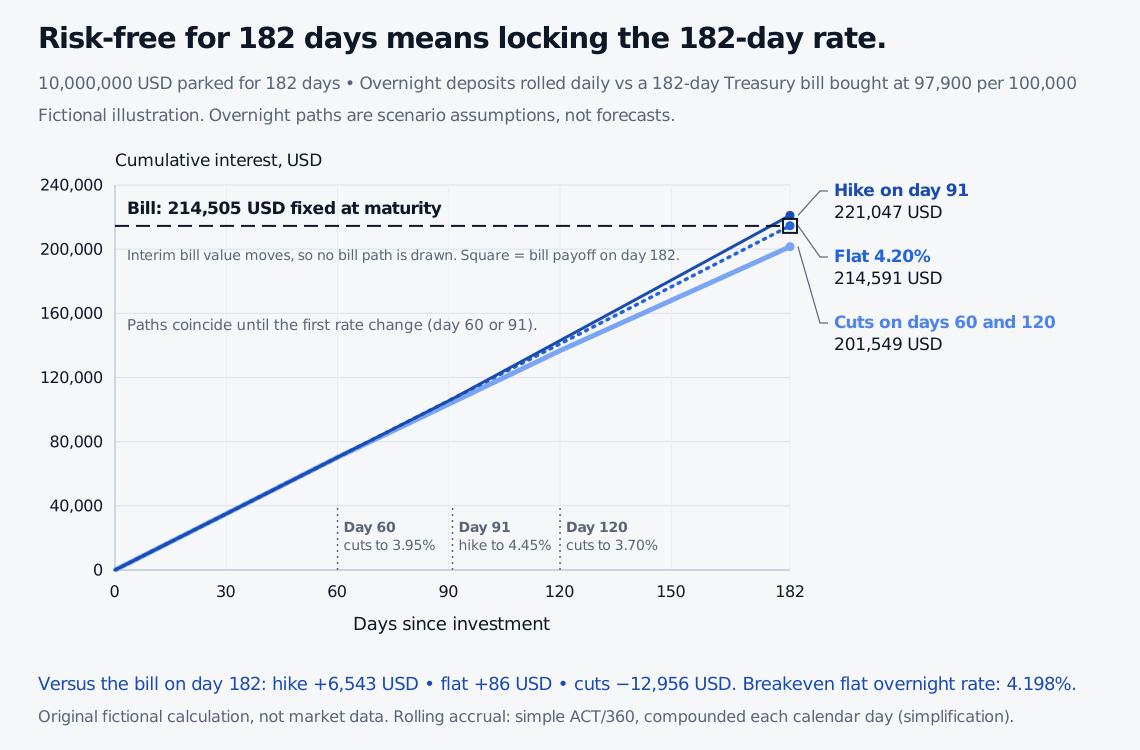
Each overnight loan carries almost no default risk for one night, but over 182 days only the bill fixes the outcome. Rolling carries reinvestment risk, because every future rate decision changes the result. The reverse also holds. If Priya needed the cash tomorrow, selling the bill early would expose her to its market price. A rate is risk-free only relative to a horizon, and the benchmark that fits is the one whose maturity matches the cash need.
Which proxy, and why it matters
Hull notes that a government is usually assumed not to default on debt in its own currency, which makes Treasury rates the natural first candidate. Derivatives desks rarely discount with them. Hull's Business Snapshot 9.1 lists three dealer arguments that these yields are artificially low: regulated institutions must hold them, the capital charge for holding them is small, and their interest is exempt from state tax. The own-currency argument also fails for an individual eurozone member, which cannot control the European Central Bank.
LIBOR was the traditional derivatives benchmark before 2008, but it was not risk-free either. A short-term loan to a AA-rated bank can default, however unlikely that is. The TED spread, the excess of the 3-month Eurodollar deposit rate over the 3-month Treasury bill rate, is normally under 50 basis points. It rarely fell below 100 basis points between October 2007 and May 2009 and peaked above 450 basis points in October 2008.
SOFR is a secured rate. The New York Fed describes it as a broad measure of the cost of borrowing cash overnight, collateralised by Treasury securities, and publishes it each business day at about 8:00 a.m. ET. €STR is an unsecured rate reflecting the wholesale overnight borrowing costs of euro-area banks, published by the ECB at 08:00 CET on each TARGET2 business day. Because their collateral differs, an OIS curve built from one is not the same curve built from the other.
| Proxy | What it measures | Typical role |
|---|---|---|
| Government bill or bond yield in own currency | Lending to a government borrowing in its own currency | Textbook benchmark; often seen as artificially low |
| LIBOR (traditional) | Unsecured interbank borrowing between banks | Pre-2008 derivatives benchmark; carries bank credit risk |
| SOFR and €STR | Secured (SOFR) or unsecured (€STR) overnight borrowing | Overnight anchor for OIS curves |
| OIS rate | Fixed rate swapped against compounded overnight rates | Discounting collateralised derivatives |
Where the rate enters quant work
- Discounting. A payment due at time has a present value of , where is the discount factor read from the risk-free curve.
- Option pricing. The Black–Scholes model discounts at . Under the risk-neutral measure the underlying drifts at , so the rate sets both the forward and the drift:
- Performance. Excess return over the risk-free rate is the input to the Sharpe ratio and to the capital asset pricing model. A fund returning 9% with 12% volatility has a Sharpe ratio of at a 4.3% risk-free rate. Using zero instead gives , nearly double. The two figures answer different questions, so state the rate and horizon whenever you compare Sharpe ratios.
Sources
- Frank J. Fabozzi, Bond Markets, Analysis, and Strategies, 9th ed., Chapter 6: bank discount yield and CD-equivalent yield.
- John C. Hull, Options, Futures, and Other Derivatives, 9th ed., Global Edition: Section 4.1 on Treasury rates; Chapter 5 on the definition of ; Section 9.1 and Business Snapshot 9.1 on proxies, the TED spread and eurozone governments.
- UK Financial Conduct Authority, US dollar LIBOR panel – 1 month to go (31 May 2023): end of the US dollar LIBOR panel.
- New York Fed, Secured Overnight Financing Rate reference rates.
- European Central Bank, euro short-term rate (€STR) overview.