A real interest rate measures purchasing-power growth after inflation. Compare exact and approximate rates, expected and realised inflation, and real bond yields.
Real interest rate
A real interest rate measures how quickly the purchasing power of borrowed or lent money changes after adjusting for inflation. A nominal interest rate measures growth in currency. The real rate asks whether the resulting money buys more or less.
This distinction matters even for a deposit that pays exactly as promised. A positive interest payment can accompany a loss of purchasing power. For a borrower, inflation can reduce the purchasing-power burden of a fixed nominal repayment; it does not automatically make the repayment affordable, because the borrower's income may not rise with prices.
The account grows, but the basket grows faster
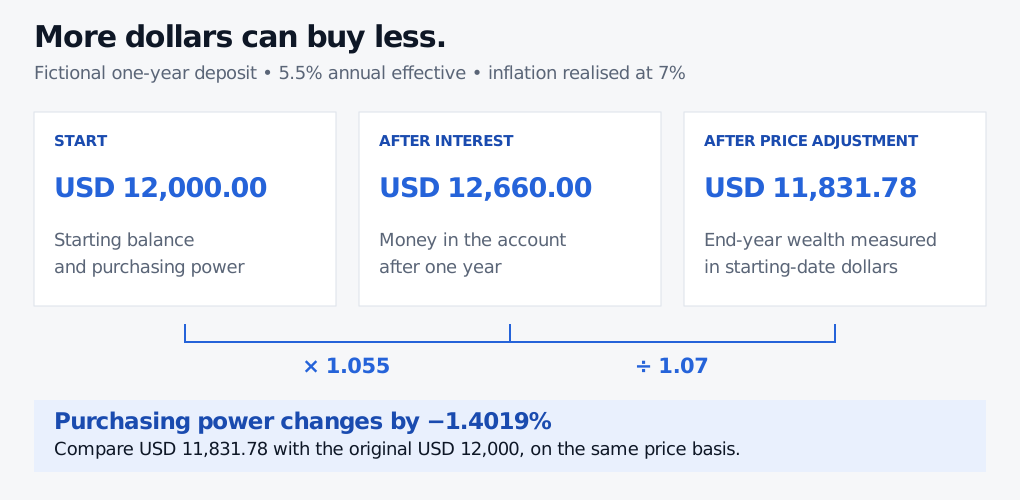
Suppose a fictional deposit holds USD 12,000 for one full year at 5.5% annual effective interest. Assume no taxes, fees, withdrawals or additional deposits. At the end of the year the account contains
12,000(1.055)=USD 12,660.
Over that same year, the price of a specified basket of goods and services rises by 7%. A basket costing USD 100 at the start now costs USD 107. To express the final balance in starting-date purchasing power, divide by the basket's price-growth factor:
1.0712,660=USD 11,831.78.
The account balance has risen, but its purchasing power has fallen below the original USD 12,000. Both numbers are correct: they measure different things.
USD 12,000 grows to USD 12,660 after one year at 5.5% annual effective. Dividing by 1.07 for realised inflation gives USD 11,831.78 in starting-date purchasing power, a real return of minus 1.4019%.
Original fictional one-year illustration. The final box restates the end-year balance at starting-date prices; it is not a withdrawal or a change to the money credited by the bank.
The exact calculation, and the shortcut
Let i be the nominal effective return over the holding period, π the inflation rate over that same period, and r the real return. Express all three as decimals in the calculation. The nominal balance grows by 1+i while prices grow by 1+π, so
1+r=1+π1+i,r=1+π1+i−1=1+πi−π.
This is the one-period purchasing-power identity underlying the Fisher equation. For the deposit,
r=1.071.055−1≈−1.4019%.
The familiar subtraction rule is an approximation:
r≈i−π.
Here it gives 5.5%−7%=−1.5%. It gets the direction right, but differs from the exact answer because it omits the denominator 1+π. The shortcut is most useful when inflation and rates are small enough for the required precision.
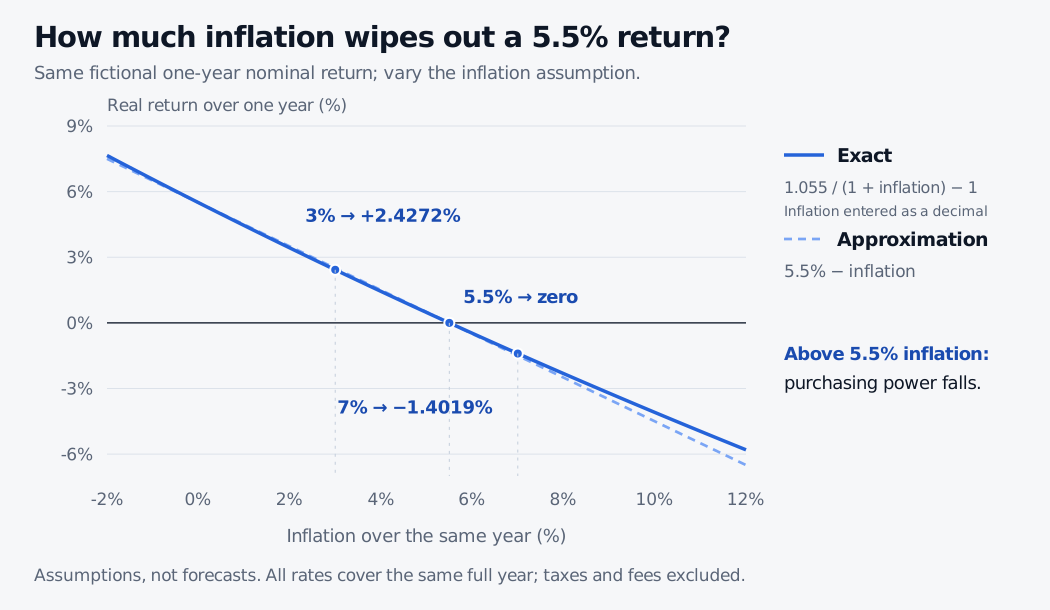
With positive price levels, the sign has a simple rule: purchasing power rises when the nominal period return exceeds period inflation, stays constant when they are equal, and falls when inflation is higher. The next figure shows both calculations while keeping the deposit's nominal return fixed.
Exact real return for a 5.5% annual effective nominal return: plus 2.4272% at 3% inflation, zero at 5.5% inflation, and minus 1.4019% at 7% inflation. A dashed line shows the nominal-minus-inflation approximation.
Original sensitivity illustration, not market data or a forecast. Each inflation value defines a separate one-year scenario. The solid curve uses the exact ratio; the dashed line uses subtraction.
The rate convention still matters. Convert a nominal annual quote with monthly compounding into the actual return over the investment's dates before adjusting for inflation. Do not subtract an annual inflation rate from a three-month return. The interest rate page explains those quotation conventions.
Before the year, and after it
The calculation above uses inflation already observed over the deposit's life. It is an ex post, or realised, real rate. An ex ante real rate looks forward and therefore needs an inflation assumption or forecast. These are different questions, as the Czech National Bank's explanation makes clear.
Before investing, suppose the saver had used a fixed 3% inflation scenario. That scenario would imply
1.031.055−1≈2.4272%
real growth. Once inflation turns out to be 7%, the realised result is −1.4019%. A nominal payment fixed in advance does not fix its future purchasing power.
For a quick forward-looking estimate, economists often use nominal interest minus expected inflation. If inflation is uncertain, however, putting its average forecast into the exact ratio gives a scenario estimate, not generally the mathematical expected real return. For a fixed nominal return and random inflation Π, the latter averages 1+Π1+i−1 across outcomes. Averaging a ratio is generally different from calculating the ratio at the average inflation rate.
The inflation measure matters too. A consumer price index describes a specified consumer basket; an individual's spending mix may differ. Say which index and dates define the adjustment, especially when comparing countries, investments or borrowing costs.
A real yield quoted in the market
Inflation-linked bonds make the distinction contractual. US Treasury Inflation-Protected Securities, or TIPS, adjust principal with a specified consumer price index and apply a fixed coupon rate to the adjusted principal. Their market yields are quoted in real terms. TreasuryDirect explains the payment rules and the original-principal floor at maturity. Buying above original principal or selling before maturity introduces considerations that this floor alone does not settle.
A TIPS real yield is not obtained by taking an ordinary bond's nominal yield and subtracting inflation that has already happened. Nor is breakeven inflation, the difference between comparable nominal and inflation-linked yields, a pure inflation forecast. Federal Reserve research explains that inflation-risk compensation and differences in liquidity also affect that spread.
Practice
1. What did the deposit earn in purchasing power? A fictional USD 2,500 deposit earns 4% annual effective over one full year, with no fees, taxes or intermediate cash flows. Inflation over exactly that year is 2%. Calculate the final balance in starting-date dollars and the exact real return.
Answer. The money balance is 2,500(1.04)=USD 2,600. At starting-date prices it is 2,600/1.02=USD 2,549.02. The exact real return is 1.04/1.02−1≈1.9608%. Subtracting to get 2% is a useful approximation, not the exact result.
2. Can a zero-interest deposit gain purchasing power? A deposit earns zero nominal interest over one full year. The same specified basket becomes 2% cheaper over that year. Ignore fees and taxes. Does the deposit's purchasing power rise, fall or stay constant, and by what percentage?
Answer. It rises. This is deflation, so the price-growth factor is 0.98. The exact real return is 1/0.98−1≈2.0408%. The currency balance stays constant, but each unit buys more. Calling the gain exactly 2% confuses the percentage fall in prices with the percentage rise in purchasing power; the denominators differ.
The deposit scenarios, figures, practice questions and purchasing-power calculations are original illustrations. They describe no prevailing market rate.