Distinguish a rate before inflation from a nominal annual compounding quote, then convert a monthly quote into effective and real returns.
Nominal interest rate
A nominal interest rate is an interest rate expressed in money terms, before adjusting for inflation. It tells you how currency amounts grow or what borrowing costs in currency; a real interest rate measures the corresponding change in purchasing power.
The word nominal also has a specific use in compounding mathematics: a nominal annual rate compounded m times per year is an annual quote whose rate per regular compounding period is the quoted number divided by m. These uses answer different questions. “Nominal versus real” asks whether inflation has been removed. “Nominal annual versus effective annual” asks how interest within the year is represented.
Suppose a fictional account starts with 10,000 USD and quotes 6% nominal per year, compounded monthly, fixed for twelve regular monthly periods. Interest stays in the account. There are no contributions, withdrawals, fees or taxes. This is a calculation scenario, not a deposit offer or a forecast.
Let j=0.06 denote the nominal annual quote and m=12 the compounding frequency. The monthly rate is
mj=120.06=0.005=0.5%.
The first month's interest is 50 USD. The next month earns 0.5% on 10,050 USD, including the previous interest. That compound interest produces a year-end balance of
A=10,000(1+120.06)12≈10,616.78 USD.
The effective annual rate i records the actual one-year proportional growth under those assumptions:
i=(1+mj)m−1=(1.005)12−1≈6.167781%.
6% is the nominal annual quote; about 6.1678% is the effective annual money return. Both are before inflation adjustment. Dividing the annual-effective rate by twelve would not recover the correct monthly rate: division is the rule for the nominal annual quote.
Description
What it specifies
Value in this scenario
Nominal annual quote, monthly compounding
Twelve times the regular monthly rate
6%
Monthly effective rate
Growth over one monthly period
0.5%
Effective annual money return
Growth after twelve compounding periods
6.167781%
By comparison, 6% annual effective would turn 10,000 USD into 10,600 USD after one year. It is a different growth assumption. To express that same 6% annual-effective growth as a nominal monthly-compounded annual quote, solve
j=12[(1.06)1/12−1].
Converting a quote this way preserves its growth factor. Keeping the displayed “6%” fixed while changing its convention changes the growth factor. Continuous compounding provides another convention for expressing equivalent growth.
The formulas here use whole, regular compounding periods. Real contracts also specify dates, day-count conventions, incomplete periods and payment rules; “monthly” does not by itself settle every accrual detail.
Now ask what the money buys
Keep the original monthly-compounded scenario. Suppose the price index relevant to the saver actually rises by 3% over the same twelve months. A basket costing 10,000 USD initially now costs 10,300 USD. The account ends above that amount, so purchasing power has increased.
The exact realised real return r compares the money growth factor with the price growth factor:
1+r=1+π1+i,r=1.03(1.005)12−1≈3.075516%,
where π=0.03 is inflation over the matching period. Equivalently, the final balance buys what approximately 10,307.55 USD bought at the start. This is a purchasing-power comparison, not an additional interest payment.
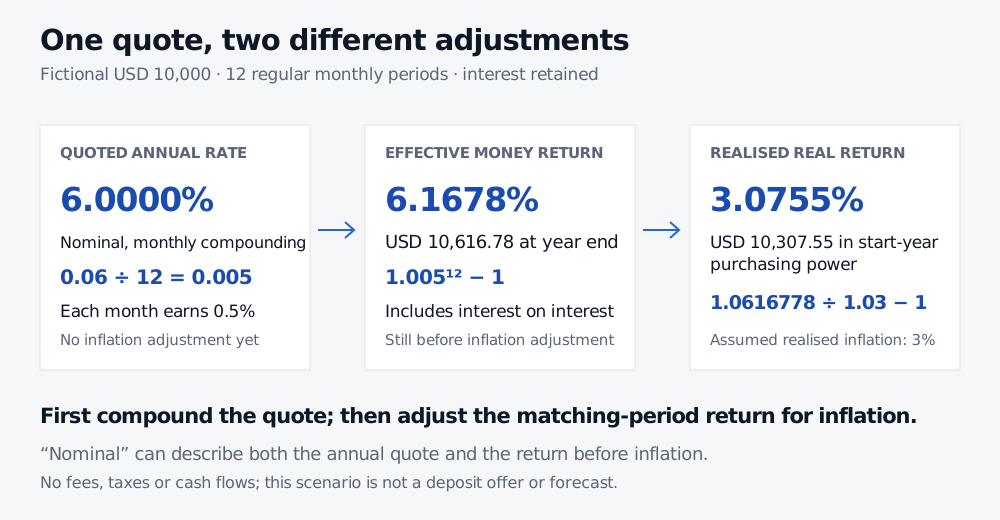
A fictional USD 10,000 grows at 0.5% each month to USD 10,616.78 after twelve months, a 6.1678% effective money return. Dividing its growth factor by 1.03 for inflation gives a 3.0755% real return.
Original fictional calculation. The first conversion accounts for compounding; the second adjusts for 3% realised inflation over the same year. No market data or forecast is used.
The Czech National Bank's explanation distinguishes the exact growth-factor calculation from the low-rate approximation r≈i−π. Here that approximation gives about 3.1678%, rather than the exact 3.0755%. Subtracting 3% directly from the 6% nominal annual compounding quote also skips the first conversion and does not give the exact real return.
Use realised inflation to assess what happened after the year. Before the year, inflation is uncertain: using an inflation assumption produces a scenario, and using expected inflation gives an ex ante estimate. Neither establishes the purchasing-power gain that will actually occur. A positive nominal money return can accompany a negative real return when prices rise faster.
For more work on rate conversion, SelfMadeQuant's Time Value of Money lesson connects periodic quotes to accumulation and discount factors. Its public page is a preview; the full lesson requires membership.
Practice: keep the two questions separate
1. A fictional account quotes 4.8% nominal annually, compounded quarterly. Interest is retained for four regular quarters, with no fees, taxes or cash flows. What is the effective annual money return? Does this conversion remove inflation?
Answer. Each quarter earns 0.048/4=0.012, so the effective annual rate is
(1.012)4−1=0.048870932736≈4.887093%.
The conversion includes interest on interest within the year. It does not adjust for inflation; the result remains nominal in the money-versus-purchasing-power sense.
2. An investment earns 4% annual effective in money terms over one year. Prices rise by 5% over that same year. With no fees, taxes or intermediate cash flows, is the exact real return −1%?
Answer. No. The exact return is
1.051.04−1=−1051≈−0.9524%.
The −1% figure is the subtraction approximation. No compounding conversion is needed because the supplied 4% is already the effective return for the matching year. The balance grows in currency while its purchasing power falls.
John C. Hull, Options, Futures, and Other Derivatives, 9th Global Edition, Chapter 4, §4.2: compounding-frequency conventions and equivalent interest-rate quotations.