Free cash flow (FCF) measures cash left after operating costs, taxes and reinvestment, with the treatment of financing depending on the definition. A company may report operating cash flow less cash capital expenditure as a liquidity measure. In valuation, the question is whose cash flow you are forecasting. Free cash flow to the firm (FCFF) covers debt and equity investors together. Free cash flow to equity (FCFE) is what is available to common shareholders after accounting for debt cash flows. SEC staff, Non-GAAP Financial Measures, Question 102.07, Damodaran, General Framework for Discounted Cash Flow Valuation
Start with the two lines in the filing
A fictional U.S. manufacturer shows net cash from operating activities (CFO) of 80 and a payment for new equipment of 25, in USD millions for the year. Find the CFO subtotal in the operating section of the cash flow statement and the cash equipment purchase in investing. Treat cash capital expenditure (capex) as a positive outflow amount, so the issuer measure is . If you copy the signed statement line of , add it to CFO. The investing subtotal can also contain cash paid for business acquisitions, proceeds from asset sales and securities transactions. In this example only the cash equipment payment enters capex. FASB, Topic 230 text in ASU 2016-15, §230-10-45-13, IFRS Foundation, IAS 7 overview
Companies can define their own FCF measure, so compare the reconciliation before comparing the numbers. For example, GE Aerospace’s 2025 filing includes proceeds from equipment dispositions and excludes specified separation and restructuring payments from its measure. Also look for asset purchases that did not use cash at acquisition, such as equipment bought by issuing shares. They still add productive assets, but there is no cash payment to deduct at that date. A positive issuer FCF can coexist with a cash shortfall after scheduled debt principal payments. GE Aerospace, 2025 Form 10-K, Non-GAAP Financial Measures, IFRS Foundation, IAS 7 overview, SEC staff, Question 102.07
Two valuations from the same cash flow statement
In the example, the manufacturer collects 174 from customers and pays 64 for operating costs, 8 in ordinary interest and 22 in cash taxes. These give CFO of 80. Assume the interest is fully deductible at a 25% tax rate and its tax benefit is realised this year, with no preferred stock, non-operating items or other adjustments. The financing section shows 12 of new debt proceeds and 16 of principal repayments. FASB, Topic 230 text in ASU 2016-15, §§230-10-45-15 and 45-17
- FCFF is 61. Remove the effect of debt financing. Adding back the 8 of interest raises cash flow, but without the interest deduction, taxes rise by . The net add-back is 6, giving .
- FCFE is 51. Interest and its tax benefit are already in CFO. Include net borrowing of , giving . This measures cash available to common equity in the model. The company chooses its actual distributions separately.
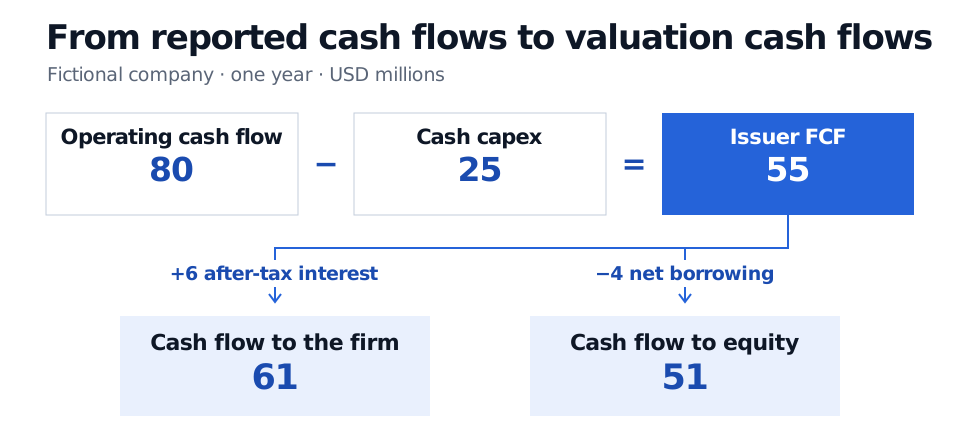
Both paths start from 55. The firm path removes the interest payment and its tax benefit. The equity path keeps both and includes net debt proceeds.
If you start a forecast from earnings, add back depreciation and amortisation and subtract cash capex and any increase in non-cash operating working capital. For FCFF, start with operating profit less the taxes attributable to those operations before financing. For FCFE, start with net income after interest and tax, then include net borrowing. When starting from reported CFO, working-capital timing is already reflected in cash collections and payments, so subtracting the same change again would count it twice. Verify where interest paid appears and how taxes were affected before using either shortcut above. Damodaran, cash-flow derivations for the firm and equity, Damodaran, Estimating FCFE
In a discounted cash flow valuation, discount forecast FCFF at the weighted average cost of capital to value operations, and forecast FCFE at the cost of equity to value the common equity claim covered by those flows. Damodaran, General Framework for Discounted Cash Flow Valuation
Read the change before you extrapolate it
A higher FCF figure can come from stronger collections or from shifting payments across the year-end. In the example, the manufacturer records 180 of sales but collects 174, so 6 is tied up in receivables this year. Collecting those receivables later lifts cash flow in the period when customers pay. Delaying an equipment payment lifts this year's FCF and pushes the cash outflow into a later period. A low capex year can also reflect postponed replacement. Maintenance capex sustains existing capacity. Growth capex supports expansion. Both reduce this year’s cash flow when paid, and a forecast of future sales needs a reinvestment budget that can support it. Use the same capex scope across companies and compare several periods to see how profit converts to cash and whether the cash left after reinvestment is repeatable. IFRS Foundation, IAS 7 overview, Damodaran, forecasting capital expenditure and working capital
Sources
- SEC Division of Corporation Finance, Non-GAAP Financial Measures, Question 102.07.
- FASB, ASU 2016-15, Topic 230 cash flow classification.
- IFRS Foundation, IAS 7 Statement of Cash Flows overview.
- GE Aerospace, 2025 Form 10-K, Non-GAAP Financial Measures.
- Aswath Damodaran, NYU Stern, Valuation, Discounted Cashflow Valuation Problems and Solutions, and Chapter 11 Derivations.