Use market-value financing weights, required returns and usable interest deductions to estimate a discount rate for operating cash flows.
Weighted average cost of capital
The weighted average cost of capital (WACC) is the blended cost of financing a business, weighted by the market-value shares of its financing claims. It combines the return required by equity investors with the cost of debt after usable interest tax savings. In a discounted cash flow valuation, WACC is the discount rate for free cash flow to the firm (FCFF) when the rate reflects the risk and financing of the operations being valued. Damodaran, Valuation, slides 11 and 16
Weight each financing claim by what it is worth
With only common equity and interest-bearing debt, let E and D be their market values, rE the required equity return, rD the current pre-tax borrowing cost and τ the marginal corporate tax rate when the full interest deduction can be used as it arises.
Debt. Use market prices where available and estimate market value for untraded debt. The rate should reflect what comparable borrowing would cost today. An old coupon records terms set at issue and can diverge from the current cost. Damodaran, Financial Measures and Ratios
The weights are fractions of total financing value. If preferred shares are a separate funding claim, add their market value to the denominator and include their weighted required return. Damodaran, Financial Measures and Ratios
What the interest deduction changes
Suppose a fictional company has USD 600 of common equity and USD 400 of debt at market values. Assume the 60% equity and 40% debt mix is sustainable. The equity cost is 12% and the pre-tax debt cost is 5%, both annual effective rates in nominal USD. Each dollar of interest reduces current taxable income at a 25% marginal rate, giving an after-tax debt cost of 5%(1−0.25)=3.75%.
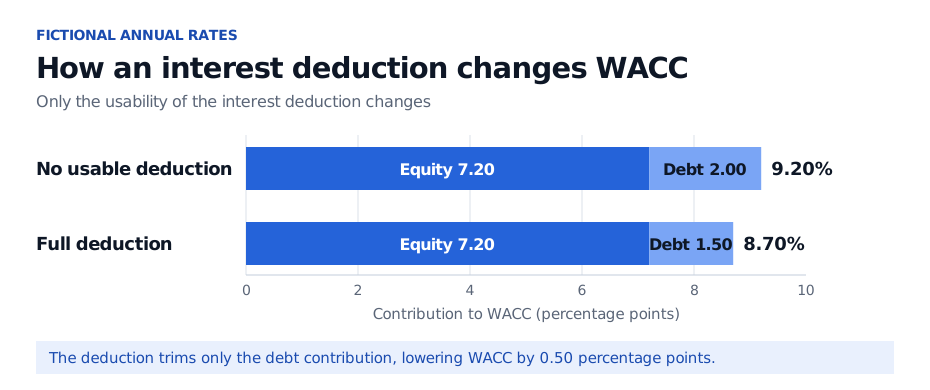
WACC=0.60(12%)+0.40(3.75%)=7.20%+1.50%=8.70%.
The annual financing-cost equivalent is USD 72 for equity plus USD 20 for debt, less USD 5 of interest tax savings. The resulting USD 87 per USD 1,000 of capital gives the same 8.70%. With the same inputs and zero usable deduction, the figure rises to 9.20%.
Equity contributes 7.20 percentage points in both scenarios. Debt contributes 2.00 points with no usable interest deduction and 1.50 points with a fully usable deduction at a 25% marginal tax rate. WACC falls from 9.20% to 8.70%.
Both scenarios use 60% equity and 40% debt and hold the required equity return and pre-tax debt cost fixed.
A statutory rate alone does not establish the saving. If losses or limits defer or prevent a deduction, model the saving in the period when it can actually be used. Changing the debt weight while freezing both required returns and the tax benefit isolates the arithmetic. In a financing change, equity holders can demand more for bearing a riskier residual claim and lenders can charge more as default risk rises. The Modigliani–Miller theorem shows how the cost of equity can rise with leverage even in a frictionless setting. Damodaran, Discount Rates
Match the rate to the forecast
The example’s 8.70% is an annual effective nominal USD rate. Use it for matching nominal USD FCFF, discounting a year-end payment by one annual factor per year from the valuation date. Pair real cash flows with a real rate. FCFF includes operating taxes and reinvestment and excludes interest and debt principal flows. When the discount rate already reflects the interest tax shield, keep that saving out of FCFF. For cash flows to common equity after net debt flows, use the cost of equity instead. Damodaran, Valuation, slides 10–12 and 16
Use a corporate WACC for operations with comparable business risk and financing assumptions. A project in a different line of business can have a different cost of capital even if the same company funds it. Use market-value weights that reflect the mix expected during each valuation period. Current weights are a starting point if they are expected to persist. Use a credible target for the stable period if the mix is changing, and let weights and required returns move through the transition if it is material. Damodaran, Discount Rates, Debt Ratios and the Cost of Capital