Replicate levered equity, calculate its required return, and see when tax savings and distress costs change total firm value.
Modigliani–Miller capital-structure theorem
The Modigliani–Miller capital-structure theorem says that in a frictionless market without taxes, changing the mix of debt and equity leaves the total value of a firm unchanged if its operating cash flows stay the same in every outcome. Borrowing changes who receives those cash flows and how much risk shareholders bear. In a valuation model, the lower rate on debt cannot by itself justify a lower discount rate for the business. Modigliani and Miller, 1958, Propositions I and II
Proposition I. Match the cash flows
Compare an all-equity firm with the same firm financed by debt and common equity. Hold its assets and investment policy fixed. Assume no corporate or personal taxes, trading or issuance costs, or losses from financial distress. Investors have the information and market access they need to trade matching claims. The personal borrowing example below also assumes that investors can borrow on the same terms as the firm.
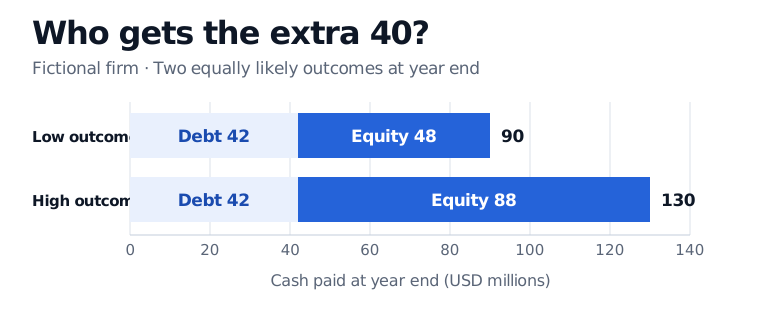
Suppose the fictional firm is worth USD 100 million today. It pays nothing before year end, when it sells its assets and has either 90 or 130 million to distribute, with each outcome equally likely. If it issues 40 million of one-year debt at 5% and uses the proceeds to buy back shares, lenders receive 42 million in either outcome. Shareholders receive the remaining 48 or 88 million.
Fictional one-year payoffs in USD millions. In the low outcome, debt receives 42 and equity receives 48 of 90. In the high outcome, debt receives 42 and equity receives 88 of 130.
The lender receives the same amount in both outcomes, so the entire 40 million swing in operating proceeds goes to equity.
Buying 10% of both the levered firm’s debt and its equity gives the same year-end payoffs as buying 10% of the all-equity firm. To replicate the levered equity alone, buy 10% of the unlevered firm for 10 million and personally borrow 4 million on the same terms. Repay 4.2 million at year end and keep 4.8 or 8.8 million, exactly what 10% of the levered equity pays. By the law of one price, positions that pay the same in every outcome must have the same price under these assumptions. So the levered equity is worth 60 million and total firm value is still 100 million. Modigliani and Miller, 1958, Proposition I
Proposition II. Reprice the equity
Let rA be the required return on the operating assets, rD the required return on debt, and rE the required return on levered equity. Use market values D and E for debt and equity. Holding both claims earns the return on the assets, so the no-tax weighted average cost of capital (WACC) and the implied equity return satisfy
The expected operating payoff is 110 million, a 10% return on 100 million. After the 42 million debt repayment, the expected equity payoff is 68 million, so rE=(68−60)/60=1331%. The debt contributes 2 percentage points to WACC and equity contributes 8, leaving WACC at 10%. Equity absorbs the same dollar swing as the unlevered firm on a smaller starting investment. Its returns range from −20% to about 46.67% across the two outcomes, versus −10% to 30% for the unlevered firm.
The equity cost rises linearly with debt-to-equity while the debt rate stays fixed and below the asset return. If extra borrowing exposes lenders to default, their own required expected return can rise, and a promised bond yield can exceed that expected return. The realised buyout IRR measures the return on the sponsor’s actual cash flows. The cost of equity is the return investors require up front for bearing risk. Modigliani and Miller, 1958, Proposition II and §I.C
What can change total value?
Corporate interest tax shield. In the 1963 correction, deductible interest reduces the cash paid in corporate tax. If the firm maintains a fixed amount of perpetual debt at a fixed rate, can use every deduction immediately at a constant corporate tax rate Tc, and discounts the savings at the debt rate, the present value of the savings is TcD. In this special case the levered firm is worth VU+TcD, where VU is the value of the same business without debt under the corporate tax regime. With finite debt or uncertain deductions, value the tax savings when the firm can use them. Modigliani and Miller, 1963, §II
Financial distress. Legal and restructuring fees can reduce the cash available to investors as a group. Losses can start earlier if customers switch suppliers because they doubt the firm will honour service contracts. These financial distress costs can offset the tax benefit of debt. Damodaran, Capital Structure, costs of borrowing
Sections 2.1 and 2.4 of the SelfMadeQuant lesson apply the benchmark to corporate hedging and show how a shortfall of internal cash can threaten profitable investment. The preview is public and the full lesson requires membership. Why Manage Financial Risk?