Financial distress costs are the expenses and losses in business value caused by difficulty meeting financial obligations. A company can incur them while it is still current on its debt. For example, a customer might stop buying equipment if it doubts that the supplier can honour a long warranty. In a capital-structure model, these costs reduce the value of a financing plan that leaves the company more vulnerable to distress. Andrade and Kaplan, 1998, §§IV and VI
What goes into the forecast?
Direct costs are incremental expenses for dealing with the distress, such as restructuring advisers, legal work and court administration. Indirect costs arise when financial pressure changes how the business operates. Customers may leave, suppliers may shorten payment terms, or the company may sell an asset in a hurry or abandon a profitable project. The SelfMadeQuant lesson's §2.4 follows the investment channel from a cash shortfall to a project the firm has to give up. Weiss, 1990, §1 · Andrade and Kaplan, 1998, §IV.B · Why Manage Financial Risk? Full lesson for members
Compare the distressed firm's cash flows with what the same business could have earned in the same market with enough funding to keep operating normally. If a downturn would have cut sales anyway, put that decline in both forecasts. For orders lost because of distress, count the forgone cash contribution after any costs saved. If a supplier asks to be paid sooner, model the change in working-capital timing. For a rushed asset sale, compare proceeds with what an orderly sale could fetch in the same market. Count a fee or cash-flow loss once, wherever it first enters the forecast. Andrade and Kaplan's 1998 study illustrates how hard this comparison is. They studied 31 distressed companies from highly leveraged transactions in the 1980s and found investment cuts and depressed asset sales, with much of the documented damage occurring before a bankruptcy filing. The authors could only partly separate financial distress from economic shocks. Andrade and Kaplan, 1998, §§I, IV and VI
What does a 20 million distress cost imply before the outcome is known?
Suppose a fictional firm has a 25% chance of financial distress next year. In that state, it pays 6 million in extra restructuring fees and loses 14 million in operating cash flow relative to a well-funded firm facing the same business conditions. The two amounts cover separate cash-flow lines. Otherwise its incremental distress cost is zero. With all amounts measured at the same year-end and no discounting, its unconditional expected cost in millions is
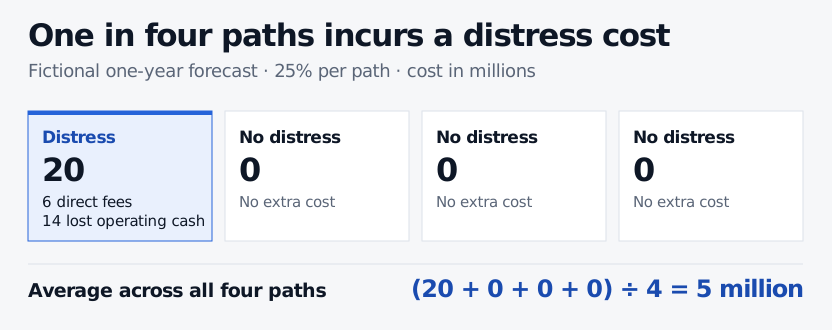
The distress path costs 20 million. Averaging over all four equally likely paths gives a cost of 5 million.
The 25% is a stipulated probability of distress. A default probability tracks a different event and can miss costs that arise before default. Likewise, a lender's shortfall relative to the debt's face value measures the loss on that claim. It can reflect the underlying downturn, how the remaining value is shared and any value destroyed by distress. Adding it to the firm's distress costs would mix the claim-level loss with the reduction in business value. Andrade and Kaplan, 1998, §§III–IV
The 5 million is an expected cost for planning. To get a market present value, also account for timing and how the losses line up with broader market conditions. If distress tends to occur in bad market states, the cost can carry a higher valuation weight than its real-world probability alone implies. Almeida and Philippon show this using risk-neutral probabilities and risk-free discounting in a model where default marks the onset of distress. Almeida and Philippon, 2007, §§I–II
In an adjusted present value model, a separate distress deduction belongs against a base forecast that excludes those costs. The interest tax shield is a separate financing benefit based on expected cash tax savings. Damodaran, The Adjusted Present Value Approach
Sources
- Weiss (1990), Bankruptcy Resolution: Direct Costs and Violation of Priority of Claims
- Andrade and Kaplan (1998), How Costly Is Financial (Not Economic) Distress? Evidence from Highly Leveraged Transactions That Became Distressed
- Almeida and Philippon (2007), The Risk-Adjusted Cost of Financial Distress
- Aswath Damodaran, The Adjusted Present Value Approach